


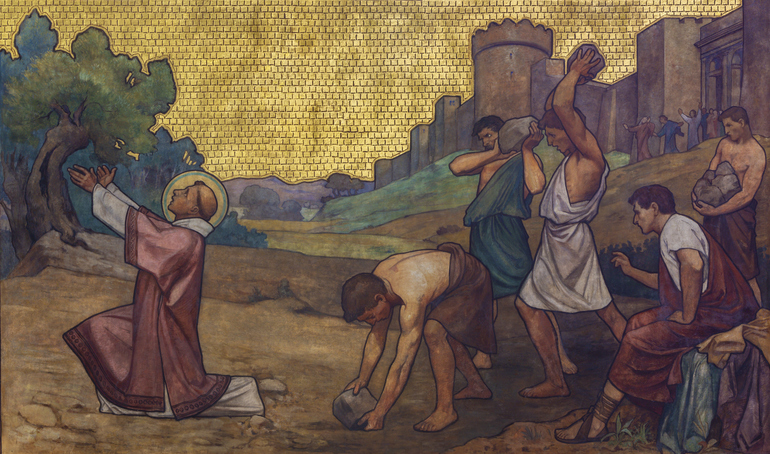
The 1896 fresco of The Stoning of St Stephen by S. G. Rudl in the Church of Saints Cyril and Methodius, Prague. (Photo: Getty/iStock)
The carol says, “Good King Wenceslas last looked out on the Feast of Stephen.” In many countries, December 26, also known as Boxing Day, is better known as St Stephen’s Day. Stephen was the first Christian martyr. This is the story …
The name Stephen
The name Stephen in English comes from the Greek Στέφανος (Stephanos), where it means wreath or crown. In English use, variants include Steven and Stefan, and it is often abbreviated as Steve. The female version is Stephanie.
In other languages it appears in different forms, such as Étienne in French, Esteban in Spanish, Stefano in Italian, Štěpán in Czech, Štefanije in Croat, Fan in Albanian, and Steffan in Welsh. It is a popular name in many countries of Orthodox, Catholic, and Protestant heritage. Stephen was considered an honourable name and was the name of a king of England from 1135 to 1154. It was also used by five kings in Hungary and by 10 popes.
Stephen of Jerusalem
The name Stephen is only used of one person in the Bible. He comes into the New Testament story in Acts chapters 6 and 7. His story is set in the early years of the Church, when it was growing. There were Christians who were Greek-speaking Jews and others who were Hebrew Jews. These first Christians, mostly from a Jewish heritage, held property in common, with the wealthier sharing what they owned with the poorer members of the community. At this time, there were many widows in need of charity. The Greek-speaking Christians, also called the Hellenists, complained that their widows were being discriminated against in the daily distribution of food (Acts 6:1–6).
As a result, the apostles called the Jerusalem community together. They asked them to select seven reputable men who would be appointed to minister to the task. The seven men who were chosen were Stephen, Philip, Prochorus, Nicanor, Timon, Parmenas, and Nicolaus of Antioch (Acts 6:5). The apostles laid their hands upon them and set them apart to serve those who were overlooked in the community. Stephen was first in the list and was appointed because he was “a man full of faith and of the Holy Spirit” (Acts 6:5).
Stephen the Martyr
Luke wrote that Stephen performed great wonders and signs (Acts 6:8), and that the number of disciples in Jerusalem increased rapidly, including many Jewish priests (Acts 6:7). As a result, this caused consternation among the Jewish authorities. Opposition arose and false accusations were brought against him, especially from the Synagogue of the Freedmen, which was a Greek-speaking synagogue for Diaspora Jews now living in Jerusalem. The text specifically mentions that it included Jews of Cyrene and Alexandria in North Africa, and Jews from the Roman provinces of Cilicia and Asia. They argued with Stephen, who seems to have preached at the synagogue, and he may well have been a member or former member of the synagogue himself.
Some members of the synagogue made false accusations against him, claiming that he had spoken blasphemous words against God and Moses (Acts 6:11). He was hauled before the Sanhedrin on charges of speaking against “this holy place and the law” (Acts 6:13). Luke notes that in that hostile courtroom, “all who were sitting in the Sanhedrin looked intently at Stephen, and they saw that his face was like the face of an angel” (Acts 6:15).
In Acts 7 we read that the High Priest spoke to Stephen (Acts 7:1), who responded not with self-defence but with a sweeping retelling of Israel’s story, from Abraham through Moses and the prophets. Stephen showed how God has always been on the move, not confined to one land or one building, and how God’s people have repeatedly “resisted the Holy Spirit” and rejected the messengers sent to them (Acts 7:1–53). Perhaps the part that annoyed them most was that Stephen confronted them and said that they had “betrayed and murdered” the “Righteous One” about whom the prophets had spoken (Acts 7:52), meaning Jesus. The reaction was fury (Acts 7:54).
Luke’s narrative in Acts then turns from Stephen’s words to his vision. He looked up “and saw the glory of God, and Jesus standing at the right hand of God” (Acts 7:55). He cried out and said, “Look, I see heaven open and the Son of Man standing at the right hand of God” (Acts 7:56). The implications of this were outrageous and blasphemous to those present.
Stoning
The crowd dragged him outside the city and stoned him. As the stones fell, he prayed, “Lord Jesus, receive my spirit” (Acts 7:59), echoing Jesus’s cry, “Father, into your hands I commit my spirit” (Luke 23:46) when he was on the cross. Then Stephen fell on his knees and cried out, “Lord, do not hold this sin against them” (Acts 7:60), echoing Jesus’s prayer, “Father, forgive them, for they do not know what they are doing” (Luke 23:34). After he was killed, he was buried and the church mourned for him (Acts 8:2–3).
Persecution
The book of Acts describes how, following the stoning, great persecution broke out, and most believers fled Jerusalem and were scattered throughout Judea and Samaria. This was prophesied by Jesus when he said that some people would kill them, flog them in the synagogues, and pursue them from town to town (Matthew 23:35), and that in Jerusalem they would stone some of them (Matthew 23:37).
Saul at the Stoning
Luke added a small detail that the “witnesses laid their coats at the feet of a young man named Saul” (Acts 7:58), who “approved of their killing him” (Acts 8:1). Saul began to try to destroy the church by going from house to house and dragging off men and women and putting them in prison. This man who witnessed the death was Saul of Tarsus, who later had a dramatic conversion and is better known today as St Paul. Tarsus is in Cilicia, and Luke specifically mentions that the Synagogue of the Freedmen included Jews from Cilicia, which seems to indicate that Saul was from this synagogue. Paul later stated, “When the blood of your martyr Stephen was shed, I stood there giving my approval and guarding the clothes of those who were killing him” (Acts 22:20). The first martyr’s death thus becomes the catalyst for Saul’s journey to faith in Christ.
Traditions about St Stephen
Stephen is considered the first Christian martyr and one of the first deacons of the Christian Church. The site of his death is not specified in the Bible, but by tradition it was east of Jerusalem, outside Lion’s Gate, which leads to one of the quarters of the city. Christians have thus traditionally known it as St Stephen’s Gate.
His death occurred a few years after the start of the Church at Pentecost and is dated variously as AD 33, 34, 35, or 36. Stephen was never formally canonised, but he is known as St Stephen. St Stephen’s Day is traditionally on December 26 in the Western Church, December 25 in the Armenian Church, and December 27 in the Eastern Orthodox world. He is considered the patron saint of deacons and stonemasons. There are many churches around the world dedicated to St Stephen, including 145 in the Church of England. The most famous is Stephansdom, the cathedral in Vienna, Austria.
St Stephen’s Day
St Stephen’s Day, also called the Feast of Stephen, is an official public holiday in many Central European countries such as Austria, Germany, Poland, and the Czech Republic, where it is the second day of Christmas and a time for visiting family and friends.
The Christmas song about Good King Wenceslas was inspired by Duke Václav of Bohemia, who lived in Prague. In the song he goes out “on the Feast of Stephen,” which is December 26. The parallel with St Stephen is that both men were concerned with the poor and both were martyred.
In the UK and many Commonwealth countries, the day is a bank holiday but is instead called Boxing Day, from the tradition of giving boxes or gifts to servants and the poor — a practice that draws on Stephen’s role in serving the needy.
Collect
The traditional Anglican collect prayer for St Stephen’s Day is: “Grant, O Lord, that in all our sufferings here upon earth, for the testimony of thy truth, we may steadfastly look up to heaven, and by faith behold the glory that shall be revealed; and, being filled with the Holy Ghost, may learn to love and bless our persecutors, by the example of thy first Martyr Saint Stephen, who prayed for his murderers to thee, O blessed Jesus, who standest at the right hand of God to succour all those that suffer for thee, our only Mediator and Advocate. Amen.”
