


One of the most profound television shows I’ve watched in the last few years on the struggle with religious identity is Vikings Valhalla, which tells the story of the complex religious and social interactions—specifically between Christians and pagan cultural and religious identities—between 1002 and 1066, during the Viking Age. It’s a fictional retelling, so of course there are holes and creative explanations of complex topics, but it gives space to imagine what these interactions may have been like and to remember the violence surrounding their stories.
It brought up so many questions for me, especially as an Indigenous woman, about the “paganism” of my Potawatomi ancestors and of my Celtic ancestors. Truly, stories like these should bring up questions for all of us as we ask what it might mean to come from peoples all around the world who have been deemed “pagan” and thus bad by broader religious narratives.
The story of religion has moved across the world, across time. Reza Aslan says in his book God: A Human History, “The entire history of human spirituality can be viewed as one long, interconnected, everevolving, and remarkably cohesive effort to make sense of the divine by giving it our emotions and our personalities . . . by making God us.”
This statement could terrify us, but I don’t think it should. Of course we find the sacred through our own humanity. Of course we try to figure out the world through the lenses that make sense to us. The danger is when religion becomes the way we justify hate and abuse, the way we twist the name of a god to fit our want for control and power. Howard Thurman writes in Jesus and the Disinherited, “A religion that was born of a people acquainted with persecution and suffering has become the cornerstone of a civilization and of nations whose very position in modern life has too often been secured by a ruthless use of power applied to weak and defenseless peoples.”
In the time of the Doctrine of Discovery, European Christian men were given permission by their religious and political leaders to take any lands they wanted in the name of God. This meant that my ancestors, and other Indigenous peoples around the world, were immediately othered, considered less than, their spiritual beliefs and the origins of their stories somehow not enough.
“Pagan” comes from the Latin word paganus, meaning “villager, rustic, civilian,” and pagus, which refers to a small unit of land in a rural district. Theodosius coined the term when he ruled the Roman Empire, differentiating between Christians and nonChristians, more specifically using the term against Celtic and Germanic peoples, and over the years this term has been used to “other” those who do not follow what the Christianity of the Roman Empire deems the right way to understand God or the world. This is a story, particularly of Christianity, that continues to create a reality of supremacy, and it’s incredibly dangerous. I want a spirituality that is humble, is grounded, values childlikeness, can be felt in the heartbeat of Mother Earth, a spirituality that practices kinship, care, and belonging with everyone and everything.
I don’t want to focus only on the ways religion and faith practices harm us (there are entire books on that, and you should be reading those too). I want us to remember that our faiths, our spiritual paths, our religious realities can offer stories of immense healing. Eckhart Tolle, in his book A New Earth, reminds us of the realities that come from the stories of religion we let become our lives: “All religions are equally false and equally true, depending on how you use them. You can use them in the service of the ego, or you can use them in the service of the Truth.”
So it goes with beliefs, with the stories we tell and carry, with the ways we interact with the world around us. When used for the truth, for love, stories of faith are like tiny sprouts carefully growing, stories that begin in our precious childhoods and grow to teach us to understand the rights of other beings.
In the summer of 2024, I spoke at the Chautauqua Institution in New York, on the land of the Erie and Haudenosaunee peoples. It was the 150th anniversary of the founding of Chautauqua, and I was honored to be there with the interfaith dialogue series to speak on how we can be caring resisters.
That week, I met and spoke in the series with the Venerable Tenzin Priyadarshi, a polymath monk who is the president and CEO of the Dalai Lama Center for Ethics and Transformative Values at the Massachusetts Institute of Technology. He gave his keynote address the afternoon before I did, and I was so comforted by and grateful for the way he spoke about the reality that we are all contemplatives. Asking what that means for our full humanity (not just our particular religion) is key to changing the world. He shared about the importance of the micro, the moments we hold within ourselves, the ways we value self-transformation.
Like Priyadarshi, I believe that so much of the work we need to do to change societies begins with us, around our tables, in the corners of coffee shops and our favorite reading nook at home, in our personal sanctuaries where we learn how to pray and why.
Priyadarshi shared about activists and saints who are deeply rooted in their interior life, and I remember feeling a sense of relief, like a page in my own story had been turned.
In that sacred moment, I had the freedom to remind myself that it’s okay to focus on the micro. It matters to focus on the micro, because the mezzo and the macro—the community and the society—will always be there, loudly telling stories, loudly proclaiming what we are to believe.
Let’s remember that an oak tree can drop up to three million acorns in their lifetime. That’s like three million micro stories in a big, big world. Imagine the possibilities of how many stories are held in the world, how many seedlings we may tend to over the course of our own lives. This tender season of adolescence, of young life, is the time when we make decisions about who we hope to be in the world. Let us not take that work lightly.
Only we can practice transformation; only we can decide how we show up in the world, what beliefs we hold. What we choose will shape the circles of influence around us and will ripple out. Those stories matter, and it’s up to us, each of us, to choose stories of love and belonging over stories of hate—even and especially in our religious communities, our spirituality, and our faith practices.
When we understand the sacred as profound, enduring love, we can see the hurting world as in need of love and not missional evangelism, kinship and not judgment. We can use faith and spirituality to shape the world for the better, to tell a more loving story of the relationship between The Sacred and the people, however that shows up.
As we raise the kids in our homes, communities, and neighborhoods, we get to be honest about how religion harms and how it heals. We get to critique our stories and our ways of understanding, practicing kinship with one another as we ask who or what or why God, or The Sacred, is.
This, in turn, helps us practice love in the world, and that’s beautiful.
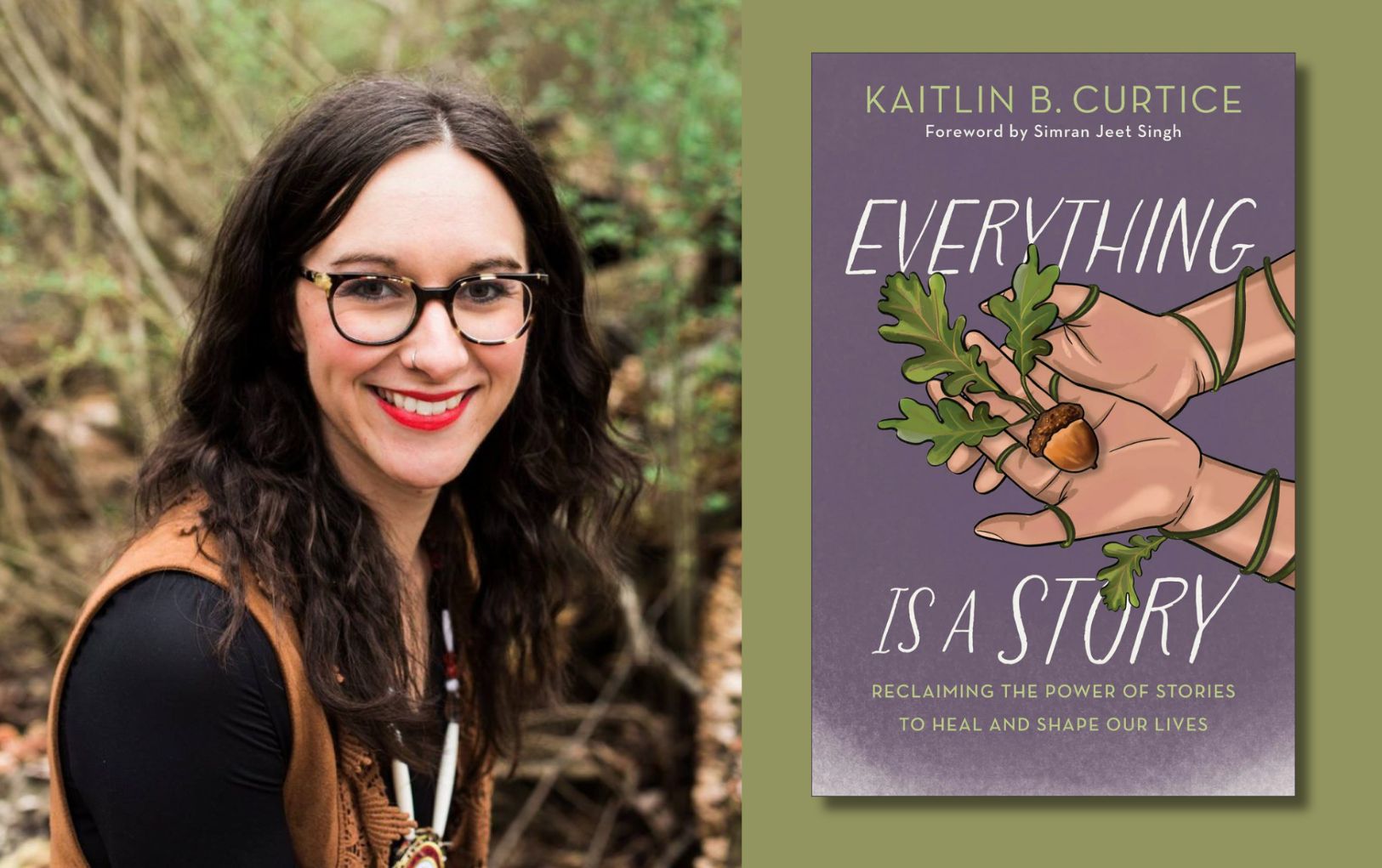
Content taken from Everything is a Story by Kaitlin B. Curtice, ©2025. Used by permission of Brazos Press.
