


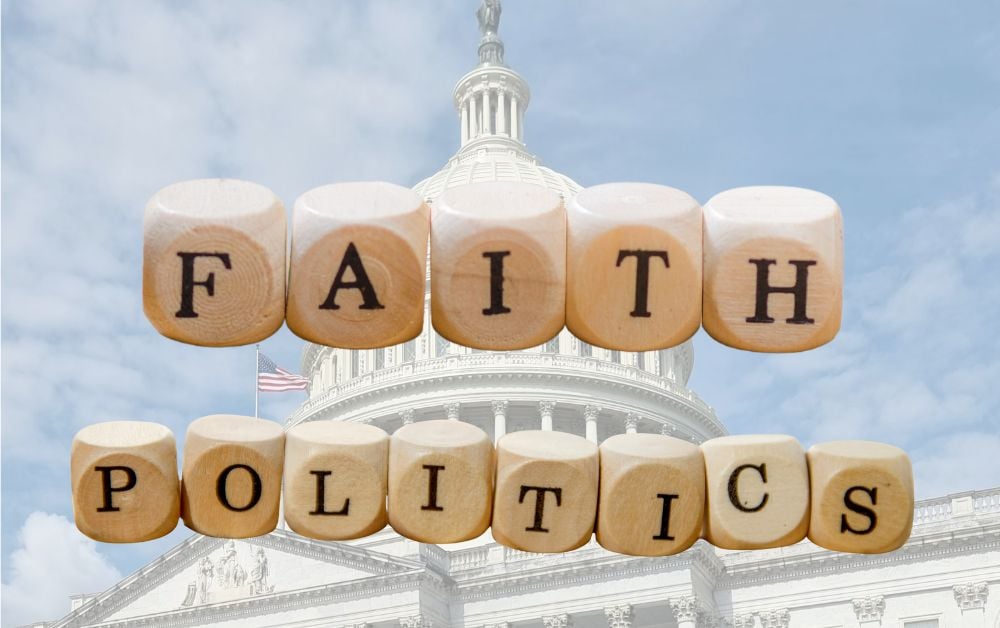
Why would we never talk about what is most important to us?
It’s a cliché that many live by – don’t bring up religion or politics in polite company – at least if you want to keep it polite.
Religion is what we believe in, our literal articles of faith.
Politics is how we see our beliefs and values articulated and manifested in the actual social and physical world.
Doesn’t it seem obvious that there is nothing MORE important to be talked about than what we value and what it should look like in our daily, lived-in world?
I think what most people mean by politics and religion is “opinions” about politics and religion.
If airing opinions is what people mean when they say that we shouldn’t bring up religion or politics in polite company, I’d have to agree.
But my bias is that opinions are wispy, variable, largely worthless no matter what the topic.
Imagine a conversation based on opinions about food; spicy or bland, breakfast or dinner, local or imported.
Is anyone likely to change their minds, or be “converted” to another category of food? It’s possible but not likely.
Our preferences are largely fixed and non-negotiable.
That’s true of religion and politics as well; we believe what we believe and we are unlikely to change.
And that’s the problem.
What if, in religion or politics, or anything else really, our attitude was something like “I’ve been told it was this way, but I’m willing to respectfully listen to another way”?
What if our belief system was not “I grew up believing this, and it can never change” but was closer to “I believe in what makes sense now, for me – and for others – and that too is subject to change”?
In other words, our “faith” is, or could be, based on what every world religion began with – revelation and direct experience – instead of codified doctrine and passed-on tradition?
And of course, politics would be the same.
Administration and tax laws, for example, should be based on actual, practical need and economic realities – not quasi-religious ideologies.
Political platforms should be based on what constituents want or need, not on abstract philosophies or slogans.
Consider how we treat those who would urge us to have a fair and productive tax system, for example.
Or those who would inspire us to embrace a larger, more humane vision and practice of living together no matter our appearance or lifestyle?
Perhaps we could even stop doing what we humans have been doing for several thousand years – maybe we could stop persecuting and sacrificing those who came to save us – mostly from ourselves.
And maybe we could leave behind strategies and beliefs that have never worked and have only led to rage and destruction.
From tariffs to culture wars, could we ever leave behind the rhetoric and arguments and policies that take us nowhere? And do nothing but divide and distract us from what we actually do care about?
When I look at what I care about, it doesn’t fit into any easy, familiar categories of faith or politics, and I find myself less and less interested (and committed) as time goes by.
There is nothing in those platforms or ideologies that appeals to me – nothing that has any life or substance.
That’s what I want to talk about, and encounter, and learn from and maybe even hold loosely so that they too do not become fossilized and frozen into some non-negotiable formula.
Becoming a leader or prophet in religion or politics means, almost by definition, recognizing new territory, new ideas, new language and new approaches.
But the key word there is “new”.
We love to remember and echo the territory, ideas, language and approaches of those leaders.
But like too many people of the past, we like our prophets and leaders dead.
Mostly because we know that they would not like how we twist their words and visions to suit our own purposes – and do our best to keep those challenging words and visons “safe” and unthreatening to what we already believed.
In other words, we just edit, reduce or summarize it, take the power and punch out of it and add it to what we already believe.
We make sure, in other words, that it doesn’t change or challenge us.
Which was, in most cases, their intent.
And why they were silenced.
In the end, there are two types of religious and political leaders; those who would unite us and those who would divide us, those who would have us look forward, and those who would have us look back.
And those who would lie to us, and those who would tell us the truth we don’t always want to hear.
In many places across history and around the world, we have the right and obligation to make the choice between those pairs of choices.
Our faith and values dictate our choices.
But sometimes that faith and set of values is short-circuited by fear and suspicion. And our faith and values become smaller and more protective. And then even smaller and more protective.
And we find comfort in being divided. And looking back. And being lied to.
And there always seems to be those leaders who, for their own reasons, have been waiting for their moment, to fracture us and pit us against each other for their own profit and amusement.
And they promise a return to some gilded age, which if achieved at all, seems to start, and often end, with them.
And they lie. And lie. And lie. And lie.
Until even their supporters don’t know what to believe. Or who to trust.
And that is the point.
Religion and politics are where we apply and work out our deepest values and beliefs – and discover, maybe even live out, what we really care about.
Those of us with vision might realize what all the great prophets taught us – and what every child knows instinctively; we are not really so different, and our need and hopes and fears are very much the same.
Our shared humanity does not require a sophisticated theology or a polished political platform, but, for whatever reason, we have forgotten that those most important values, hopes and beliefs are only within reach if they are in reach for every single one of us.
