


At the End of the Day
As stated previously, as a minister of the gospel, a director of bereavement, and a chaplain within the health care system, I have been called to the bedside of those who are reported to be actively dying. Actively dying signifies the final stage of dying when the patient is expected to die within a matter of hours or days, usually within three days. This could be considered an application of “at the end of a day”—when the moral or temporal body is at the end of life. At the end of the day, what matters to the Black Church? Dean David Goatley asserts that “what we do, implicitly or explicitly, affects all around us; to include the care or corruption of creation.” Like John in Revelation, Goatley asserts, there is more to see than what is seen with the ordinary or natural eye. Davis in Scripture, Culture,
and Agriculture suggests that there is a way of seeing that is bifocal—having the near sight on what is imminent then a long-term vision of the day of the Lord, the day of reckoning. Goatley would suggest in preparation for the end of the day it is advantageous for the Black Church to “seek discipline and discernment to faithfully follow the will of God as we await the return of Christ Jesus.” The embodiment of an ecological theology through creation care is what a proactive wait resembles, what Dean Gregory Jones would consider as “pushing-off from our tiptoes and not reacting from our heels.” The green funeral is an alternative to the toxic traditional funeral practices that invites the Black Church to push-off from our tiptoes and not react from our heels because the end of the day is nearing.
This book aims to raise the consciousness of Black churches around environmental theology that will result in discouraging toxic burial practices and embracing the environmentally friendly practices of green funerals by answering three fundamental questions:
1. How might better attention to environmentalism help Black churches, ecclesial leaders and families to understand better the toxic impact of traditional funeral practices on creation?
2. How might better attention to environmental theology help Black churches, ecclesial leaders and families to seek alternatives to environmental degradation from traditional funeral practices?
3. How might better attention to environmentalism cause churches to reconsider all their material practices so that they might seek to embody holiness and promote beauty relative to creation in all that they do?
A Call to Stay Woke
Suzanne Kelly in Greening Death acknowledges “that people are waking up to a deeper yearning—a hunger for more meaningful death practices.” I extend this invitation to the Black Church inside of its funeral practices. Theologian James Cone, author of God of the Oppressed states “theology should not put us to sleep, but should wake us up!” So, WAKE UP! Do not die, get to higher ground! “Every round goes higher and higher!” RISE, for it is critical that you keep moving forward by seeing yourself in a forward-moving state. People are depending on you! As leaders, it is necessary for the Black Church to find its collective voice on the topics of local and global issues while holding together the tension without damaging its own.
Is this a tall task? Perhaps, but how might the Black Church do this? However painful, the Black Church is obligated to “always be opened and oriented toward freedom,” as Herbert R. Marbury in Pillars of Cloud and Fire tells us. Expounding on Exodus 13:21–22 (“The Lord went in front of them in a pillar of cloud by day, to lead them along the way, and in a pillar of fire by night, to give them light, so that they might travel by day and by night. Neither the pillar of cloud by day nor the pillar of fire by night left its place in front of the people.”), Marbury gives space for the cloud symbol to be subtle and quiet in movement, where appropriate and legitimated by civil society and not as a hiding space to invoke more hurt and pain. In contrast, Marbury interprets the fire as “the symbol invoking a radical challenge to the social and political fabrics of our time.”
Although the respective beacons of cloud and fire appeared in vastly different forms, they both led the Children of Israel in the same direction, from slavery toward the Promised Land, and were necessary components of a liberation project. It is not optional for the Black Church to lack in its efforts to exhibit ecological faith. Since its conception, the Black Church has challenged the social and political order of its time. Today, in like fashion, the community needs leaders to include clergy, to lead being the “pillar of cloud by day and a pillar of fire by night.” At the end of the day, there is a call for the Black Church to stay woke and to lead—through pandemics, viruses, flus, militarism, racism, sexism, genderism—toward life in the most life-giving ways, even in death.
Green funerals are essential to the practices of Black churches as we continue to meet contemporary challenges. However, green funerals should not be in isolation to other aspects of ministry that help families prepare for the dying aspect of living and honoring God in these critical phases. Green funerals need to fit within a continuum of conversations critical for the Black Church to engage. For example, there is an African American Advanced Planning network that is coordinated by Dr. Patrick Smith and Maria Mugweru. (See Advance Care Planning and Healthy Living Through Faith at https://tmc.divinity.duke.edu/advance-care-planning-and-healthy-living-through-faith/.)
Additionally, technology raises new questions about artificially extending “life” through technology and the right to die with dignity. (See Activism and End of Life Choice (April)— The Kenan Institute for Ethics at Duke University at https://kenan.ethics.duke.edu/activism-and-end-of-life-choice/.)
With a renewed commitment to environmental theology, the Black Church will be posed to meet and exceed the challenges that are presented in this dissertation.
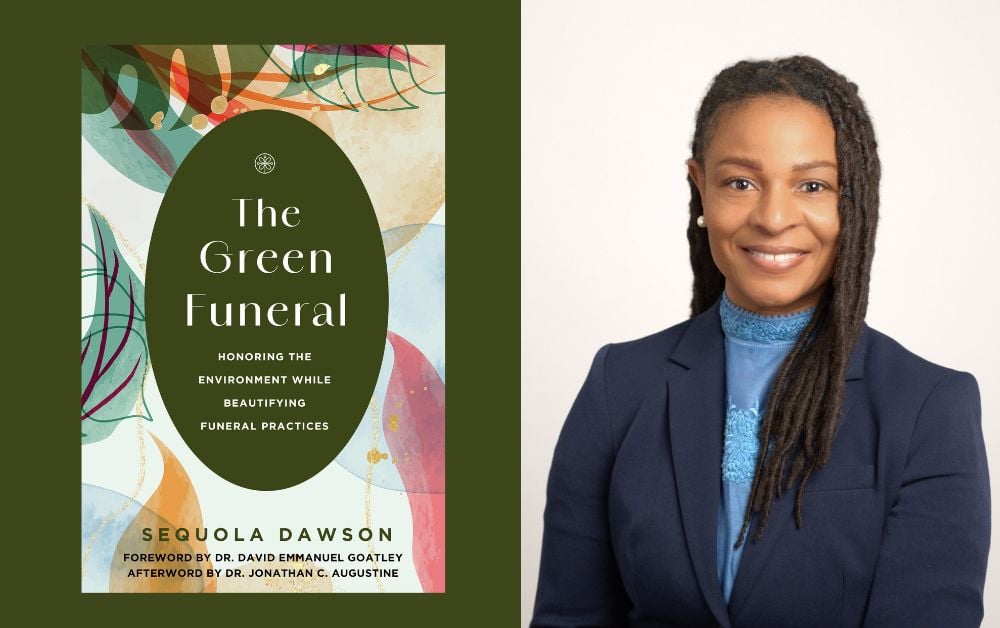
Reprinted with permission from The Green Funeral: Honoring the Environment While Beautifying Funeral Practices by Sequola Dawson copyright © 2025 Broadleaf Books.
RLC welcomes and encourages individuals who engage in critical thinking at the intersection of faith and justice to contribute to our blog. The views and opinions expressed by our blog authors are their own and do not necessarily reflect or represent the views and opinions of RLC, its staff, members, or officers.
