


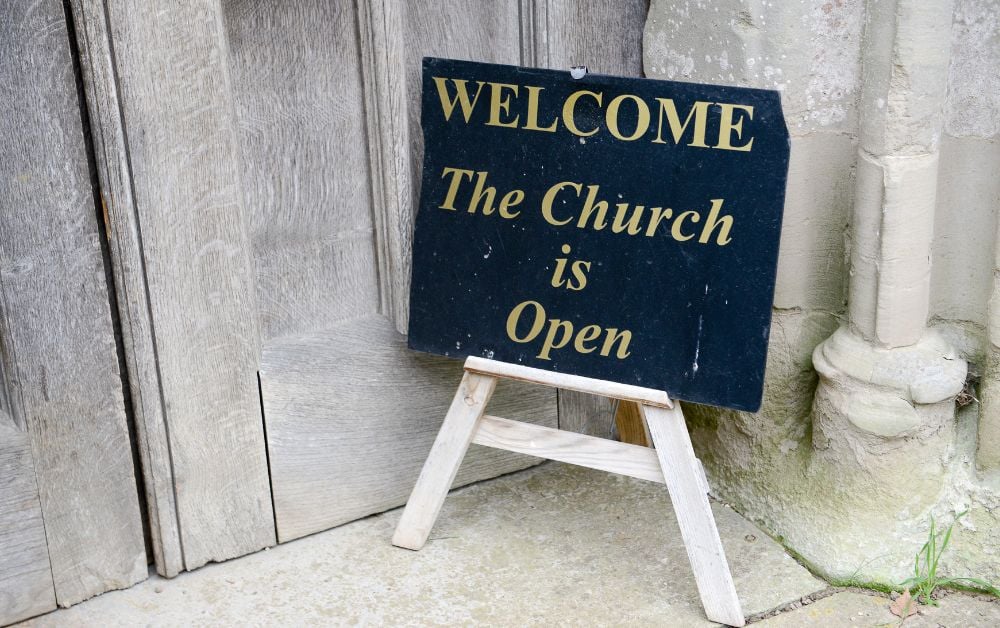
On Sunday I looked at the people in the seats all around me. We were a ragtag mix. From seniors with their walkers to the heavily tattooed couple; from those practically born in the pews to first-timers. There are those recovering from alcohol addiction and those who never touched a drop in their life. We are a gathering of people with different abilities and challenges, and very diverse views. It is difficult to be in community with those who think your child is an abomination or that you are sliding down the slippery slope of progressive thinking. I am sure it is also difficult to be on the opposite side of the spectrum as a dyed-in-the-wool conservative who fears change. In the words of author Karen Stiller, “we are a strange soup,”(1) this body of Christ. Author Sarah Billups sums it up this way, “Most churches most often resemble the body of a preteen, gangly, awkward, uncoordinated, and clumsy”. (2)
In this world rife with division, this gathering should not exist–there are too many things about which we disagree.
This is not a new phenomenon. Since the church began over two thousand years ago, there have been divisions, disagreements, and schisms. The early church did not know what to do with the Gentiles; they had to navigate slaves and masters worshipping together. They got it wrong often. And yet, the church lives on. You can find us here every Sunday in various locations, seeking to learn what it means to be the visible presence of God on earth.
I wonder how the first friends of Jesus managed to get along. How the poor hard-working fishermen could hang out with one who worked for the empire which taxed them so heavily it was hard to make ends meet? How the quiet ones could work alongside the ones with big egos and voices. How the “sons of thunder” could get along with anyone?
Their times together were not without some struggle. I am convinced there were many instances where they gave each other the side-eye. When the plot was revealed that James and John had been putting themselves forward for important positions in the coming kingdom, I can only imagine the reaction amongst the rest of the disciples. Each one of them was involved in jostling for position– a desire to be the greatest– but only James and John had the cojones to ask.
The disciples too were a ragtag bunch, a “strange soup”, awkward and gangly. As I look around the gathered body on a Sunday morning, I realize it is also true of us.
The one thing we do have in common is a need for mercy.
Each of us, to a greater or lesser degree, knows we have messed up. Many of us are keenly aware of our shortfalls. We have trouble forgiving ourselves for the things we have done. We are not who we would like to be; we regularly fail ourselves and others, and find it hard to believe the best of another. For this we need mercy.
I am so grateful to know,
“He does not treat us as our sins deserve or repay us according to our iniquities. For as high as the heavens are above the earth, so great is his love for those who fear him; as far as the east is from the west, so far has he removed our transgressions from us.” (Psalm 103:10-11)
I work as a florist and when making a floral arrangement I always use a variety of greens as the foundation. I love the droopy form of seeded eucalyptus with its blue/green hue, and the stiff upright form of pistache stems. Plumosa adds a soft airy texture and the common leather leaf fern with its glossy fronds contributes its own beauty to the arrangement. Each green is different. Alone they are good, but together they are stunning.
Each stem is valued for what they contribute by just being what they are. When arranged well, no one green takes the spotlight, but together they create a lush foundation of beauty.
As I worked on my arrangement, I came to think about the church. The way all of our variety comes together to create something more beautiful and effective than if we were to stand alone.
I realize that the church does not always function as it should. Too often one part wants to take over and steal the show, hoard power and authority rather than serve and shepherd others. Sometimes our churches become too homogeneous – a collection of all leather leaf if you will – a group of people who look similar, believe within shared boundaries, and speak the same language of faith.
It can seem like this is the standard for churches these days as we read story after story of Christian nationalist gatherings where the flag takes up the same space as the cross, where the poor are not fed nor cared for, and where the immigrant is not welcome.
And yet, on any given Sunday across the world, there exist complex pockets of diversity – ragtag bunches of people conscious of their need for one another and their need for grace. There are congregations which truly believe we are better together in all of the messy awkwardness, through all of the growing pains.
The Jesus we follow, gathered to himself, as he walked on earth, a most diverse and motley bunch of characters. He chose the loudmouths, the forgotten, the poor, and the outsiders. He modeled for us the way of radical inclusion. May we go and do likewise.
Here’s to all the awkward and gangly gatherings of the people of God.
- Holiness Here, Karen Stiller, Nav Press, 2024
- Nervous Systems, Sarah Billups, Baker Books, 2025, page 131
RLC welcomes and encourages individuals who engage in critical thinking at the intersection of faith and justice to contribute to our blog. The views and opinions expressed by our blog authors are their own and do not necessarily reflect or represent the views and opinions of RLC, its staff, members, or officers.
