

Shakespeare, Fear, and the Evangelical Reluctance to Reckon with Trump
“Our doubts are traitors and make us lose the good we oft might win, by fearing to attempt.”
Lucio, in Shakespeare’s Measure for Measure
In the first act of Shakespeare’s Measure for Measure, a young woman named Isabella hesitates to plead with a harsh judge for her brother’s life. Her friend Lucio, sensing her reluctance, offers a line that has since become famous: “Our doubts are traitors, and make us lose the good we oft might win, by fearing to attempt.”
Most people hear this as simple motivational advice: stop overthinking, take the leap. But Shakespeare is doing something far more profound. Lucio is not merely telling Isabella to believe in herself. He is naming a truth about human nature that most of us would rather not face: that doubt is not always the noble, intellectual posture we imagine it to be. Sometimes doubt is a form of self-protection. Sometimes it is cowardice dressed as prudence. And sometimes it is outright treachery, not against our enemies but against our own souls.
I want to suggest that this insight speaks with particular force to a crisis unfolding within American evangelicalism: the widespread inability of many believers to honestly reckon with their support for Donald Trump, and the deep reluctance to acknowledge that this support may have been, and may continue to be, a serious error.
The Anatomy of Self-Protective Doubt
Notice what Shakespeare understood about Isabella’s hesitation. She had the standing to act. She had the moral authority. Everything she needed was already in her possession. What threatened to stop her was entirely internal: the fear that acting might cost her something, that stepping forward meant stepping into uncertainty. Her doubt was not protecting her from a bad decision. It was preventing her from making a necessary one.
Something remarkably similar is happening among millions of evangelical Christians today. Many sense, at some level, that their political alignment has cost them something essential: their prophetic witness, their moral credibility, and their ability to tell the watching world that Jesus, not political power, is their true allegiance. They see the Christ-mocking cruelty, the casual dishonesty, and the strongman rhetoric that has no parallel in the Sermon on the Mount. And yet they cannot bring themselves to say plainly what they see.
Why? Because acknowledging the error would be enormously costly. It would mean admitting they were wrong, not about a policy preference but about a fundamental posture of the heart. It would mean facing the disapproval of their community, their family, perhaps even their pastor. It would mean surrendering the intoxicating feeling of winning the culture war. And so a protective doubt descends, not the honest doubt of someone wrestling with hard questions, but the strategic doubt that says, Well, who can really know? Both sides are flawed. It’s complicated.
The philosopher Søren Kierkegaard identified this pattern with devastating precision. He warned that the modern person treats perpetual deliberation as a virtue, always gathering more information, always considering another angle, always finding one more reason to wait. Kierkegaard called this person a “spectator of his own existence.” He has all the maps but has never left the harbor. For many evangelicals, the endless refrain of “it’s complicated” or “we don’t have all the facts” has become exactly this kind of harbor: a place of safety disguised as thoughtfulness.
Double-Mindedness as a Spiritual Condition
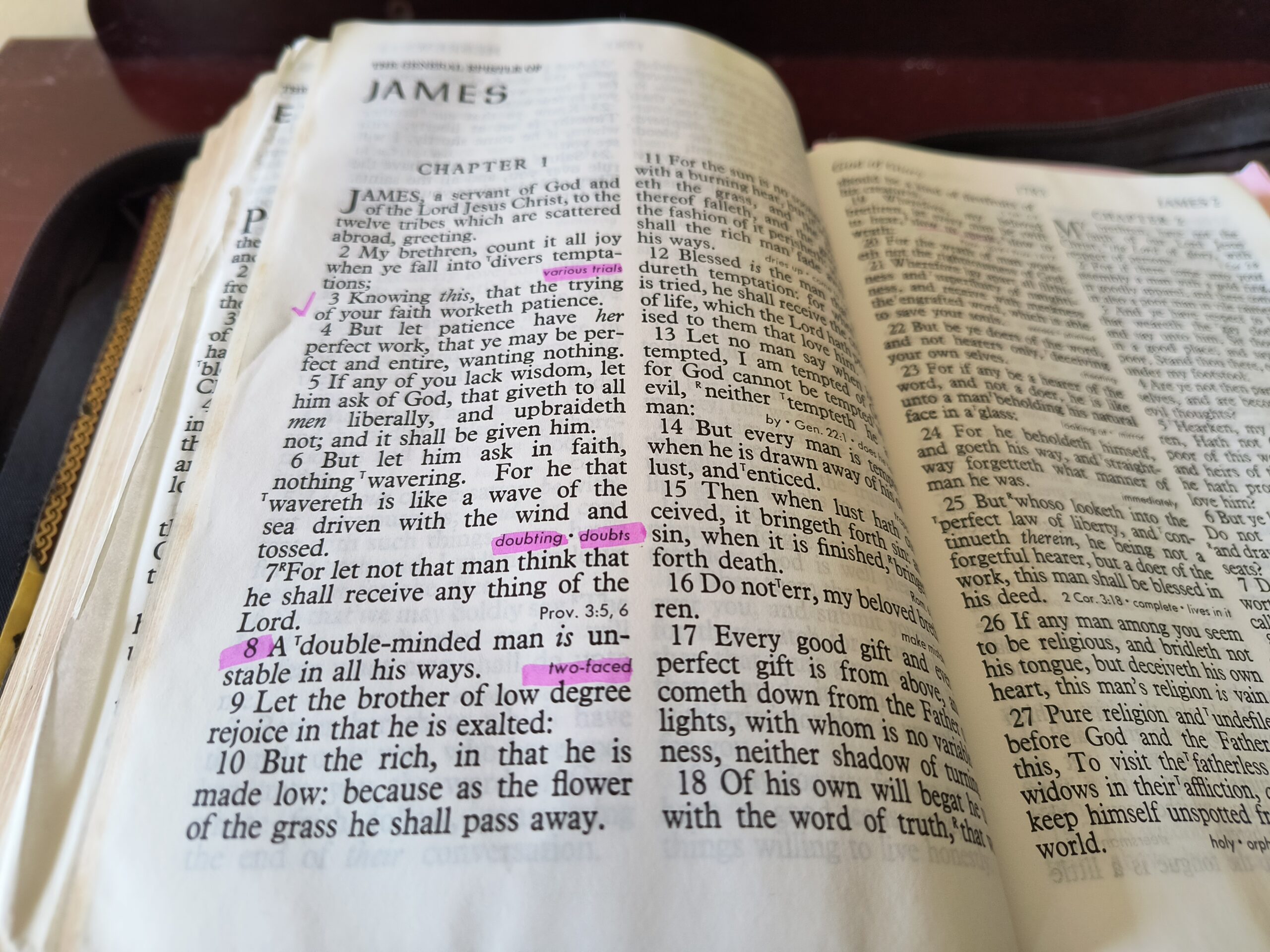
The letter of James describes the doubter as “double-minded,” literally “two-souled” (James 1:8). This is not someone honestly wrestling with hard questions. This is someone who asks God for wisdom yet has already decided not to act on whatever answer comes. It is the spiritual equivalent of asking for directions while refusing to turn the steering wheel.
This is the condition of an evangelicalism that prays for revival while refusing to examine its own complicity. That laments the decline of Christian witness in America while declining to ask whether its political entanglements might be a primary cause. That invokes the name of Jesus on Sunday and defends behavior on Monday that Jesus explicitly condemned: the love of money, the will to dominate, the contempt for the vulnerable, and the routine bearing of false witness.
The great theologian Helmut Thielicke wrote that the opposite of faith is not doubt but disobedience. That is a disorienting claim because it reframes everything. If the core issue is not intellectual uncertainty but a refusal to act on what we already know, or at least strongly suspect, then the solution is not more information. More information is precisely what the double-minded person always wants, because the quest for more information is the perfect excuse for continued inaction. The real need is not for more knowledge but for courage, not for certainty but for honesty, not for more light but for the willingness to walk by the light we already have.
Many evangelicals already have the light they need. They know that character matters; they said so loudly during the Clinton years. They know that cruelty is not a Christian value. They know that wrapping the cross in a national flag is a form of idolatry as old as Constantine. What they lack is not information but the willingness to act on what they know, because doing so would mean losing something they have come to love more than they realized.
Grace for the Reckoning
Here is where Shakespeare’s insight, profound as it is, reaches its limit. Lucio tells Isabella to overcome her fear and act. That is good counsel. But the gospel goes further, addressing the question Lucio’s advice inevitably raises: What if I step forward and lose everything: my community, my certainty, my identity?
The secular version of this challenge can only say, “At least you’ll have your integrity.” That is not nothing, but it leaves you fundamentally alone.
The gospel says something categorically different. It says that the God who calls you to repentance is the same God who has already acted on your behalf. Before you ever mustered the courage to face your error, Christ had already faced the cross for you. The Christian who acknowledges a wrong, even a deeply consequential, publicly visible one, is not stepping into the void. She is stepping onto ground secured at Calvary.
Think of Peter, who denied Christ three times and was then, in John 21, restored three times. Jesus did not say, “I’m disappointed in you.” He said, “Feed my sheep.” The path back from failure was not punishment but a calling. It was not humiliation but a vocation. Peter’s denial was real. Christ’s restoration was even more real.
This is the word the American evangelical church most desperately needs to hear. You are not being asked to abandon your faith. You are being asked to return to it. The prophetic tradition of Scripture is not an attack on the faithful; it is the deepest expression of God’s love for his people, a love that refuses to let them sleepwalk into ruin.
Your doubt about whether to speak, that quiet voice that says it’s not worth the cost, it’s too late now, and it wouldn’t change anything, is a traitor. It is working against the very thing your soul most needs: the freedom that comes from telling the truth.
And the good news, the genuinely good news, is that you do not have to find your way back alone. Grace is older than your complicity, and it has been reaching for you since before you ever thought to push it away.
Stephen White is a retired pastor and nonprofit executive. He is the author of several books, most recently, Misplaced Glory: Breaking the Spell of Pastor Worship in the Modern Church. He and his wife, Dawn, live in Scottsdale, AZ.
