


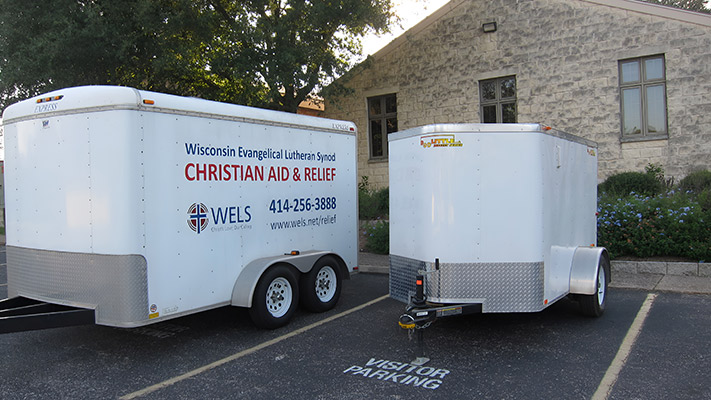
Often, compassionate Christians have the desire to donate items to help those in need. The following guidelines will help to ensure that disaster relief supplies do the most good for those who need them.
1. Financial contributions are often best.
Providing a financial contribution to a disaster relief agency is often the most efficient way to help those who are hurting. Disaster relief organizations have the experience, skills, and expertise to make the greatest and most positive impact on those whose lives have been disrupted by a disaster. These organizations are skilled in disaster assessment, disaster cleanup, mass feeding, mass shelter, first aid, crisis counseling, pastoral care, childcare, home repair, and many other areas. When people support these organizations (such as WELS Christian Aid and Relief) with financial contributions, it helps secure a steady flow of important services to survivors of a disaster.
There are other reasons that financial gifts make sense. Disaster organizations tend to spend money in or near the community impacted by disaster. This helps to support the local economy and local people who work in it. Cash donations avoid the complicated, costly, and time-consuming work of collecting, sorting, packing, transporting, unloading, re-sorting, storing, packaging, and distributing donated goods. Cash donations tend to meet people’s needs more precisely because the organization can purchase exactly what is needed in each situation. Cash donations also allow for vouchers so that people can provide for their own personal needs. And, of course, cash donations to registered non-profit disaster relief organizations are tax deductible.
We appreciate donations to WELS Christian Aid and Relief, which allow us to provide vital disaster relief operations through our congregations across the country and in our missions around the world. To donate go to wels.net/CARgift.
2. Used clothing is rarely a useful donation in a disaster relief situation.
Used clothing is usually not a helpful donation because it is hard to clean, sort, pack, store, and distribute. In addition, used clothing is of varying quality and condition and therefore doesn’t fit the needs of disaster survivors.
Statistics vary, but somewhere between 60 to 90 percent of used clothing donated for disaster relief ends up in the landfill. If you want to collect clothing, it might work better to have a yard or garage sale to sell the clothing. Then the proceeds can be donated.
3. Confirm the need before collecting donations of goods.
Again, financial contributions are almost always the best way to support disaster survivors and provide the goods and services they need. However, sometimes goods are collected. Before donating goods, it’s important to find out what is really needed. It is usually a mistake to assume what is needed. In the case of major disasters, relief organizations and state emergency management agencies often set up toll-free numbers and websites where the public can find out what goods are needed. In the past, vast quantities of goods have been wasted because there was no plan for distribution or they simply weren’t needed. Donors should be wary of those who say “everything is needed” in a disaster situation. This is almost never true. Do some research. Find out first.
4. Donate through a reputable organization.
It’s never a good idea to donate goods without knowledge of what goods are needed and a clear plan to deliver and distribute them. Experienced disaster relief organizations know how to assess what is needed, where it is needed, and when and how to deliver the needed supplies. They have the infrastructure and know-how to handle the influx of donated goods. Donating through a relief group helps to assure that the right goods in the right amounts are collected and delivered where they are needed most. Our advice: As always, it is best to donate cash. However, if you want to collect needed supplies, talk to a reputable disaster relief organization that is working in the area.
5. Plan transportation in advance.
When it comes to donations, planning how to get them where they need to be is crucial. Without proper planning, a donor can easily be stuck with a large amount of donated goods and no way to get them to those who need them. Do not assume that donated supplies will be delivered at no charge or at government expense. The donor has the primary responsibility for seeing that donations are delivered to the disaster area in a timely fashion. Transportation volunteers should be sought or money budgeted for this expense.
6. Donated goods must be well-packed and carefully labeled.
Once there is a plan in place to receive, store, and distribute needed goods, they must also be properly sorted, packaged, and labeled. If you are unsure how to do this, speak to an experienced disaster relief organization. Detailed packing labels should be affixed to each box of relief supplies. This helps with directing the goods to the right places.
