


Thank you for serving as a WELS Disaster Relief volunteer! What a wonderful opportunity to help people in need and show them the love and compassion of Christ our Savior!
Working safely during deployment is important. Please read through the following guidelines and put them into practice!
Basic Safety
If you haven’t done so, please view our basic safety video.
- When traveling to the worksite, be alert for any dangers including downed wires, logs or brush in the road, safety vehicles, etc. Streetlights and stoplights may not be working. Remember, you are entering a disaster zone. Take your time, be alert, and arrive safely.
- Be sure to bring your completed Volunteer Medical Form with you. Put it in a sealed envelope with your name printed clearly on the front. This form will only be used in case of a medical emergency. It will be returned to you unopened or destroyed at the end of the deployment.
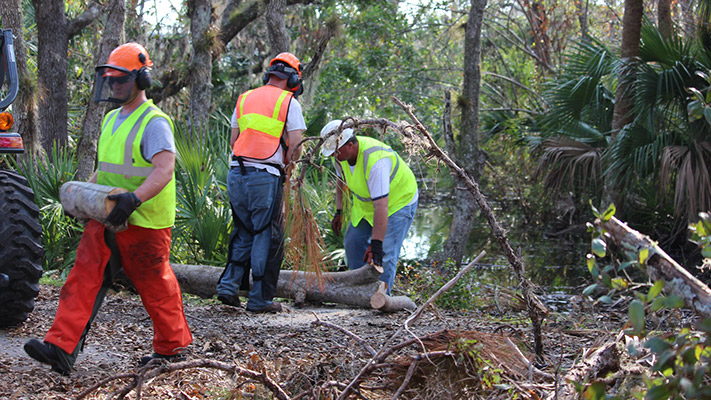
- Please wear gloves while working. Safety glasses and helmets will be provided when needed.
- Stay visible by wearing a WELS Disaster Relief T-shirt or safety vest (provided) when on the worksite.
- No open-toed shoes. Steel-toed safety shoes are preferred.
- Work at your own pace. Rest when tired. Do not try to match the pace of younger or fitter volunteers.
- Hydration is important. Drink plenty of water. This is especially important in warm weather.
- Stay alert to avoid possible accidents. Pick up logs and brush on walking paths. Inform fellow volunteers of stumps and other obstacles that they might trip on.
- Stay clear of any downed wires. Assume that they are energized.
- Watch out for snakes or other animals that may be hiding under brush, in water, etc.
- Alert the Safety Officer of any injuries or illnesses.
Chainsaw Safety
- All sawyers must meet with the Lead Sawyer each day before work begins. The time, place, and leader of this meeting will be announced.
- Wearing safety gear is not optional. All sawyers must wear chaps, ear and eye protection, helmet, and gloves while using the chainsaw.
- Do not approach the sawyer to clear brush until he has indicated it is safe to do so. In general, stay at least 10 feet from the sawyer while he is working.
Flood Relief Safety
- Rubber gloves should be worn when removing debris from a flooded building.
- Be careful when reaching into any water. It may contain sharp objects or other hazards.
- In some situations, personal protective equipment (PPE) including a respirator may be required.
Engaging with People
- Take time to introduce yourself to homeowners and let them know where you are from.
- Be respectful of homeowners’ property and possessions.
- If they would like to talk about their experience, please take the time to listen to their story. Living through a disaster is a traumatic experience. It helps survivors to talk about it.
- Listen with R.E.S.P.E.C.T.
- Repeat key phrases
- Eye contact
- Summarize
- Probe for more information/clarification
- Empathize
- Concentrate
- Take your time
- Some phrases to avoid:
- “I know what you’re going through.”
- “Everything will be OK.”
- “Many people have it worse.”
- “This happened because . . .”
- “Let me tell you about my experience.”
- “You’ve got this!”
Dealing with Problems
Please encourage your fellow volunteers to work safely. Any concerns about safety or behavior should be reported to the Incident Commander.
Other Notes
- Each day will begin with a devotion, safety briefing, and work assignments. The time and place for this will be announced.
- Meals will be provided. Snacks and water will be available all day.
- Breaks are mandatory. When a leader announces a break, work must stop.
- Be respectful of leaders and follow their instructions.
- Please return any tools or equipment at the end of the workday. Report any damage. Note any maintenance that needs to be performed.
* * *
For this Deployment
A place for special deployment-specific notes.
