
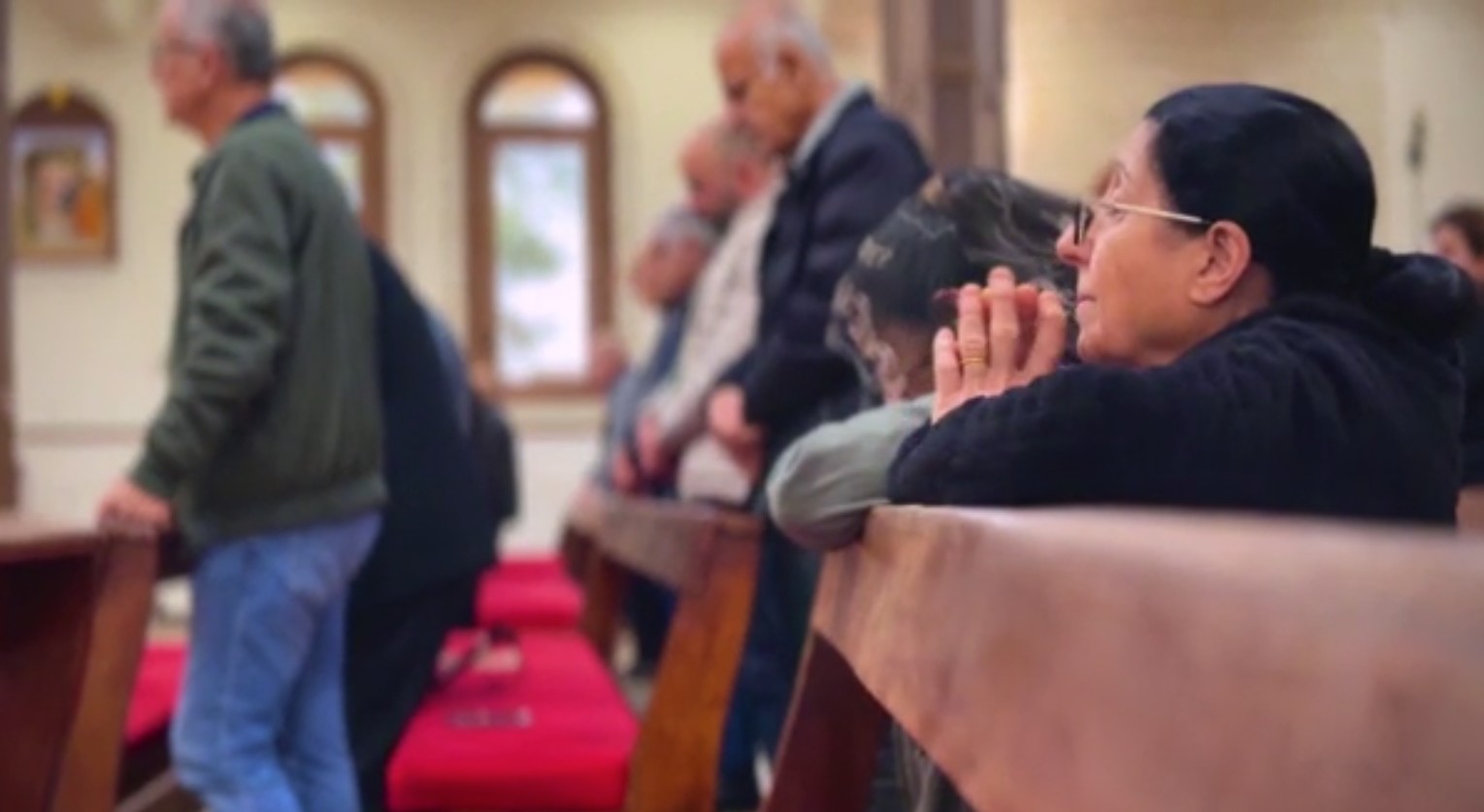
ANKAWA, Northern Iraq – One of the world’s oldest Christian communities is on the brink of disappearing. Decades of war and persecution in Iraq have driven most believers out of the country, but all hope is not lost.
In Erbil, just beyond the ancient citadel, lies a neighborhood unlike any other. This is Ankawa, a Christian enclave that has endured for nearly 2,000 years. Here, people still speak Aramaic, the language of Jesus.
Archbishop of Erbil Bashar Matti Warda said, “This is a place of evangelization; this is a place where Christianity came right in the First Century.”
The Assyrian Church of the East, the Chaldean Catholic Church, and the Syriac Orthodox Church all trace their roots to this land, making Iraq home to some of the oldest Christian communities on earth.
Today, however, that ancient presence is fading. The Christian population here has been shrinking for decades.
“Every time there’s a crisis, there’s a war, there is violence, there is persecution, these old wounds start bleeding again,” Archbishop Warda said.
Before the U.S.-led invasion in 2003, Iraq was home to as many as 1.5 million Christians. Today, fewer than 130,000 remain. “It’s a frightening, frightening situation,” Archbishop Warda said.
Ano Jawhar Abdoka, Minister of Transportation and Communications, is the only Christian member of the Kurdish government’s cabinet. He says wave after wave of violence has pushed Christians out of their homes.
After the U.S. invasion came the rise of ISIS, which forced more than 100,000 Christians to flee.
Abdoka said, “1,100 churches were attacked, 1,328 Christians were killed on identity only in just two years, so our people were targeted because we are Christians.”
Among those who left decades ago and made the decision to come back is Dilan Adamat.
“I used to come here as a child for holiday, just for a few weeks and going back to France was always a bit frustrating because I was missing here, there was something missing in my life which was my Iraqi side after growing up in France,” he said.
For Adamat, this neighborhood isn’t just where he’s from. It’s part of who he is. “This is my uncle’s house, there’s my cousin’s house, this is my aunt’s house over there,” he said, showing us each home that holds a connection.
Born in Ankawa and raised in France, he spent years returning here as a child, never feeling at home anywhere else.
The former U.S. Consulate now just so happens to be his cousin’s house. “I know, you think everyone here is my cousin (starts laughing), but in the early 2000s, I used to come here to this house, to spend a few weeks here,” he said.
For Adamat, this is more than geography. As an Aramaic-speaking Chaldean Christian, he sees Iraq as the cradle of his faith, language, and history. “I hope people will preserve this area because it’s part of our heritage here in Ankawa,” he said.
Now that heritage is at risk. And after decades of violence and displacement, he fears it could disappear altogether.
“We are at a very sensitive moment of history; we may disappear completely in a couple of generations and so if we don’t do anything now about this it will be too late in a few years,” Adamat said.
In 2019, he left a successful law career in France and returned to Ankawa to start The Return, a nonprofit helping Iraqi
Christians come back to their ancestral home.
“I wanted to normalize the idea of returning here, especially for our community. You know, we left for legitimate reasons, people were traumatized by wars and crisis, but at a point I realized that most of these people had this dream of coming back.”
It’s not an easy mission. Iraq remains unstable, and new regional tensions once again have families questioning if it’s safe to return.
Still, since 2023, his organization has helped hundreds begin that journey home. “One of the key elements of our Christian faith is hope, and I noticed that our people had lost hope, so my mission is to bring back this hope amongst our community, and this is deeply rooted in our Christian faith.”
Minister Abdoka sees signs of hope, especially here in Iraq’s Kurdistan region.
“In Ankawa, which is often called the Vatican of Iraq or the Vatican of the East, we had only 2 churches. … that was in 2003, only two churches. Now in Ankawa, we have more than 30 plus churches,” Abdoka said.
Last year, the region hosted its first Kurdistan National Prayer Breakfast, bringing together people of different faiths, a rare moment of unity in a divided region. “In Kurdistan, we are saying to all the Middle East that peace is possible and diversity, ethnic and religious diversity, is not a threat.”
Pastor Malath Baythoon of the Christian Missionary Alliance Erbil has seen that hope firsthand. “Kurdistan has become kind of like a safe place for many people over many years,” he said.
He started his church in 2012 with just two families. It’s now one of Iraq’s largest evangelical churches.
“Here, we have freedom to work, to be officially recognized, to expand, to build, and even to reach out to the people, to have open service, to have whoever wants to come and visit the church, and always the government wants to support the churches.”
Still, those here know the future will not be easy.
Adamat said, “We will never be completely at peace, but at the same time, it will never be dead. There will always be life.”
