


The world is made up of sheep and goats—or maybe I should say sheep vs. goats. There will come a time, Jesus says, when the Son of Man in his glory sits on a throne and divides the people into sheep and goats, one or the other. The heavenly King will decide. (And remember it’s a story. Jesus is telling another story.)
Sheep and goats, really? It seems monstrous, if not unfair, that there would be such a division, as though we had any choice in the matter. But then again, maybe we do. We choose every day whether to see others with compassion or contempt, whether to serve or turn away.
First off, what would be wrong with being a sheep or a goat? I like them both. I drink goat milk and savor sheep yogurt (taking advantage of the health benefits of both). The distinction or comparison seems vague to this twenty- first- century city dweller. But it would be immediately apparent to Jesus’s listeners in first- century Judea. They saw the reckless goats scrambling over rocks. They watched over sheep in the fields.
Sheep were docile, gentle, biddable creatures; goats could be feistier. Sheep were considered easier to raise, responding to the calling of their shepherd.
In Jesus’s words, the King, as he calls this decider, determines the fate of both. The good people, the sheep, go on the right, the goats go to the left. The former are granted life everlasting, sublime pastureland with nary a storm cloud in sight—or maybe it’s just that the clouds are welcomed for all their benefits to the landscape. The goats are banished into some sort of eternal punishment, a future of unescapable misery. It’s also possible that the two are in the same place and just see things differently. As the old saying goes, hell is being in heaven and not liking it.
One caveat: When you hear of life everlasting or eternal life in the Scriptures, and also eternal damnation, be careful where your imagination takes you. It’s easy enough to figure heaven is somewhere above the clouds where angels play harps and people float around in bliss rather than burn in a fiery tomb underground, demons throwing darts at them and stabbing them with knives. When you linger with Jesus’s words you start seeing—or rather, feeling— something different. This life eternal is much more an emotional and spiritual state that starts here on earth. We get to be like sheep, cared for and loved, in constant community, close to the shepherd at hand.
We do all the right things, effortlessly. And what exactly do we do to deserve it? Keep reading. When Jesus or God or the Spiritual One was hungry, as he tells it, we gave him food. When he was thirsty, we gave him something to drink. When he was alone and away from home, we welcomed him into our home. When he was without clothes, we gave him something to wear. When he was sick, we cared for him. When he was in prison, we visited him. When we hear this, we might scratch our heads—as Jesus’s listeners certainly did— and wonder, “When did we do all these things?” We don’t remember. When did we see our Lord hungry and give him food? When did we see him thirsty and give him something to drink? When was he alone and we took him into our house? When was he without clothes and we gave him something to wear? When was the Lord sick or in prison and we visited him? When did we act like sheep and not goats?
All those “whens”! Goodness has its own inscrutability. Perhaps because those who are good— when we are good— have such pure motivation. We don’t harbor any self-congratulatory accolades. The truly good ones are not going around saying, “Aren’t I great? Didn’t I give a great presentation? Wasn’t I generous? Did you see me visiting that friend in the hospital?” They just do good because they do. Happiness doesn’t have to proclaim itself.
Heaven is here on earth. Or to repeat that saying, hell is being in heaven and not liking it. The King in the story, or God, or Jesus, the sublime Whoever, answers that slew of “when” questions, that whenever we did those good things, we did them for Jesus, to Jesus. However, when we didn’t do them, when we ignored the world’s misery, when we didn’t see that the sick, the lonely, the imprisoned, the hungry, the thirsty, the poorly clothed needed our help, we missed seeing who they really were. We missed seeing God on earth.
At our worst, we’re sent away to a place of eternal punishment where people burn forever. There is a hell on earth, which they or we have unwittingly claimed. We can be ornery goats, not biddable sheep. The choices seem very clear then, don’t they? We’re expected to feed the hungry, clothe the naked, give shelter to the homeless, visit the sick, send them emails, call them, and spend time with the prisoners, including those who find themselves imprisoned in inner torment. Looking for Jesus here on earth?
Turns out that the Lord isn’t so far away after all. Look around you. See the opportunities to serve him. I must confess that when I do those good things, it usually takes an elbow nudge or two: “Come on, Rick, you’re not doing anything this Saturday, volunteer at the church soup kitchen,” or “Okay, Rick, you’ve been in the hospital before. You know how much it meant to have visitors in that lonely misery, drop on by. Just show up. If they don’t want to see you, you’ll find out. You might be surprised.” When the beggar holds out his cup to me, when the woman on the subway gets close enough that I can smell her, I don’t see Jesus, not until I drop a coin or a buck in the cup or in the open hand. And then, even in this shamelessly secular era, they always say, “God bless you.” I think I’m meant to take them at their word.
Because Jesus is there. Jesus is right here. Right now. All around us. In need. In love. Waiting to be seen.
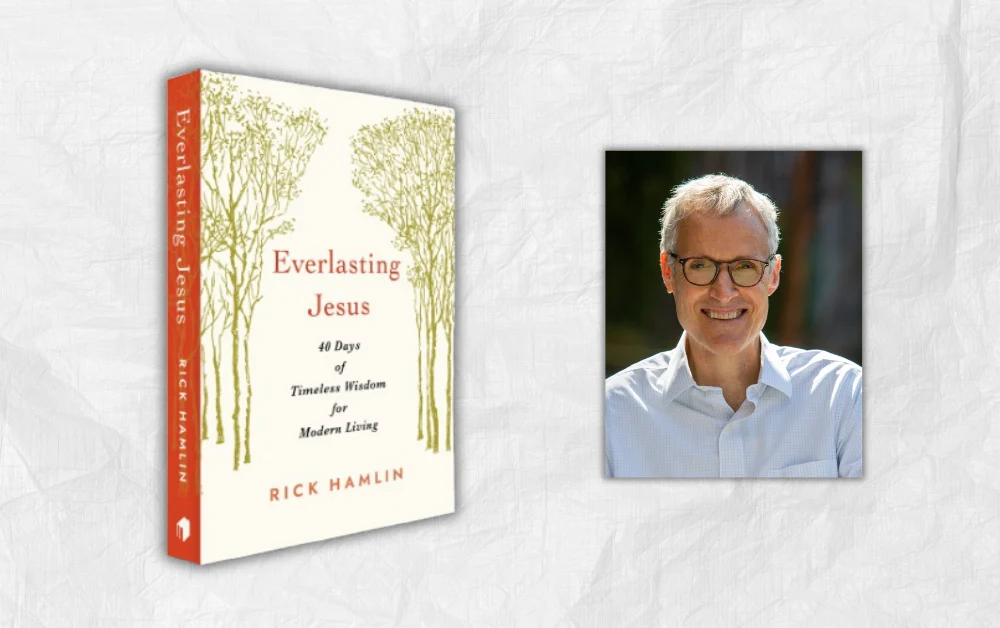
Excerpted from Everlasting Jesus © 2026 Rick Hamlin, by permission of Morehouse Publishing, an imprint of Church Publishing, Incorporated.
