


Reading Time: 4 minutes
The 2025-2026 Supreme Court term is coming to a close. The Justices heard their last oral arguments for the term on April 29. They’re now writing their opinions and dissents. Their decisions will be released over the next few weeks until June 30.
Join others crying out to the Lord day and night.
Three consequential decisions are expected to be handed down which could have a significant impact on our country. IFA has brought these cases to your attention and requested prayer. Please continue in your prayers over these three cases for the Justices to decide righteously and in God’s wisdom.
Case #1: Birthright Citizenship
Perhaps no case will have the deepest impact on our country then the Justices deciding who can be an American citizen. The case is Trump v. Barbara. At issue is… children of illegal aliens and temporary visa holders born in the United States automatically be entitled to U.S. citizenship under the 14th Amendment, which states…
“All persons born or naturalized in the United States, and subject to the jurisdiction thereof, are citizens of the United States and of the State wherein they reside.”
The 14th Amendment was enacted in 1868 after the Civil War to give the former slaves and their children citizenship. President Trump said it was never meant to include illegal aliens who are ‘not subject to the jurisdiction thereof’ of the United States. The president believes the amendment has been misinterpreted from the beginning.
President Trump issued an Executive Order excluding children born in the U.S. where neither parent is a U.S. citizen or holds lawful residency.
The ACLU says the president has no right to rewrite the Constitution by Executive Order, and any child born in the U.S. is entitled to birthright citizenship. The only legal exceptions are children born to foreign diplomats or children born to foreign invaders.
The Supreme Court’s decision could change the meaning of citizenship and reshape immigration forever. Did the framers mean to make the 14th Amendment a universal entitlement to all immigrants and aliens, or was it meant only for freed slaves? Could the justices be wary of correcting a misinterpretation of the 14th Amendment as being just too cumbersome and complicated to overturn and implement?
Case # 2: Boys in Girls’ Sports
Another highly anticipated decision is in the two cases, Little v. Hecox and West Virginia v. B.P.J which would ban biological males playing in girls sports.
Idaho and West Virginia are among 27 states that prevent biological males from competing on female sports teams. Lower courts in these states struck down the bans as unconstitutional violations of Title IX prohibiting sex-based discrimination (West Virginia), as well as the equal protection laws of the Fourteenth Amendment (Idaho). The states appealed to the Supreme Court.
The legal issue in these cases is: Are these state bans discriminating based on sex? But perhaps the larger question the Supreme Court is being asked to decide is: Are biological males claiming to be female in fact females? The Supreme Court is being asked to rule on basic biological science. Will the Court uphold biological reality in these cases?
Will the court uphold the state bans? Will they expand their decision and rule that biological males are not legally female?
Case #3: When is Election Day?
In Watson V. Republican National Committee, the Supreme Court will decide if states can count mail-in ballots after Election Day.
Federal law declares the first Tuesday after the first Monday in November as Election Day. The law also states that ballots must be received by that day. But 15 states and D.C. passed laws allowing ballots postmarked by election day but received five days after Election Day to be counted
The RNC is arguing that allowing so-called “grace periods” is unconstitutional. On election day, the ballot box must close, and every vote received, argues U.S. Solicitor General John Saur.
Michael Watson, Mississippi’s Secretary of State, argues that the federal law imposes when the ballots must be cast, but not when the state has to count them. It’s the states that determine the process of running elections in these individual states.
This case is a significant case for the integrity of our national elections and public trust in their outcomes. How many times in recent years has one candidate “won” on election night, only to lose days later as ballots continue to trickle in?
Please keep these three cases and the Justices’ decisions in your prayers.
Let justice roll on like a river, righteousness like a never-failing stream! (Amos 5:24)
Let’s Pray for the Justices to do God’s Will
Dear Lord, we ask that you grant holy wisdom and courage to the Justices deciding these controversial issues critical to our nation. Give them the mind of Christ, and may they do what pleases You and not man. May. May their decision glorify you, Lord God. We pray for unity in the decision of the Supreme Court Justices. We pray that, whatever the decision, the people will hear it and accept it peaceably. We pray against any anger and violence that could erupt when the Supreme Court releases these decisions. We ask for protection for the Supreme Court Justices from any harm. In Jesus Name, Amen.
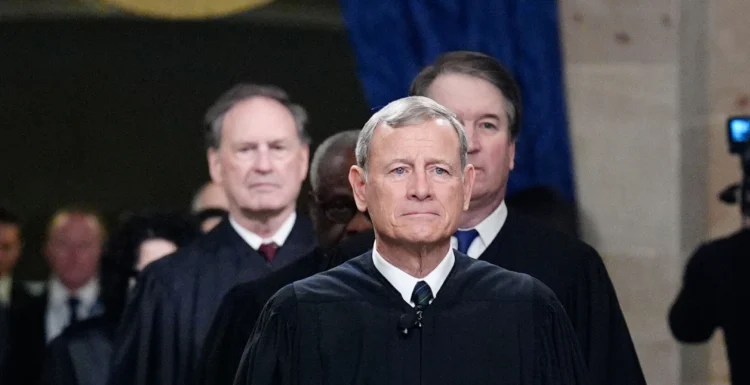
Belinda Brewster analyzes cultural, political, and world events from a biblical worldview. Belinda’s passion is to equip, support, and encourage parents and grandparents who are courageously battling against the spiritual and cultural forces impacting children and grandchildren. Photo Credit: Melina Mara – Pool/Getty Images.
