
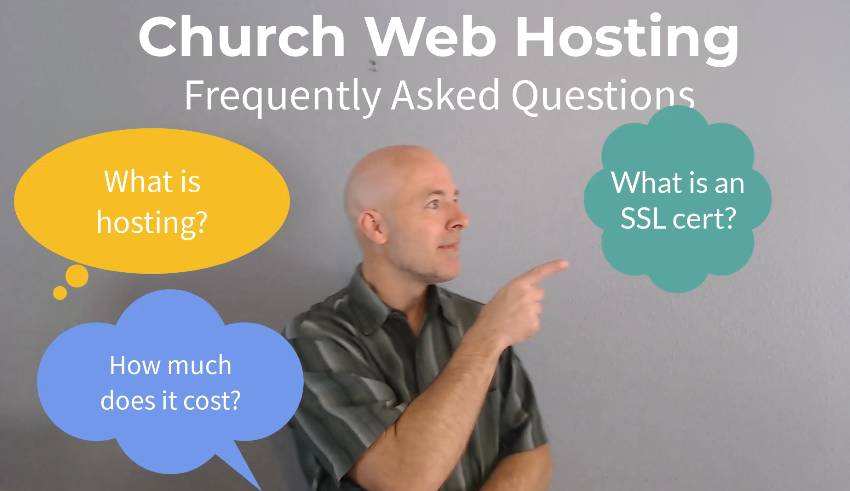
We continue our series on Church Website Hosting FAQs…
Cecil in Spartanburg, SC would like to know, “What is an SSL Certificate?”
SSL stands for “Secure Socket Layer.”
An SSL certificate is a digital certificate that establishes a secure encrypted connection between a web server and a browser. It ensures that sensitive information, such as personal data and financial details, transmitted between the server and the user’s browser remains private and protected from unauthorized access.
When a website has an SSL certificate installed, it enables the use of HTTPS instead of HTTP, indicating a secure connection. The certificate verifies the authenticity of the website and encrypts data during transmission, preventing it from being intercepted or tampered with by someone with malicious intentions.
An SSL certificate plays a crucial role in establishing trust, confidentiality, and data integrity for secure online communication.
Click to share this image on Facebook, Twitter, Pinterest or Instagram
3 More Reasons for an SSL Certificate
1. SSL Matters for Church Websites
An SSL certificate is important for every website, but it is especially important for church, ministry, and Christian organization websites because visitors often use these sites to share personal information.
Your church website may include contact forms, prayer request forms, event registrations, volunteer signups, newsletter subscriptions, or links to online giving. Even if your church does not directly process payments through your website, people still expect the site to be safe and secure when they interact with it.
SSL helps protect the information visitors submit by creating an encrypted connection between their browser and your website. This helps prevent sensitive information from being easily intercepted while it is being sent.
It also helps communicate trust. When someone visits your church website for the first time, they may be looking for service times, directions, beliefs, ministries, or ways to contact the church. A secure website helps make a good first impression and reassures visitors that your church is taking care of the details that matter.
2. SSL Helps Build Trust with Website Visitors
When a website does not have SSL, modern web browsers may display a warning such as “Not Secure” near the website address. Some browsers may even show a more serious warning before allowing someone to continue to the site.
For a church website, that kind of warning can create confusion or concern. A first-time visitor may wonder if the website is outdated, unsafe, or no longer being maintained. Even if the website content is accurate, a security warning can make people hesitant to fill out a form, click a giving link, or continue browsing.
A secure website uses HTTPS instead of HTTP. This lets visitors know that the connection between their browser and the website is encrypted. While many people may not understand all the technical details, they do notice when a browser tells them a site is not secure.
Having SSL installed helps remove that barrier and gives visitors more confidence as they learn about your church, ministry, or organization.
3. SSL Helps with SEO
An SSL certificate can also play a role in search engine optimization. Google has confirmed that HTTPS is used as a ranking signal, which means having a secure website can help support your overall SEO efforts.
That does not mean an SSL certificate alone will cause your website to rank at the top of Google. Content quality, relevance, website structure, mobile-friendliness, page speed, and many other factors are still very important. However, SSL is one of the basic website trust and security signals search engines look for.
For churches and ministries, SEO matters because people in your community may be searching for a church, service times, ministries, events, or Christian resources online. A secure website helps support your visibility in search results while also giving visitors a better and safer experience once they arrive.
Your SSL is Included, Set Up, and Tested by Real Humans
OurChurch.Com includes an SSL certificate with all of our website hosting packages. Not only do we provide the SSL itself, but we also set it up with your web hosting account, and update your website to work with the SSL (something very few web hosting companies do).
If you’re looking for church website hosting with an easy-to-use website builder, provides all the other services you need, and is supported by a team that shares your faith…
Getting started with OurChurch.Com’s church website hosting is simple:
- Go to OurChurch.Com
- Select your web hosting package
- Complete your order
Comment and Discuss…
- What comments or questions do you have about SSLs?
See more Church Web Hosting FAQs videos and articles
Co-founder & CEO, OurChurch.Com
Paul has been the CEO of OurChurch.Com since its founding in 1996, combining his passion for faith and technology to lead the organization.
An accomplished writer, Paul has authored over 2,000 articles on faith and technology, featured on platforms like ChurchLeaders.com, The JoyFM, and his personal blog, LiveIntentionally.org.
Beyond his professional achievements, Paul serves as an elder at Journey Community Church and is deeply engaged in his community through his involvement with the Florida Sheriffs Youth Ranch and the Safety Harbor Chamber of Commerce. He is a contributing author of the book Outspoken! Conversations on Church Communication.
