


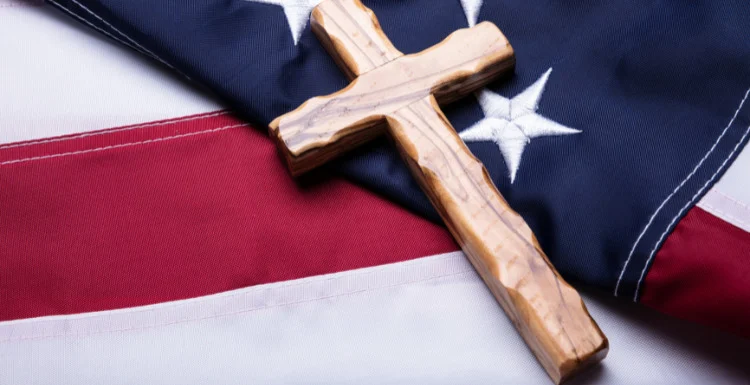
As Americans celebrate the freedoms secured by the nation’s founding, many are also asking whether the First Amendment is being understood the way the Founders intended. Modern debates over religious liberty often invoke the phrase “separation of church and state,” but historians argue that the Founders’ primary concern was protecting the Church from government control—not removing faith from public life.
This content is supported by your donations.
Give today.
From CBN:
These days, the phrase “wall of separation between church and state” has come to mean keeping God or His believers from having a big effect on government and public life. But that’s far, far from what the Founding Fathers were thinking of when they were separating church and state.
…
So what they meant by saying in the First Amendment “Congress shall make no law respecting an establishment of religion” was that the federal government was banned from creating – or “establishing” – a national religion with the national government wedded to it.
…
Not only did the First Amendment say, “Congress shall make no law respecting an establishment of religion,” but it also said, “or prohibiting the free exercise thereof.”
The Founders had firsthand knowledge of the dangers posed by state-controlled religion. Many early American settlers fled Europe to escape governments that dictated religious belief and practice. England’s established church, headed by the monarch, served as a powerful example of what many of America’s founders hoped to avoid. Rather than establishing a national church, they sought to preserve every citizen’s freedom of conscience by preventing the federal government from controlling matters of faith.
Supporters of this historical interpretation also point to Thomas Jefferson’s famous 1802 letter to the Danbury Baptist Association, where he wrote of a “wall of separation between church and state.” According to historians cited in this report, Jefferson viewed that wall as protecting churches from government interference, not preventing religious convictions from influencing public policy or civic life. They also note that the nation’s founding documents repeatedly acknowledge God, from the Declaration of Independence’s references to the Creator and Divine Providence to the Constitution’s closing date, “in the Year of our Lord 1787.”
These historical debates remain highly relevant today as courts continue to hear cases involving religious liberty, parental rights, education, free speech, and the public expression of faith. Regardless of where one falls on specific legal questions, the First Amendment’s guarantee of the free exercise of religion remains one of America’s foundational liberties. For intercessors, protecting that freedom is about more than preserving a constitutional right—it is about ensuring that believers remain free to obey God, proclaim the Gospel, and live out their faith without government coercion. As our nation approaches its 250th anniversary, this conversation offers an opportunity to revisit both our constitutional heritage and the biblical principles that helped shape it.
How can believers help preserve religious liberty in America? Share your prayers and Scriptures in the comments below.
(Excerpt from CBN. Photo Credit: AndreyPopov/Getty Images via Canva Teams)
