


Emerging health technologies like robots and artificial intelligence could improve the lives of countless patients moving forward. Two recent breakthroughs, still in the testing phase, already offer a great deal of hope.
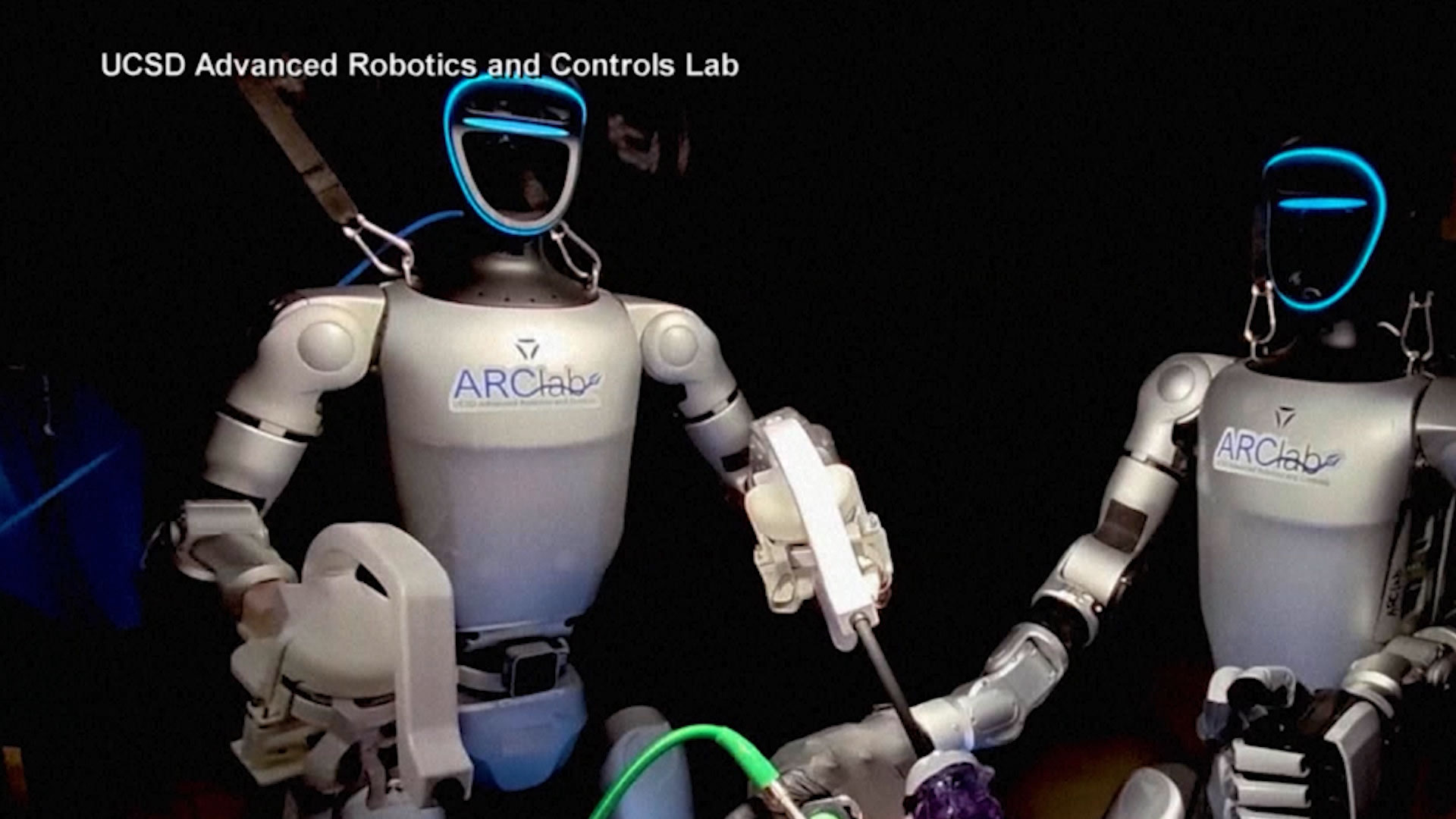
Humanoid robot surgeons successfully completed two gallbladder removal procedures on pigs at the University of California San Diego. Although operated remotely by a human surgeon just feet away, it could potentially be operated from miles away for surgeries in rural areas, battlefields, and even space.
“You can imagine this device being deployed on a ship, in a village somewhere, in a smaller operating environment that’s not in major cities,” said Dr. Shanglei Lue, a surgeon at U.C. San Diego. “It opens up, I think, a lot of doors for access.”
Unlike current robotic surgical systems, which weigh nearly a ton, take up a lot of space, and usually perform only one function, humanoid robots weigh only 60 pounds, are mobile, and perform many different tasks.
U.C. San Diego Professor Michael Yip said, “With this study, I believe we’ve shown that it is possible to use humanoid robots in an operating room to do real procedures that can eventually save lives.”
In addition to performing the duties of a lead surgeon, the humanoid robots could also serve as surgical assistants by handling tools and cleaning up, easing hospital staff shortages.
Another stunning breakthrough, still in the testing phase, uses artificial intelligence to offer new hope to victims of paralysis.
This has been tested with outstanding results on a patient named Keith Thomas, who lost feeling and the ability to move from the chest down after a diving accident years ago. Now he can feed himself, lift his arms, scratch his face, and perhaps best of all, feel the touch of a loved one.
“It’s like, it’s unreal,” he said, “because I haven’t felt that in three years.”
He participated in a successful double neural bypass trial conducted at New York’s Feinstein Institutes for Medical Research. Doctors implanted five microchips in Keith’s brain that use AI to read his intent to move, then send those messages to his muscles. Dr. Chad Bouton further explained how it works.
“There are signals from his motor area responsible for movement going to the computer, and signals from the computer are going back to different stimulation points in his body, brain, and spinal cord,” he said. “And the goal is to restore movement and the sense of touch in a lasting way.”
In addition to patients suffering from paralysis, this procedure could help stroke victims as well.
Both the humanoid robotic surgeon and the AI neural bypass need more study before they become available to the general public.
*** AI tools threaten to hide CBN News from your online searches! Sign up for CBN Newsletters today to ensure you can still find the latest news from a Christian perspective.***
