


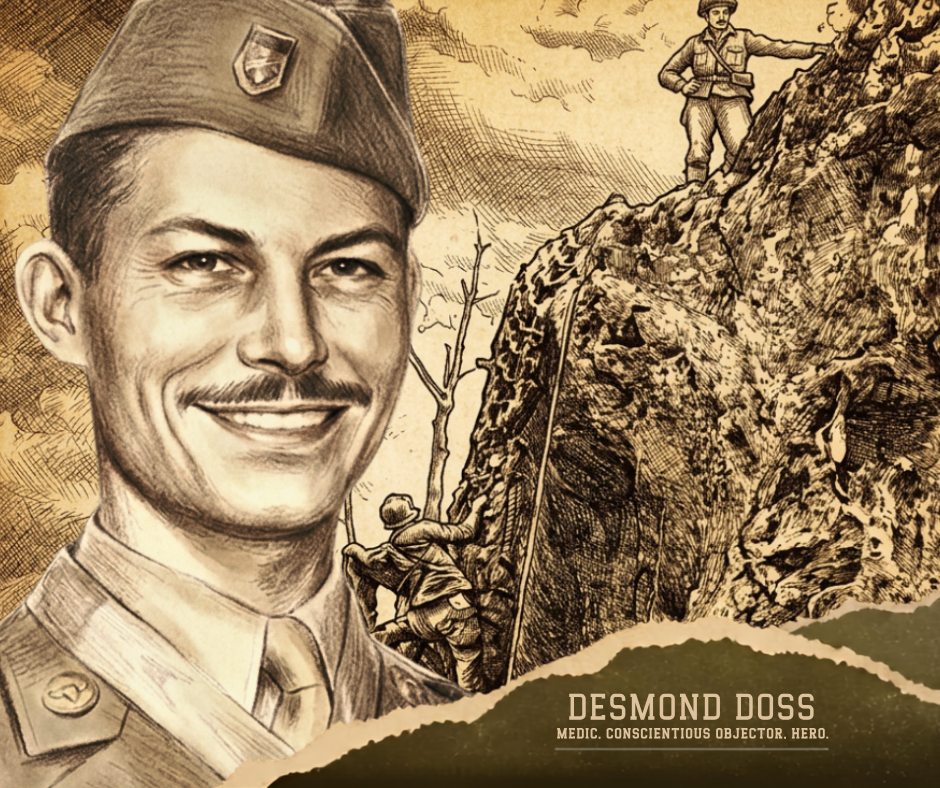
Medic. Conscientious Cooperator. Hero.
In the heavy, brutal machine of total war, a soldier’s worth is measured by his ability to fire his rifle. However, faith in the mission sustains discipline and resolve. The rules of combat, the structure of an infantry squad, and battlefield strategies rest on one idea. To survive and win, you must be willing to destroy the enemy.
Nevertheless, in spring 1945, on a blood-covered rock plateau on Okinawa, a slender, soft-spoken young man overturned this rule. His name was Desmond Thomas Doss. He was a devout Seventh-day Adventist from Lynchburg, Virginia, guided by faith.
Desmond Doss walked directly into one of the worst battles of World War II without a single weapon. He did not carry a rifle, he refused to wear a pistol, and he would not even touch a gun during target practice. He went to war armed only with a small pocket Bible, a canvas bag full of bandages, and an unshakeable promise made directly to God.
buck·ler [ˈbək(ə)lər] noun historical
a small round shield held by a handle or worn on the forearm.
To his commanding officers, this quiet young man looked like a disaster waiting to happen. They thought he was a coward or a mental liability who would fall apart under fire. To the regular soldiers in B Company, 1st Battalion, 307th Infantry Regiment, 77th Infantry Division, he looked like a dangerous burden. They genuinely feared that his refusal to shoot a gun would get them all killed.
But when the 77th Division finally hit the steep, jagged cliffs of the Maeda Escarpment—a terrifying place the men called “Hacksaw Ridge”—everything changed. During a massive enemy attack, the American forces were completely overwhelmed and forced to retreat down the cliff side. Only one man stayed behind on top of the fire-swept plateau. It was the weaponless medic.
Under an apocalyptic storm of artillery, mortars, and machine-gun fire, Doss spent hours rescuing his wounded brothers. He worked entirely alone, pulling injured men out of the dirt and lowering them down a 40-foot drop using a rope. As his hands bled and his muscles tore, he repeated a personal prayer over and over again: “Lord, please help me get just one more.”
This historical account looks deeply at the life, faith, and military service of Corporal Desmond Doss, sourced from official battle logs, modern research, and eyewitness statements from both American and Japanese soldiers. Above all, it shows how an absolute faith in God created one of the greatest displays of pure courage in human history. This truth mirrors the words of the prophet Isaiah:
Fear thou not; for I am with thee: be not dismayed; for I am thy God: I will strengthen thee; yea, I will help thee; yea, I will uphold thee with the right hand of my righteousness.
Biography and Early Upbringing
The Forging of a Conviction
Desmond Thomas Doss was born on February 7, 1919, in the mountain city of Lynchburg, Virginia. His early life was shaped by two major forces: the heavy financial struggles of the Great Depression and the strict, literal Bible teachings of the Seventh-day Adventist Church.
His father, William Doss, was a carpenter who had fought in the trenches of World War I. The terrible things William saw in Europe had broken his spirit, leaving him deeply depressed and prone to heavy drinking. His mother, Martha Doss, was the steady spiritual anchor of the home. She raised Desmond, his sister Audrey, and his brother Harold to love the Bible, keep the Sabbath holy on Saturdays, and follow a strict vegetarian diet.
Two specific events in Desmond’s childhood fixed his belief in non-violence forever. The first was a simple piece of religious artwork hanging on the living room wall. It was an illustrated poster of the Ten Commandments. Next to the words “Thou shalt not kill,” there was a vivid drawing of the world’s first murder. It showed Cain standing over the lifeless, bloody body of his brother Abel.
Young Desmond would look at that picture for hours. He would wonder how a brother could do something so terrible to his own family. To his young mind, the lesson was absolute. God was not making a suggestion; He was giving a permanent command.
The second event was a terrifying family argument that occurred when Desmond was an older boy. His father, during a bout of heavy drinking, got into a violent fight with Martha’s brother. A pistol was pulled out, and a tragedy almost happened. Martha stepped between the men, took the gun away, and quickly handed it to young Desmond, telling him to run and hide it.
As Desmond sprinted down the street to conceal the heavy steel weapon, his heart pounded with terror. He realized that if his mother hadn’t stepped in, his father might have become like Cain. Right then and there, Desmond made a solemn promise to the Lord. He vowed that he would never touch a firearm again for the rest of his life.
As he grew up, Desmond also developed a deep desire to help people who were hurting. Even though his family had very little money, he would regularly walk miles to the local hospital to donate blood whenever he heard on the radio that there was a shortage. He learned early on that saving lives brought immense joy.
When the United States entered World War II after the bombing of Pearl Harbor, Desmond was working as a shipbuilder in Virginia. Because his job was vital to national defense, the government offered him a legal deferment, meaning he did not have to go to war. But Desmond felt a powerful moral duty to help his country fight against tyranny.
He did not want to hide at home while other young men fought and died. However, he refused to compromise his promise to God. He volunteered for the United States Army on April 1, 1942, but he specifically asked to be a non-combatant medic. He chose to call himself a “Conscientious Cooperator” rather than an objector, explaining that he wanted to serve the flag, but build up lives instead of tearing them down. His heart was guided by the words of Christ:
Greater love hath no man than this, that a man lay down his life for his friends.
Military Service and Rupture in Training
The Crucible of Fort Meade
The United States Army of 1942 was a massive machine designed to turn ordinary citizens into disciplined killers. It was not built to handle unique religious beliefs. When Desmond arrived at training camps like Fort Meade, Maryland, the military paperwork failed to register his special status correctly. Instead of being sent directly to medical school, he was placed into a regular, frontline combat unit: Company B, 307th Infantry Regiment.
This mistake caused immediate, intense conflict between Desmond and the rest of the unit. Infantry squads rely entirely on teamwork and firepower. Every single soldier needs to know that the man next to him will shoot to kill when the enemy attacks. Desmond’s absolute refusal to pick up an M1 Garand rifle was instantly seen as a sign of cowardice or a cheap trick to avoid danger.
The daily life of Private Doss in training became a long, lonely nightmare of emotional and physical abuse. His platoon leader, Captain Jack Glover, looked at him as a major threat to military discipline. His fellow soldiers mocked him constantly during marches, calling him a parasite and a holy roller.
The Sabbath Argument: Because of his faith, Desmond refused to do any army work from Friday sunset to Saturday sunset. Even though he volunteered to work all day on Sundays without rest to make up for it, the other men felt he was getting an unfair weekend vacation.
Physical Attacks: When Desmond returned to the dark barracks late at night after praying alone in the woods, men would throw heavy leather boots and metal mess kits at his head while he knelt by his bed.
The Mental Discharge: His officers tried to use military laws to throw him out of the Army as a “Section 8” psychiatric case, claiming he was mentally unfit for duty. Desmond refused to sign the papers, stating he was completely sane and wanted to serve.
The Court-Martial Trap: Command staff ordered him to hold a rifle during inspections, warning him that refusing a direct order meant a severe prison sentence. Desmond stood his ground, stating he would accept prison before he broke God’s law. The threats only stopped when high-level officials confirmed that federal law legally protected his right to be an unarmed medic.
Through all this systemic cruelty, Desmond never yelled back, never raised his fists, and never held a grudge. He simply remembered the words of the Apostle Peter:
For this is thankworthy, if a man for conscience toward God endure grief, suffering wrongfully.
Eyewitness Accounts: The Training Camp Friction
“Doss was a total mystery to us, and honestly, he irritated the hell out of the officers. I went straight to the commander and said he was going to be a complete dead-weight when we hit the beach. I tried everything to get him out of my company. He just looked me in the eye and said, ‘Captain, I’ll be a better medic than any of these men. I’ll save your life if you’re hit.’ I thought he was a complete liar. I had no idea how wrong I was.”
“The men were genuinely brutal to him. They hated him because they thought he was using religion to save his own skin. One night, a big guy leaned over his bunk and yelled, ‘You enjoy your praying now, Doss. Because when we get into combat, I’m gonna personally shoot you in the back.’ Desmond didn’t even flinch. He just stayed on his knees and kept praying for the soul of the man who had just threatened his life.”
Early Campaigns
The Pacific Proving Grounds (Guam and Leyte)
Before his ultimate test at Hacksaw Ridge, Desmond Doss went through intense combat during the heavy jungle battles of Guam and Leyte in late 1944. It was during these terrifying, muddy island campaigns that his absolute bravery completely won over the hearts of the men who had once hated him.
In the thick, dark rain forests of Guam, Japanese snipers were hidden everywhere in the trees, specifically targeting medics. Normal army rules told medics to stay hidden until a fire fight was completely over. But whenever Desmond heard a man scream for help, he would immediately break cover and crawl out into the open, using his own body as a human shield to protect the patient while he bandaged them.
The infantrymen noticed that Desmond did not care about his own safety at all. He also treated wounded Japanese soldiers with the exact same tenderness and care that he gave to American GIs. When his friends asked why he would risk his life to save an enemy who wanted to kill him, Desmond simply replied that God made all souls, and his only job was to heal, not to judge. His actions perfectly matched the words of Jesus in the Gospel of Matthew:
But I say unto you, Love your enemies, bless them that curse you, do good to them that hate you, and pray for them which despitefully use you, and persecute you;
On the rain-soaked island of Leyte, the mud was so deep that trucks and tanks got stuck. During one advance across an open valley, Company B was pinned down by a hidden Japanese machine-gun nest. Two riflemen were hit badly and lay bleeding out in the middle of a wide, muddy field.
Desmond did not hesitate for a second. He dashed out into the open mud, sliding down to reach the fallen soldiers. He applied pressure bandages while bullets zipped through his uniform jacket, pulled the first soldier back to safety, and immediately ran right back out to get the second man. By the time the Leyte campaign was finished, the men who had once threatened to kill Desmond were begging to be near him, believing that God sent angels to guard him. They saw the truth in the Psalms:
The angel of the LORD encampeth round about them that fear him, and delivereth them.
The Battle for Maeda Escarpment (Hacksaw Ridge)
By late April 1945, the American invasion of Okinawa had slammed into a massive wall of defense. The leader of the Japanese forces, Lieutenant General Mitsuru Ushijima, had built a giant underground fortress across the southern end of the island. He used the natural limestone hills to create a network of tunnels, hidden bunkers, and heavy gun positions.
The most dangerous point of this defensive line was the Maeda Escarpment. To the tired soldiers of the 77th Division, it was known simply as “Hacksaw Ridge.” It was a massive, jagged limestone cliff that rose 400 feet into the air. The top of the cliff was a flat, rocky plateau that looked completely empty but was actually a deadly trap.
The Japanese military used a clever strategy called a reverse-slope defense. They did not stand at the edge of the cliff where American navy ships could shoot them. Instead, they hid deep inside the mountain in caves that could withstand the heaviest bombs.
When American soldiers climbed up the massive cargo nets to the top of the ridge, they saw nothing but broken rocks. But as soon as the companies moved a few hundred yards inland, Japanese soldiers would pour out of hidden holes in the ground behind them, cutting them off from the cliff edge and opening fire from all sides. Desmond Doss knew the danger was absolute, but his spirit stayed strong, resting on the promises of God:
4He shall cover thee with his feathers, and under his wings shalt thou trust: his truth shall be thy shield and buckler.
5Thou shalt not be afraid for the terror by night; nor for the arrow that flieth by day;
Data and Engagement Statistical Breakdown
To truly understand what happened at Hacksaw Ridge, we must look at the actual numbers. The losses taken by the 77th Division were incredibly high, making the survival of an unarmed man even more unbelievable.
Statistical Graph: Casualty vs. Survival Vectors
A Chronicle of Heroism
The Twelve Hours of the Maeda Escarpment
On the morning of May 5, 1945, Company B made a desperate push to take the top of the ridge. The men climbed up the giant rope nets and advanced across the flat, rocky plateau. Everything was completely quiet for a few moments.
Suddenly, at around two o’clock in the afternoon, the entire mountain seemed to explode. The Japanese forces launched a massive ambush, firing hundreds of mortars and artillery shells directly into the American ranks. Hundreds of enemy soldiers rushed out of the caves with bayonets. The American line collapsed immediately, and the order was given to retreat back down the cliff side.
Out of the 155 men who had climbed up that morning, only 55 made it back down the cargo nets. The other 100 men were left stranded on top—severely wounded, unable to walk, and completely cut off from medical help.
As the last healthy soldiers scrambled down the ropes, they looked up and saw that Private Desmond Doss had stayed behind. He refused to leave his friends. He walked right back out into the thick black smoke, completely unprotected, to find the men who were crying out in pain.
For the next twelve hours, Doss worked entirely by himself in a place that had become a literal field of death. Crawling on his stomach through pools of blood, he moved from one shell crater to the next, checking for signs of life.
Every time he found a living soldier, he would bandage their wounds, wrap them in a special double-bowline knot he had learned as a boy, and drag them to the edge of the cliff. He would then slowly lower the man down the 40-foot rock face, using his own arms to hold the weight until the medics at the bottom could catch them.
As the hours dragged on, the rough rope tore the skin off Desmond’s palms, leaving his hands raw and covered in blood. His muscles were completely exhausted, and Japanese patrols were actively searching the field to kill any survivors. Yet, every single time he finished lowering a man, he looked back out at the smoke and prayed his specific warfare petition: “Lord, please help me get just one more.” He lived out the words of the Apostle Paul:
And let us not be weary in well doing: for in due season we shall reap, if we faint not.
One of the men he saved that afternoon was Captain Jack Glover—the very officer who had tried so hard to throw him out of the military during training. Glover was lying paralyzed by shrapnel, completely helpless. Desmond crawled through a wall of machine-gun fire, bandaged his captain, and dragged him to the cliff edge, proving that his love for his comrades had no boundaries.
Official division records later detailed the unbelievable scenes witnessed by the men waiting below. According to an excerpt extracted from the 77th Infantry Division After-Action Combat Logs (May 1945):
“During the afternoon of 5 May, the battalion witnessed a spectacular exhibition of courage. Under an intense concentrated mortar barrage, Private First Class Desmond T. Doss refused to seek safety. Standing completely silhouetted at the precipice, he manually lowered wounded infantrymen one by one down the sheer face. His actions single-handedly prevented the annihilation of the remaining elements of the company.”
The Divine Shield
The Japanese Sniper Barrage
The historical reality of Desmond Doss’s survival borders on the miraculous. During the entire twelve-hour rescue mission, Doss was completely unarmed and frequently forced to stand fully upright at the very edge of the ridge while tying his rope harnesses. This made him an easy target for enemy marksmen.
Years after the battle, a Christian missionary working in Japan uncovered a staggering piece of first-hand evidence. He met an Imperial Japanese Army veteran who had been stationed at the Maeda Escarpment during the ambush on May 5.
This enemy soldier explicitly recalled having an American medic in his sniper rifle scopes multiple times. The medic had no gun and was completely open to a fatal shot. Yet, every single time the sniper squeezed the trigger to kill Doss, the firing pin failed and the rifle jammed.
Remarkably, the Japanese soldier noted that when he turned his weapon away to target other moving soldiers, the rifle fired perfectly. The moment he re-aligned his sights onto Desmond Doss, the weapon locked up unexplainably. This extraordinary testimony matches the scriptural promise of divine protection:
No weapon that is formed against thee shall prosper; and every tongue that shall rise against thee in judgment thou shalt condemn. This is the heritage of the servants of the LORD, and their righteousness is of me, saith the LORD.
The Medic’s Supply Kit and Reconstructed Uniform
To understand how Desmond Doss kept 75 men alive while they were bleeding out on the rocks, we must look at the exact medical gear and combat uniform he carried into the fight. He did not have a modern hospital; he carried everything on his hips in two heavy canvas bags known as the M1910 Medical Corps Combat Kits.
Every item in Desmond’s kit was designed to do one thing: keep a soldier alive for just a few more hours until he could reach a real doctor. He had to use these simple tools with perfect speed while artillery shells were exploding all around him.
The Battle Against Bleeding: He used heavy canvas tourniquets to stop soldiers from bleeding to death from lost limbs. If a man had a deep chest wound, Desmond would stuff it with Carlisle gauze dressings to seal out the air and stop the lungs from collapsing.
The War Against Infection: In the hot, damp air of Okinawa, wounds became infected within hours. Desmond carried dozens of packets of Sulfa powder. He would rip the paper open with his teeth and pour the white chemical dust directly into open flesh wounds to stop bacteria.
The Relief of Pain: To keep soldiers from dying of physical shock brought on by extreme pain, he carried small metal tubes of morphine. He would inject the medicine directly into the soldier’s arm, whisper a prayer into their ear to keep them calm, and then begin the long, agonizing crawl back to the rope station.
He trusted completely in the ultimate Healer, remembering the words of the Psalm:
He healeth the broken in heart, and bindeth up their wounds.
Experiences from Both Sides – Eyewitness Recollections
The fact that an unarmed man survived twelve full hours of constant combat on top of Hacksaw Ridge is a matter of historical record. The accounts written down by both American and Japanese soldiers after the war show that something extraordinary happened on that mountain.
American Testimonies
“I was trapped in a shell hole with my leg completely shattered. The Japanese were coming out of their holes, and I could hear them bayoneting guys who couldn’t move. I knew I was dead. Then Doss crawls right into the hole with me. He didn’t have a weapon, and he didn’t even have a helmet. He just gave me this incredibly calm look, wrapped up my leg, and whispered, ‘Hold on, Al. The Lord isn’t done with us yet.’ He dragged me across eighty yards of solid rock while bullets were hitting the ground an inch from his face. It made absolutely no sense.”
“I was at the bottom of the cliff helping unhook the wounded guys he was lowering down. They just kept coming, one after another, all through the day and straight into the dark. We looked up and could see his shape against the sky, standing right at the absolute edge of the drop. He was a perfect target for any sniper on that hill, but not a single bullet touched him. God was shielding that boy. There is no other way to explain it.”
Japanese Testimonies
I was dug in near a rock pile with a clear view of the cliff edge. During our attack, I saw an American soldier who had no gun. He was constantly carrying wounded men on his back. I aimed my Arisaka rifle right at his chest. I pulled the trigger twice, but both times the rifle jammed—a mechanical failure that had never happened to me before. My friend tried to shoot him with a machine gun, but a sudden American mortar burst went off right in front of us, throwing off his aim. We started talking about this man as a holy ghost, because no regular human could stand in that spot and survive.”
Final Wounds and the Search for the Holy Bible
Desmond Doss continued to serve on the front lines for two more weeks as the 77th Division pushed deeper into Okinawa. But the cold laws of probability eventually caught up with the brave medic. On the night of May 21, 1945, his unit was hit by a massive night-time ambush near the city of Shuri.
While Desmond was treating a wounded soldier in the dark, a Japanese hand grenade bounced into their dirt hole. Instead of jumping out to save himself, Desmond placed his boot directly over the grenade to shield his patient. The explosion went off, tearing seventeen pieces of hot metal shrapnel into his legs and hips.
Refusing to call another medic out into the dangerous crossfire, Desmond waited five hours in the mud, praying silently. When stretcher-bearers finally arrived to carry him away, they were attacked by a Japanese sniper. Desmond saw another soldier lying on the ground who was in even worse shape. He rolled off the stretcher, told the bearers to take the other man, and began crawling back to the hospital tents alone.
As he was dragging his bloody body through the dirt, a sniper bullet struck his right arm, completely fracturing the bone. In a final show of incredible willpower, Desmond crawled over to a discarded rifle on the ground and used the wooden stock as a splint to tie up his broken arm. He then crawled an additional 300 yards through the deep mud until he finally reached safety.
It was only when he was safely aboard a hospital ship that a profound panic hit him. He reached into his chest shirt pocket and realized that his small King James Bible—the gift from his wife Dorothy—was missing. It had fallen out somewhere in the blood and mud on top of the escarpment. Doss sent word back to his unit, stating he felt completely lost without his source of spiritual power.
What happened next deeply demonstrates the absolute love his unit now held for him. Upon hearing that their beloved medic had lost his Bible, the entire combat company halted their advance. An entire infantry company turned around, returned directly into the active fire zone of the Maeda Escarpment, and formed a horizontal line. They combed through the rocks on their hands and knees under fire until a soldier successfully located the blood-stained Bible and mailed it safely back home to Doss. They fulfilled the ancient proverb:
A friend loveth at all times, and a brother is born for adversity.
The Post-War Years and Continuing in a Life of Ministry
When Desmond Doss came home from the Pacific, his body was completely broken. In 1946, he was diagnosed with a severe case of tuberculosis that he had caught while living in the wet trenches of Leyte. The illness was so bad that doctors had to surgically remove five of his ribs and one of his lungs.
He spent five and a half long years in military hospitals recovering from his wounds. Because of an overdose of antibiotics used to save his life from the infection, he eventually became completely deaf in 1976. Despite these heavy physical trials, he never complained, believing that God had spared his life for a special purpose.
Desmond spent his post-war years focused entirely on helping young people. He became a major leader in the Pathfinders, a global youth organization run by his church. He built a small cabin in Rising Fawn, Georgia, and opened up his land to host youth retreats, survival camps, and outdoor skills workshops.
He loved to sit around the campfire with young boys and girls, teaching them how to read the stars, pitch canvas tents, and find clean mountain water. He would bring out the heavy hemp ropes he used during the war and show the kids how to tie knots, always emphasizing that a simple skill, combined with a prayer to God, could change history.
He remained completely humble until his death on March 23, 2006, at the age of 87. He never wanted to be treated like a celebrity or a Hollywood star. When public crowds cheered for him, he would simply point to heaven, stating that all the glory belonged to the Lord. His post-war life matched the lesson found in the Book of Proverbs:
Train up a child in the way he should go: and when he is old, he will not depart from it.
The Congressional Medal of Honor
On October 12, 1945, Private First Class Desmond Thomas Doss stood on the green lawn of the White House. He was incredibly thin, still recovering from his extensive combat injuries. President Harry S. Truman stepped forward, holding the nation’s highest decoration for valor.
Rank: Private First Class (Highest Rank: Corporal)
Conflict/Era: World War II
Unit/Command: 307th Infantry, Medical Detachment, 77th Infantry Division
Military Service Branch: U.S. Army
Medal of Honor Action Date: April 29 – May 21, 1945
Medal of Honor Action Place: Urasoe-Mura, Okinawa, Ryukyu Islands
Desmond Doss was the first conscientious objector in United States history to receive the Medal of Honor. Below is the exact, unedited language of his official citation, preserved in War Department General Orders No. 97 (October 12, 1945):
He was a company aidman when the 1st Battalion assaulted a jagged escarpment 400 feet high. As our troops gained the summit, a heavy concentration of artillery, mortar, and machine-gun fire crashed into them, inflicting approximately 75 casualties and driving the others back. Pfc. Doss refused to seek cover and remained in the fire-swept area with the many stricken, carrying them one by one to the edge of the escarpment and there lowering them on a rope-supported litter down the face of a cliff to friendly hands. On 2 May, he exposed himself to heavy rifle and mortar fire in rescuing a wounded man 200 yards forward of the lines on the same escarpment; and two days later he treated four men who had been cut down while assaulting a strongly defended cave, advancing through a shower of grenades to within eight yards of enemy forces in a cave’s mouth, where he dressed his comrades’ wounds before making four separate trips under fire to evacuate them to safety. On 5 May, he unhesitatingly braved enemy shelling and small-arms fire to assist an artillery officer. He applied bandages, moved his patient to a spot that offered protection from small-arms fire, and, while artillery and mortar shells fell close by, painstakingly administered plasma. Later that day, when an American was severely wounded by fire from a cave, Pfc. Doss crawled to him where he had fallen 25 feet from the enemy position, rendered aid, and carried him 100 yards to safety while continually exposed to enemy fire. On 21 May, in a night attack on high ground near Shuri, he remained in exposed territory while the rest of his company took cover, fearlessly risking the chance that he would be mistaken for an infiltrating Japanese and giving aid to the injured until he was himself seriously wounded in the legs by the explosion of a grenade. Rather than call another aidman from cover, he cared for his own injuries and waited five hours before litter bearers reached him and started carrying him to cover. The trio was caught in an enemy tank attack and Pfc. Doss, seeing a more critically wounded man nearby, crawled off the litter and directed the bearers to give their first attention to the other man. Awaiting the litter bearers’ return, he was again struck, this time suffering a compound fracture of one arm. With magnificent fortitude he bound a rifle stock to his shattered arm as a splint and then crawled 300 yards over rough terrain to the aid station. Through his outstanding bravery and unflinching determination in the face of desperately dangerous conditions Pfc. Doss saved the lives of many soldiers. His name became a symbol throughout the 77th Infantry Division for outstanding gallantry far above and beyond the call of duty.
Comprehensive Bibliography and Reference Archive
Primary Archival Sources
- United States War Department. Official Combat Reports: 77th Infantry Division, Okinawa Campaign, Period 29 April to 31 May 1945. National Archives and Records Administration (NARA), Record Group 407.
- 307th Infantry Regiment. Company B Master Roll Sheets and Daily Field Logs, April–May 1945. U.S. Army Heritage and Education Center (USAHEC), Carlisle, PA.
- Office of the Adjutant General. Official Recommendation File for the Medal of Honor: Doss, Desmond T. (PFC), Medical Detachment, 307th Infantry. Washington, D.C.: Government Printing Office, 1945.
Contemporary Periodical Literature
- The Lynchburg News. “Local Lynchburg Soldier Given Medal of Honor for Unbelievable Bravery on Okinawa Cliff.” October 14, 1945.
- YANK, The Army Weekly. “The Medic with No Gun: The Story of Private Desmond Doss.” Vol. 4, No. 12, September 1945.
- The Stars and Stripes (Pacific Edition). “77th Division Medic Lowers 75 Wounded Soldiers Down Sheer Okinawa Rock Face Under Total Fire.” June 2, 1945.
Oral Histories and Personal Collections
- Doss, Desmond T. Personal Oral History Interview Archive. Veterans History Project, Library of Congress, Item AFC2001/001/32978, recorded July 14, 1987.
- Glover, Jack (Captain). Recorded Audio Statements regarding Company B’s Actions at Maeda Escarpment.Combined Arms Research Library (CARL), Fort Leavenworth, KS, archived 1972.
- Minami, Toshiro. Translated Letters and Statements from the Battle of Okinawa. Imperial Japanese 32nd Army Survivors Association Records, Tokyo, Japan, archived 1968.
Secondary Historical Monographs & External Resources
- Appleman, Roy E., et al. Okinawa: The Last Battle. United States Army in World War II Series. Washington, D.C.: Center of Military History, 1948.
- Benedict, Terry. The Conscientious Objector. Complete Documentary Film Interview Files, Los Angeles: Rich Crest Films, 2004.
- Booton, Herndon P. The Statue of Liberty Division: A Complete History of the 77th Infantry Division in World War II. Atlanta: Albert Love Enterprises, 1947.
