


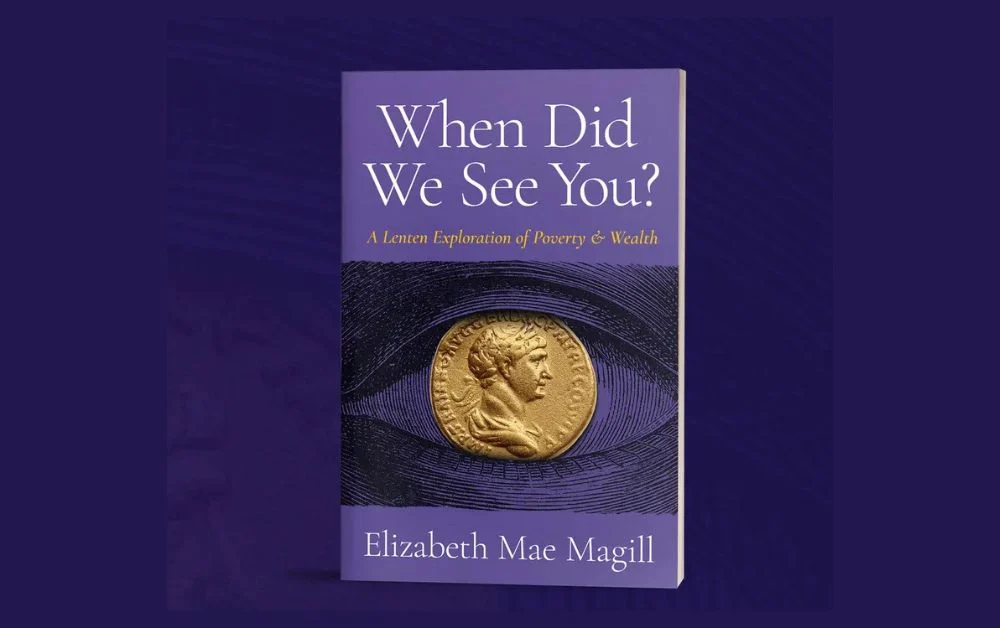
Excerpt from When Did We See You? A Lenten Exploration of Poverty & Wealth
Many people don’t feel wealthy even if they have a comfortable income because of a modern source of anxiety that doesn’t come up in the Bible: retirement. Today, the average person lives years, if not decades, beyond the end of their working years leading to fears that Social Security and whatever savings they have will either be insufficient or disappear entirely. Beyond day-to-day expenses rising healthcare costs threaten bankruptcy. Also, we don’t just want to survive through these last years, we want to do something! We want to travel, pursue hobbies, or simply spoil our grandchildren. We desperately want to save enough. We want to be safe.
This brings us to the parable of the barn-builder. When a rich man’s land produces unexpected abundance, he faces a dilemma about what to do with this excess. His solution is to build more storage space, securing his comfort for the days ahead:
Then [Jesus] told them a parable:
“The land of a rich man produced abundantly. And he thought to himself, ‘What should I do, for I have no place to store my crops?’ Then he said, ‘I will do this: I will pull down my barns and build larger ones, and there I will store all my grain and my goods.
And I will say to my soul, Soul, you have ample goods laid up for many years; relax, eat, drink, be merry.’ But God said to him, ‘You fool! This very night your life is being demanded of you. And the things you have prepared, whose will they be?’ So it is with those who store up treasures for themselves but are not rich toward God.”—Luke 12:16-21
Instead of the comfortable, relaxing life he envisioned, the barn-builder completes the project and immediately dies. As the saying goes, “You can’t take it with you.” Jesus explains that this is what happens when you hoard treasures for yourself rather than “being rich toward God.”
In the first-century, the wealthy comprised a tiny percentage of the population, yet had power in both the economy and the government. In contrast to the barn-builder, wealthy landowners and business owners were culturally obligated to hire a large number of laborers every day, to leave some extra crops in their fields to be harvested and taken home by the poorest in the community, and to support priests and rulers. In the Roman Empire of Jesus’ time, accumulating wealth for the sake of wealth, storing wealth, was viewed as theft. (11)
Of course, storage barns are essential to agricultural life. Even subsistence farmers must preserve their harvest, keeping enough to eat through the year and seeds for next season’s planting. This parable isn’t about normal saving but about hoarding excess.
When I read this, I think about the inheritance my husband and I received when his dad died. We immediately opened new accounts to store this unexpected bounty. We already have Social Security and a pension; now we have this additional cushion. We save it not in order to eat, drink, and be merry, but to quiet our fears about the future.
Yet the barn-builder died right after finishing his storage. What if he hadn’t died? How could anyone retire without storing some of their excess in bigger barns? Should we literally be like the lilies of the field and stop worrying about retirement? I’ll be honest: that’s a hard one for me; I worry constantly about retirement. Is saving for retirement the right thing, or are we the barn-builders?
The Bible offers another barn-building story in Genesis 41:28-36. Joseph interprets Pharaoh’s dream, predicting seven good years followed by seven years of famine. He follows this up by saving the Egyptian people and building huge storehouses to save the excess produced during the good years. In this story, saving for the future is clearly the right thing to do.
But in Joseph’s story the barns serve a fundamentally different purpose. They aren’t built for individual comfort—no eating, drinking, and being merry. Instead, the bigger barns represent how the kingdom cares for the entire community—collecting surplus during the good years to sustain everyone through the lean ones.
Jesus closes this parable by commanding us to “be rich toward God.” Perhaps we do this by caring for God’s people—the poor, the oppressed, the stranger, the widow, and the orphan. Instead of clinging to excess to protect us, we hold onto God.
(11) Bruce J. Marina and Richard L. Rohrbaugh, Social Science Commentary on the Synoptic Gospels (Minneapolis: Fortress Press, 1992), 48.
This is an excerpt from When Did We See You? A Lenten Exploration of Poverty & Wealth (Upper Room Books, January 2026). Elizabeth Mae Magill is Coordinator for Community Life at Episcopal Divinity School. Find her newsletter and her Lenten Mediations at elizabethmaemagill.com. https://upperroombooks.com/book/when-did-we-see-you/
Upper Room Books grants permission to Elizabeth Magill and Red Letter Christians for the use of pages 46-48 of When Did We See You? A Lenten Exploration of Poverty & Wealth for online publication.
RLC welcomes and encourages individuals who engage in critical thinking at the intersection of faith and justice to contribute to our blog. The views and opinions expressed by our blog authors are their own and do not necessarily reflect or represent the views and opinions of RLC, its staff, members, or officers.
