
The way children learn in American public schools has changed a lot over the last 250 years. Methods practiced in today’s classrooms are a far cry from those taught to our founders. However, that could be shifting as classical education makes a comeback.
Jim and Jensina Printz always wanted to homeschool their six kids, and when they found out about classical education, the Printz’s instantly knew it was the direction to take.
“Their ability to communicate, their confidence, their debate skills at such a young age, and just able to communicate with kids at their own age, kids, older, adults,” Jim Printz tells CBN News, is what sold him on the method. It’s what he wanted for his children.
“When they said that our founders learned this way. The reason they could speak five languages, they wrote the Declaration and the Constitution, they were able to do this because they learned Latin, they learned logic, they learned debate from an early age,” Jensina Printz added. Hearing that was exciting.
The Printz family uses a popular God-centered homeschool curriculum called Classical Conversations.
It was created 30 years ago by a mom, Leigh Bortins, in North Carolina, for her children and some neighbors. Today, the program has students in all 50 states and 60 countries.
“It’s really trying to form a human that’s going to love truth, beauty, and goodness,” Robert Bortins tells CBN News. He’s a product of Classical Conversations and now runs the program that his mother started.
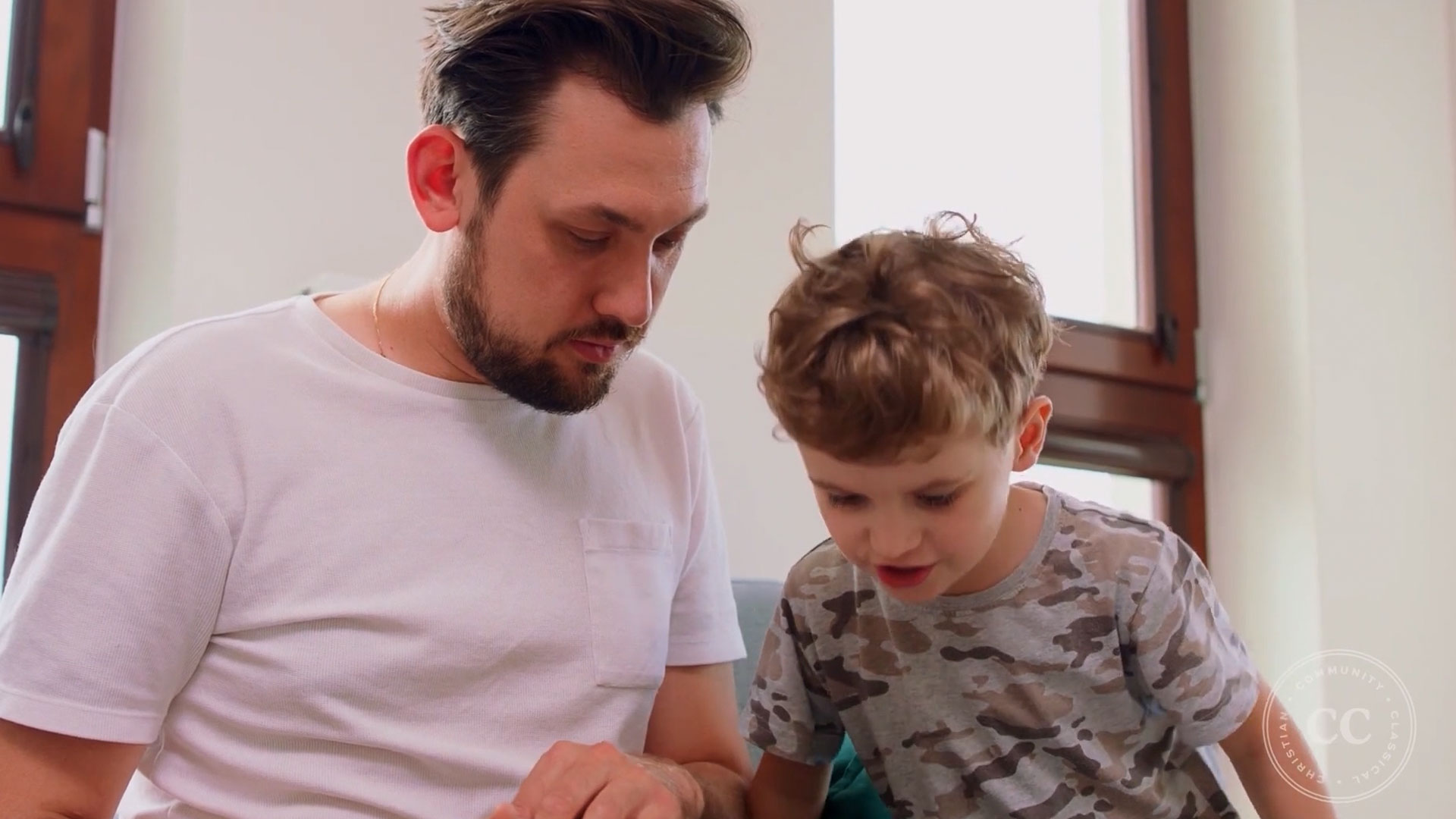
Classical Conversations brings students together for class with their community once a week to introduce new material. Students then head home to master it with parents as their teachers.
Classical education is generally a time-tested method of teaching that trains children how to learn. Its roots are in ancient Greece and Rome. The goal is to develop a student’s mind, character, and civic responsibility.
It focuses on the trivium or three roads of grammar, logic, and rhetoric. Along with the quadrivium or four roads of math, geometry, music, and astronomy.
“We get taught basically the same things, but we also get taught like logic and debate and cartography and stuff. And it’s not teaching us what to learn but it’s teaching us how to learn,” says James Printz who is in 9th grade.
“It is memorizing a lot of things but it gives you a very broad overview of the entire world,” Rachel Printz told us. She’s in 10th grade.
“They learn to draw the world from memory. All the countries, capitals. Pretty neat,” Janna Bowers adds. Her children are also enrolled in Classical Conversations and she serves as a director in the program. She manages the tutors who present material to the students once a week when they meet as a community. Students then head home to master it. Their parents are their teachers.
The youngest Printz kids showed us how they’re learning a timeline of the world, from Creation to today, through song.
“They all have songs and jingles for every subject, and for history, there’s this one, it’s, ‘In 1945, after the League of Nations…'” 5th grader Joel Printz explained to us as he started to sing.
His younger siblings, Paula, grade 3, and George, grade 2, both joined in the song singing, “…failed to prevent World War II, American President Roosevelt, British Prime Minister Churchill, and Soviet Premier Stalin, began the United Nations.”
“As we all know, something set to music, it stays in our head, so music is one of the ways to get information locked into our long-term memory,” explains Carla Yoder, who is also a Classical Conversations mother and director.
American classical education started to decline in the late 1800s as priorities shifted to training young people for jobs. Now it’s seeing a resurgence that accelerated during COVID as parents looked for alternatives to public schools.
Among U.S. Christian evangelical schools, more than a quarter, 26%, now use a classical curriculum and that doesn’t include home school programs. Parents particularly like the focus on logic and debate.
“I just wanted my kids to be able to speak well and be able to hold conversations and argue well because that’s very big in today’s society,” Kristin Beery told us. She’s a mother of Classical Conversations students and a director.
Classical Conversations uses Socratic circles, or student-centered structured discussions, which helps students learn to form arguments and defend them. Parents see it as an example of iron sharpening iron from Proverbs 27:17.
“We were created to sharpen each other in an honoring way, but we’ve lost the tools, and so classical gives you the lost tools of learning to come back to how God created us to be,” says Jensina Printz.
“That’s really our goal for our students is that they get to that point where they can speak winsomely and persuasively to others about things that are true, and good, and beautiful,” adds Jenna Bowers.
In Classical Conversations and all classical curricula, students also read a lot, actual books, cover to cover.
“We read a lot of C.S. Lewis books,” Franklin Printz, an 8th grader, tells us.
“I just finished ‘The Hobbit’ and I’m about to read ‘Screwtape Letters’,” Rachel Printz says.
“We read like ‘Call of the Wild’ this year,” James Printz remembers.
Reading, Franklin says, helps with paying attention. “If you read it out loud, you’re reading it, hearing it, and then you have to go back and study it, so you’re getting it like three times.”
And in Christian classical education, God is at the center of everything they learn.
“The way we learn everything is brought back to the bible because He’s woven into everything,” Franklin adds.
There’s also a national standardized college admissions test called the CLT. It’s based on classical education, but any student can take it, and it’s accepted alongside the SAT and ACT at more than 300 colleges and universities.
Although classical education has been around for, well, as long as there’s been organized education, there are some misconceptions.
“Well, the biggest one is that it’s for the elite. It’s for everyone,” Robert Bortins says. “Our farmers at the founding, you know, they read Homer. They would read the Iliad, they would read Shakespeare. They would have deep conversations at the pub about these sorts of books. So, you know, throughout human history classical education has been for everyone, and I think we’re returning back to those roots.”
