


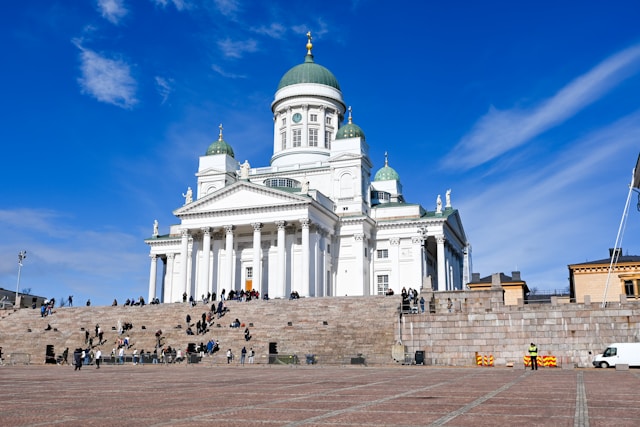
(Photo: Unsplash)
A new peer-reviewed study suggests that, in one of Europe’s most secular countries, a growing number of young men are finding Christianity compelling because it offers what the researchers describe as a fuller framework for identity, meaning, stability and belonging.
Published in the Journal for the Scientific Study of Religion, the article by theology scholars Kati Tervo-Niemelä and Pietari Hannikainen examines why young men in Finland are apparently showing more interest in the Christian faith.
Based on interviews with 30 young men, the research points to “a possible reversal” of long-established gender patterns in religiosity, with young men becoming more engaged with Christianity.
The authors argue this challenges two widely held assumptions: that religion is in steady decline among younger generations, and that women have historically been more religious than men.
Recent findings, they note, suggest young Finnish men may now show stronger religious commitment on some measures than both young women and young men of previous years.
Similar trends have also been observed in other Finnish research.
In February 2025, the University of Eastern Finland said its data showed boys’ commitment to the Christian faith had strengthened in recent years, with belief in God becoming “clearly more common among boys than girls.”
But the new study moves beyond statistics to ask what is actually drawing these young men in. The answer is complex and the researchers say the attraction is driven by “multiple, overlapping reasons.”
They explained: “Saying that it is only about conservatism is by far simplifying the phenomenon. In sum, the attraction of Christianity for young men appears multifaceted: It offers community and safety, stability through tradition, and hope in times of personal and global crises while also providing a countercultural identity and a responsible model of manhood.
“Rituals and theological depth give the faith both intellectual seriousness and embodied presence, making it more than an abstract worldview.”
Rather than presenting Christianity mainly as a political or ideological statement, the study describes it as a stabilising force in a fragmented culture.
The authors say many of the men they interviewed saw the faith as offering “structure, responsibility, and stable role models” as opposed to what they viewed as “relativism and individualism” in wider society.
The paper’s analytical discussion frames this development on three levels.
On the personal level, faith often emerged in response to crisis, self-questioning and the search for a healthier sense of identity especially regarding debates around masculinity and gender roles.
On the communal level, churches, theology and confirmation culture offered not only support and fellowship but also a strong sense of belonging.
On the wider social level, Christianity was often seen as a moral anchor and countercultural response to rapid change, instability and what participants perceived as a broader crisis of meaning.
The authors argue that this is not a repeat of older patterns of religious revival but reflects distinctly contemporary influences.
These include growing insecurity in an unstable world, confusion around masculinity in a polarised society, the growing influence of social media, and a desire among some young men to connect with Finnish and European identity through Christianity.
The paper also highlights the importance of digital influence.
Online religious content and social media did not merely reinforce existing beliefs, the researchers found, but often helped initiate interest in Christianity in the first place.
In that sense, faith is being encountered not only through churches and family life, but through podcasts, video platforms, influencers and public expressions of belief online.
At the heart of the study is the argument that Christianity is being embraced by some young men not simply as a set of doctrines, but as what the authors call “a holistic framework for identity, meaning, and growth” in an uncertain age.
Even so, they caution that their findings are based on a qualitative sample of 30 Finnish young men and are not intended to be statistically generalisable.
The study’s publication comes at a notable moment in Finland’s public life. Just days before the study’s publication, Finland’s Supreme Court convicted former Interior Minister Päivi Räsänen and Lutheran Bishop Juhana Pohjola of agitation against a population group over material made available online from a church pamphlet first published in 2004. The court also ordered unlawful passages in the internet publication to be deleted.
At the same time, the court unanimously acquitted Räsänen on a separate charge related to a 2019 Bible verse post.
According to the Supreme Court, the conviction concerned material kept publicly available between November 2019 and January 2022.
The court imposed fines of several thousand euros on the defendants, including the Luther Foundation Finland which had published the pamphlet with Räsänen and Pohjola.
Räsänen said she was “shocked and profoundly disappointed” by the decision and that she was considering appealing to the European Court of Human Rights.
