
Reading Time: 4 minutes
Trump’s Early Warnings to the UN
President Donald Trump, drawing on his experience as a businessman, approached the United Nations as he would any large corporation in crisis. From the beginning of his presidency, he openly criticized the UN’s inefficiency, lack of accountability, and failure to fulfill its founding mission.
Join others crying out to the Lord day and night.
His first major confrontation with the UN came in 2017, when he addressed the General Assembly and declared that the organization was failing. He argued that the UN “failed to enforce its own resolutions, failed to confront dictatorships, and failed to act in a global crisis.” He accused member states of endless talk with little action, questioning the UN’s credibility and long‑term viability.
The 2025 Foreign Aid Review and UN Vulnerability
Trump’s second major reckoning with the UN came on January 20, 2025, the first day of his second term. He signed Executive Order 14169, initiating a 90‑day pause on all foreign development assistance to evaluate whether U.S. aid aligned with American interests. The review uncovered “widespread corruption, fraud, misuse of funds, and wasteful spending on programs with little or no impact.”
The findings triggered massive layoffs and program cuts across the UN system. For decades, the U.S. had contributed roughly one‑third of the UN’s operating budget, plus millions for peacekeeping. When that support was halted, the UN was forced to confront its financial fragility. Although no official layoff total has been confirmed, UN leaders estimate that restructuring could affect up to one‑fifth of its workforce.
U.S. Withdrawal from UN Specialized Agencies
Trump also targeted the UN’s specialized agencies – the most powerful policy‑making bodies within the UN system. These agencies operate independently, and even the Secretary‑General cannot change their policies or submit recommendations.
Trump withdrew the U.S. from five major agencies and bodies, including:
- UN Educational, Scientific and Cultural Organization (UNESCO)
- UN Human Rights Council (UNHRC)
- UN Relief and Works Agency (UNRWA)
- UN Global Compact for Migration
- UN World Tourism Organization (UNWTO)
UNESCO, the most influential specialized agency, wields considerable power as the UN’s chief educational arm. UNESCO raises its influence by partnering with other agencies to promote sexual education programs from birth through adulthood, as well as extensive climate change curricula for children. President Reagan withdrew the UN from UNESCO during his term in office, as did President Trump. President Trump’s withdrawals from multiple specialized agencies represented the largest U.S. pullback from UN institutions in American history.
Trump’s UN80 Address: A Call for Reform
September 23, 2025, during the UN’s 80th anniversary celebration, President Trump delivered one of the most forceful speeches of his presidency. Speaking before the member states- representatives of 193 nations, he declared that the UN had become “slow, politicized, and ineffective” in confronting global crises.
He accused the UN of allowing authoritarian regimes to shape policy, failing to enforce its own resolutions, and drifting far from its founding mission to prevent war. He challenged the UN to “choose reform or irrelevance.”
The UN’s Struggle to Return to Its Original Mandate
UN Deputy Secretary‑General Guy Ryder urged the organization to return to the mission outlined in the UN Charter’s Preamble: to save future generations from war and uphold human dignity. The UN’s return to preventing wars has been discussed with little interest in making the cessation of wars its focus.
The UN80 reform effort, launched by Secretary‑General António Guterres in 2024, aimed to root out corruption, reduce spending, and restore the UN’s peacekeeping mission. But the program failed because member states refused to accept the required financial discipline. Funding continued to flow into ineffective programs, making meaningful reform impossible.
The Strait of Hormuz: A Test of UN Relevance
Less than a year after Trump’s UN80 speech, Iran closed the Strait of Hormuz, threatening global shipping and energy markets. Iran’s actions, including mining the waterway and harassing commercial vessels, disrupted one of the world’s most critical trade routes.
Although Trump has not formally asked the UN to intervene, he continues to seek help from allies. If the UN could broker a peace agreement that allows ships to pass safely through the strait, it would demonstrate its renewed relevance in a world desperate for stability.
Any viable resolution would require China’s support. Persuading China to vote for a resolution addressing Iran’s restrictions would be a powerful sign that the UN can still function as a global peacekeeping body.
Trump likely sees the Hormuz crisis as a real‑world test of whether the UN he once declared failing can rise to meet a global challenge.
The UN’s Internal Crisis and the Risk of Collapse
For 80 years, the UN has operated as a self‑governing institution funded by wealthy nations and billionaire philanthropists. As programs expanded, so did opportunities for corruption. The idea that the UN could face existential danger once seemed impossible. Yet today, UN leaders and member states are grappling with how to keep the organization afloat.
Without reform, the UN could fall into the hands of rogue actors, i.e., China, the Global South, or globalist billionaires, i.e., Bill Gates and George Soros.
The UN’s Animosity Toward Israel and the United States
The UN denies any prejudice against Israel and the United States, but voting patterns tell a different story. As previous U.S. ambassadors have noted, when votes are taken, 191 nations often vote as a bloc, leaving Israel and the U.S. isolated in opposition.
This dynamic further undermines the UN’s credibility as a neutral arbiter of global peace.
What Happens If the UN Fails?
This moment represents the UN’s final opportunity to correct its course. If it fails, the iconic building on New York’s East River will not sit empty. Instead, global powers – including China, the Global South, and wealthy private actors – stand ready to fill the vacuum.
The crisis at the Strait of Hormuz underscores the stakes. If the UN cannot help to resolve a threat to global shipping, energy markets, and international security, then its relevance – and perhaps its future – is in jeopardy.
How are you praying about the UN? Share your prayers and scriptures below.
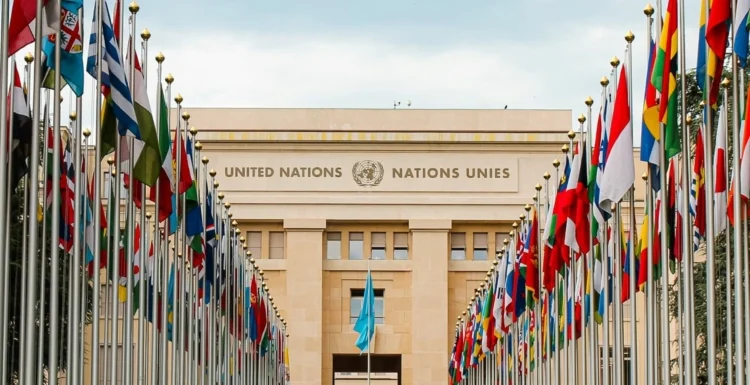
Nancy Huff is an educator with a mission to equip believers to pray strategically for the Cultural Mountain of Education. She has authored Taking the Mountain of Education: A Strategic Prayer Guide to Transform America’s Schools. She leads prayer groups to pray at key educational locations across the US. For additional information, go to: https://takingthemountainofeducation.com/author/nancyahuff/. Photo Credit: Mathias Reding from Unsplash.
