


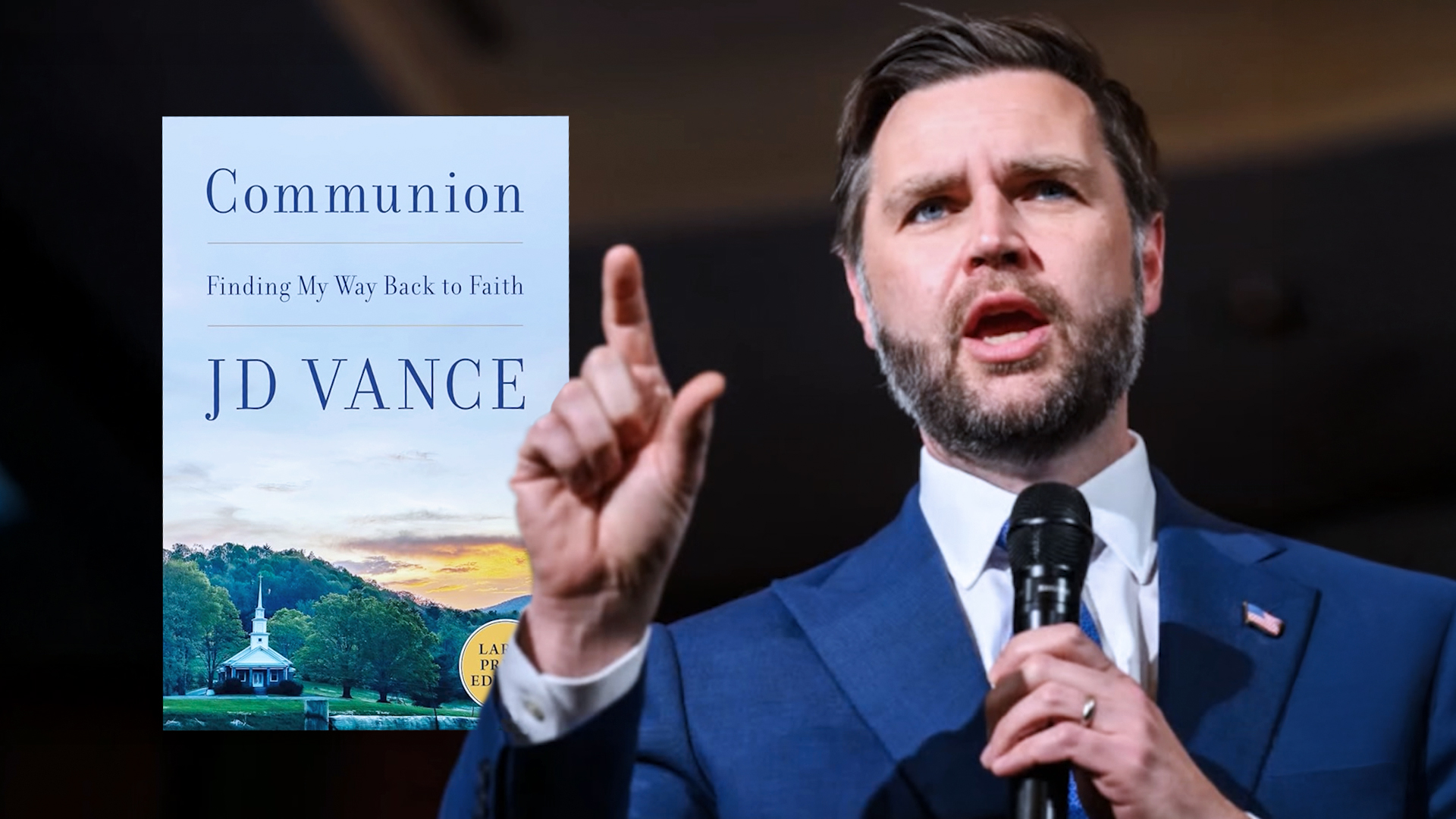
While Vice President JD Vance leads U.S. negotiations with Iran, the world is also learning about a different side of him through his new book, Communion: Finding My Way Back to Faith.
“Even though my faith journey is different from any other person’s, everybody, I think, who has a personal relationship with Jesus, they all have their own distinct flavor of how they got there,” Vance tells CBN News. “I thought maybe writing this down on paper and talking about all the ways in which I’m flawed and all the ways in which I came back to my faith, maybe that would be helpful in somebody else on their journey. So I hope that it is and I hope if it’s helpful, great. But if it’s not helpful, blame me. Don’t blame the faith that inspired the book.”
*** As AI tools threaten to hide CBN News from your searches, please sign up for CBN Newsletters today to ensure you can still find the latest news from a Christian perspective.***
The story Vance tells is a roller-coaster ride. It begins with an abusive, dysfunctional family and a blue-collar, no-nonsense grandmother who continually pointed him toward the Bible.
“It was all rooted around my grandmother,” the vice president tells CBN News. “When she passed away, I kind of felt lost. We didn’t have much of a church community. We would sometimes go to church, but most Sundays, I was not at church. If I was doing anything, I was watching CBN or TBN. I was watching The 700 Club back in the day, and because of that, when Mamaw died, and she died in 2005, right before I left for Iraq in the Marine Corps, I just didn’t feel that connection to my faith anymore. And I didn’t have anybody to talk to about it anymore. I didn’t have a community to support me.”
As a result, Vance says he drifted away from the faith he had known growing up. “I just felt like Jesus and the church weren’t speaking to me.”
That spiritual drift eventually led him into atheism during much of his 20s and 30s, a period when ambition and achievement became his primary focus.
“I was a striver, man,” says JD Vance. “I was worried about all the things that you shouldn’t be worried about: How much money did I make? What kind of job did I have? I wanted to go to the best schools. I wanted the best credentials, and I started looking around and saying, you know what? Is this actually making me a good person?”
After meeting his future wife, Usha, Vance began to think more seriously about what really mattered. He started focusing on becoming a better husband, father, and person. Along the way, he also encountered men whose Christian faith was clearly shaping the way they lived.
“One of the really interesting takeaways from this book is sometimes people take very long and winding paths, and what gets them back on the journey is just a person who’s a good example, who’s a good husband, who’s a good father,” Vance says. “My Uncle Dan, he was just a good guy, and I realized that it was his faith that inspired him, and maybe getting back to that faith could lead me to be the same kind of guy that he was.”
In short, Vance eventually found his way back to the Christian faith he had once abandoned. When I asked him whether that return was driven by a sudden spiritual breakthrough or a more gradual intellectual journey, he said it was a combination of the two.
“I think it was both, but for me, it was more of an intellectual process because at first I said, okay, these Christians are really interesting, they seem to have something that they believe that motivates a really good behavior. There were rays of sunshine that I saw from Christians, and I started thinking, well, what is the source of those rays of sunshine? And the more that I got into that, the more that I said, well, it’s this belief in Jesus Christ. It’s this belief in grace and forgiveness.”
Vance ultimately converted to Catholicism, but one moment in particular stands out as a turning point in that journey. During a visit to France with his family, he found himself alone inside a cathedral with his young son asleep in a stroller.
“We were there with our son in this beautiful old cathedral, and I think Usha was going to the bathroom or getting a coffee. She wasn’t there. It was just me and my son, and my son was asleep in a stroller. He was 14 months old. And I just I had this feeling of, like, loneliness at first because no one was there. The cathedral was empty. But then I look up at this beautiful stained-glass window and just the timing of it, and I was saying my prayers, and I was not yet—I would not necessarily call myself a Christian. I certainly wasn’t going to church regularly at the time but was curious. And the light is shining through the stained glass, and you can almost see the dust in the cathedral dancing in these rays of light. And I just felt like God was speaking to me. You belong here.”
“And for all the problems with faith that I had had and all the skepticism and all the doubt, I just in that moment felt a certain sense of peace and a certain sense of belonging. I think that most of us, if you listen hard enough, God is always trying to speak to us. Sometimes it’s not always obvious what He’s trying to say. Sometimes it’s not always easy to hear Him. But I think there are certain moments where He’s talking so loudly it just smacks you across the face, and that was one moment for me.”
It was a powerful moment of clarity for a man who had spent years wrestling with doubt, skepticism, and questions about his faith journey. Now, as vice president and as one of the administration’s leading voices on some of the world’s most consequential issues—including the ongoing negotiations with Iran—Vance says the faith he rediscovered continues to shape the way he views life. And if the challenges ahead are any indication, it is a faith he may need to lean on even more in the days to come.
Click here to find Vice President JD Vance’s book: Communion: Finding My Way Back to Faith.
