


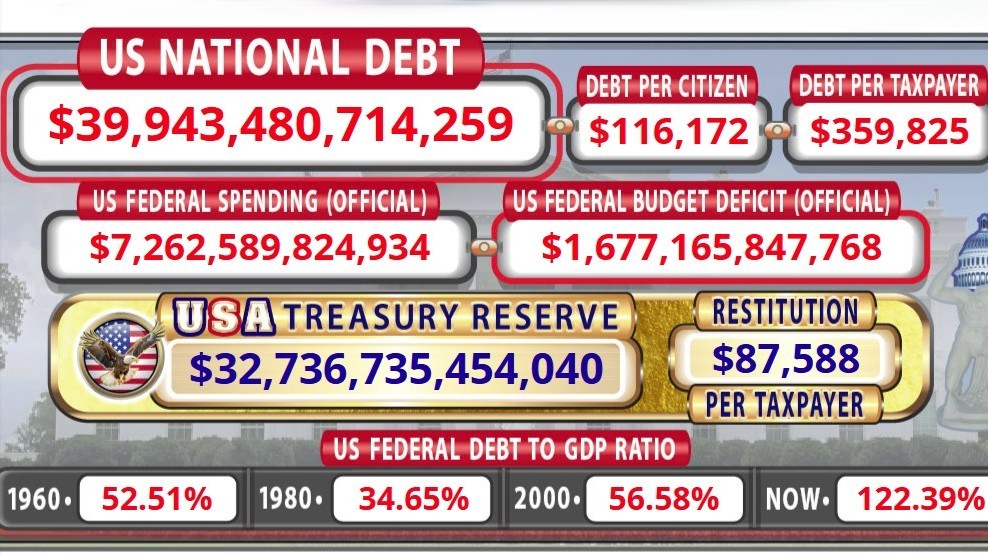
The U.S. national debt is hitting a staggering $40 trillion milestone this week. The Treasury Department says the debt is already around $39.9 trillion and climbing by the second – you can watch it spiraling here.
And there’s another concern: the cost of paying that debt is climbing. Annual interest payments are now expected to top $1 trillion, which is approximately what the country spends on national defense.
As America’s borrowing continues to rise, lawmakers could face another debt ceiling showdown as early as next year.
It’s hard to fathom that much debt, but imagine the NFL’s 30 football stadiums, filled to the top with stacks of $100 bills. That still wouldn’t be enough to hold the $40 trillion U.S. national debt. You’d need at least seven more football stadiums full of $100 bills.
With the national debt barreling ahead, the U.S. government seems caught in what some are calling a debt-driven ‘doom loop.’
To make matters worse, the Penn Wharton Budget Model warns that the national debt is actually closer to $100 trillion. Half of every dollar the government borrows now goes to interest on the debt, close to one trillion per year.
And while the economy seems fine now, experts warn that the situation could turn bad very quickly.
It seems few in Washington have the political courage to do anything about it.
Earlier this year, House Budget Committee Chairman Rep. Jodey Arrington (R-TX) condemned Congress’s lack of action on the debt. “This institution has failed,” Arrington said from the House floor. “We have failed our country. We have jeopardized our economy, our security, and our leadership in the world. And worst of all, we have compromised on our children’s future.”
***Please sign up for CBN Newsletters and download the CBN News app to ensure you receive the latest news from a Christian perspective.***
And yet, few politicians in Washington are willing to essentially sabotage their chances of reelection by voting to rein in the major cause of the debt: Social Security, Medicare, and Medicaid.
Dominik Lett, policy analyst at the Cato Institute, said, “These three programs are the entire budget problem. And unless we address them, it’s pretty much impossible to balance the budget or achieve some level of fiscal sustainability.”
Meanwhile, the Congressional Budget Office warns the federal debt is on track to hit $150 trillion in 30 years, equivalent to more than a million dollars per household. And Lett says delaying entitlement cuts will only make it more painful in the future.
“We can make relatively small, if painful, adjustments now, but if we delay them, the adjustments will need to be much larger and much more significant. Benefit cuts will need to be more significant, or tax increases will need to be larger,” Lett said.
Daniel Bunn, President and CEO at the Tax Foundation, said, “We’ve run some numbers ourselves. You need several trillion in cuts or additional taxes in order to get to a sustainable measure.”
And in light of recent government fraud scandals, Bunn says to those who think a large part of the federal debt problem is fraud…it’s not.
“Yes, it’s something meaningful,” Bunn said of the recovered fraud, “but it’s not something that’s going to save so much that you’re going to change the overall trajectory of the debt.”
Those who don’t believe the debt is a problem point out that the world keeps financing it by buying U.S. Treasury notes. However, former U.S. Treasury Secretary Henry Paulson warned recently that the national debt could lead to a “vicious bond market crash.” And the IMF is now calling the U.S. debt problem a “global risk.”
Some experts believe the answer is letting an unelected bipartisan commission make the necessary spending cuts. But Congress would still have to vote on its recommendations. And it doesn’t look like Congress will do anything until serious damage to the U.S. economy has already occurred.
