

JERUSALEM, Israel – Just days after Washington and Tehran announced new agreements to reopen the Strait of Hormuz and reduce regional tensions, Iran and the United States are now sending sharply different messages.
The Iranian Revolutionary Guard Corps (IRGC) is warning commercial ships, while U.S. officials insist that international navigation will remain free.
The IRGC used a drone to strike a Singapore-flagged cargo ship in the Strait. According to U.S. sources, the strike hit the vessel’s bridge near Oman’s coast. British maritime authorities reported no injuries but confirmed damage to the ship.
Hours before the strike, the IRGC Navy announced that “safe passage through the Strait of Hormuz is only possible via the routes designated by the Islamic Republic of Iran.”
The statement added that “the proposal of a new route by some authorities for passage through the Strait of Hormuz… is unacceptable and extremely dangerous.”
The warning triggered the International Maritime Organization (IMO) to suspend its operation to move hundreds of stranded ships out of the Persian Gulf while it assesses security conditions.
IMO Secretary-General Arsenio Dominguez said the evacuation process was paused to “reconfirm that the necessary safety guarantees continue to be in place for the ships on our evacuation list and all those in the region.”
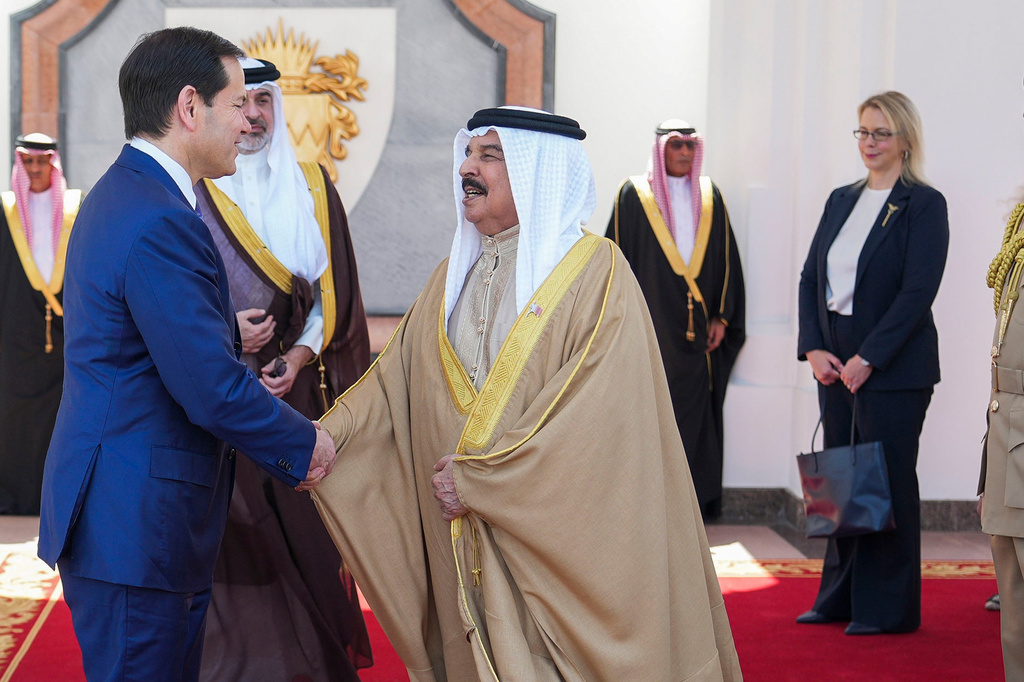
Meanwhile, Secretary of State Marco Rubio met in Bahrain with Gulf Cooperation Council foreign ministers and Saudi Foreign Minister Faisal bin Farhan al-Saud.
“We don’t want and will not be making any decisions or commitments that in any way undermines the prosperity, stability, or security of our Gulf partners,” Rubio stated.
He pledged that the U.S. and the Gulf States will ensure there are no tolls charged on ships moving through the Strait of Hormuz, and he cautioned Iran to allow commercial shipping to move unhindered.
“If that stops, then we’re going to have a problem,” Rubio said.
*** Please sign up for CBN Newsletters to ensure you receive the latest news from a distinctly Christian perspective.***
Even as the IRGC escalated pressure on shipping, the Trump administration opened a direct military channel with Iranian forces.
Vice President JD Vance revealed that a new “deconfliction mechanism” had been established during negotiations in Burgenstock, Switzerland. The IRGC and the U.S. Central Command (CENTCOM) will meet in Doha, Qatar, to establish a mechanism aimed at preventing military escalation and implementing agreements covering the Strait of Hormuz and the regional ceasefire.
Vance said in a podcast with UnHerd, “One of the things we wanted to come with (was a) channel on the Iranian side (for reducing conflict), which we did.”
He added, “They were like, ‘OK, fine. We’ll send somebody from the IRGC to go hang out in Doha with somebody from CENTCOM,’ and that’s how we’re going to settle a lot of these disputes.”
The United States continues to designate the IRGC as a foreign terrorist organization, even as CENTCOM prepares for direct coordination with it.
The new conflict prevention channel for Lebanon would exclude Israel and would limit Israeli military action to responding only to “imminent threats,” rather than to the broader category of “emerging threats.”
Vance indicated that Hezbollah would be part of the conversation between Israel, Lebanon, and other parties in the region.”
Israel is opposed to any Iranian role in postwar arrangements because Tehran backs Hezbollah.
Prime Minister Benjamin Netanyahu insists that Israel faces “no restrictions” in Lebanon.
In a further concession to Tehran, as part of the Memorandum of Understanding, the U.S. waived sanctions on Iranian oil sales this week and allowed Tehran to sell its crude in dollars for the first time in decades.
The U.S. administration claimed the funds “will have to be spent in the U.S. for the betterment of the American economy.”.
However, Iran’s Parliament Speaker Mohammad Bagher Ghalibaf denied that it was the case on Thursday.
“America falsely claims our unfrozen assets will buy their agriculture. Interesting. The only crop we’re harvesting is what you planted: decades of mistrust,” Ghalibaf posted on X.
