


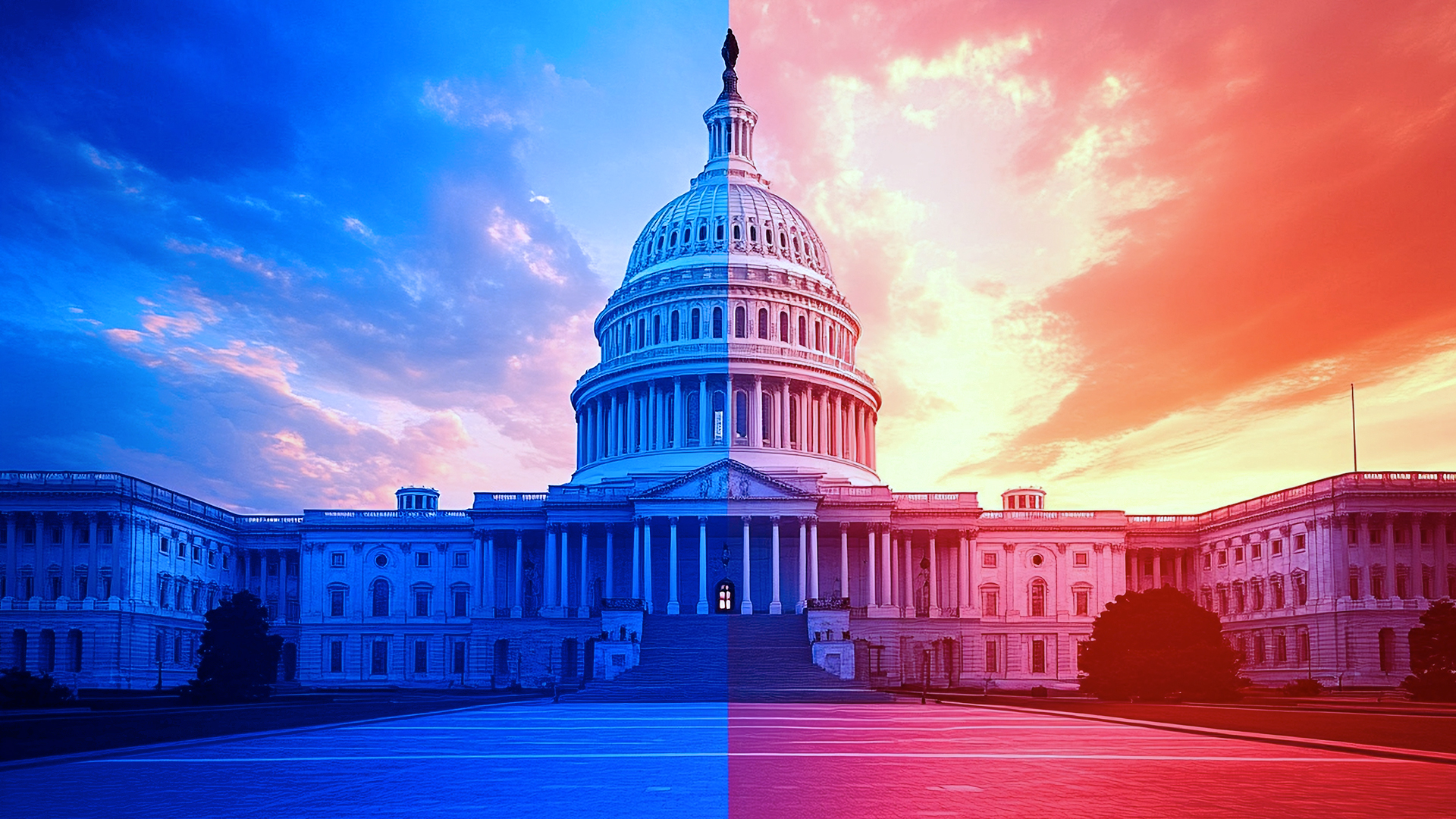
An historic redistricting battle has led to new congressional maps in multiple states, potentially altering the fight for control of Congress. This strategy is reshaping the midterm elections in a big way.
As we get closer to the November midterms, the race to control the House isn’t just on the campaign trail — it’s happening by changing maps. In today’s hyper-polarized environment, redistricting has become one of the most important — and controversial — political tools.
Tyler O’Neil of The Daily Signal told us, “It feels like we haven’t been this divided since the Civil War. … I don’t want us to have a civil war. But I keep seeing that if trends continue and, of course, God is in control, but if current ideological trends continue, we are more and more at loggerheads in this country.”
Here’s how it’s playing out so far:
Republicans have spent the past year redrawing congressional districts in states like Texas, Florida, Ohio, Missouri, and North Carolina. Democrats responded by taking their pens to places like California, Utah, and Virginia.
The result? Republicans may have created somewhere between six and 10 additional GOP-leaning House districts heading into November. Current polling, however, shows that might not be enough to keep GOP control of the House.
Harvard Kennedy School Professor Benjamin Schneer agrees.
“I think it’s safe to say that without the mid-decade redistricting, it would be a near certainty that Republicans would be on target to probably lose the House. And that’s certainly not the case. You know, if you look at various models, right now, I think it’s maybe like a 75% chance that the Democrats are taking the House right now,” he said.
Many wonder how we even got here since congressional maps are normally drawn only every 10 years after the census. That was before President Trump encouraged Republican-led legislatures to pursue a rare round of mid-decade redistricting, touching off what some describe as a political arms race.
O’Neil said, “Oh, most certainly, I would not make any bones about this. This is a very political debate.”
Conservatives believe this effort is simply an attempt to correct previous imbalances in the system.
“I think President Trump had a lot of legitimate beefs with the system because what we saw in the 2020 census was this almost systemic overcounting of Democrat-leaning states and undercounting of Republican-leaning states,” O’Neil said.
Critics, though, argue that both parties are using this tool to maximize political power rather than ensure fair representation.
Schneer said, “The way that the mid-decade redistricting has happened, it has been very top-down, right? It is part of this effort to hold on to the House. And so it really is this story, I think, of further nationalization and polarization of our politics from the top down.”
And from the courtroom on down. In Virginia, Democrats had hoped to gain as many as four favorable seats through a voter-approved redistricting amendment. The Virginia Supreme Court, however, struck it down, and an appeal failed at the U.S. Supreme Court.
Meanwhile, Supreme Court justices handed the GOP a victory over voting rights protections, which went Republicans’ way in some Southern states. Florida also approved a new Republican-favored map, which the state’s courts upheld.
This maneuvering raises a key question: Who should be making these map decisions — voters, legislatures, or judges? So far, courts have become the referees in battles where the stakes couldn’t be higher.
“I think the most important thing to know about redistricting is that it has a big impact on who wins elections,” Schneer said. “If you are in a state where the maps are being redrawn to advantage one party or the other, and particularly in a way that you don’t agree with, ultimately that may trickle down to policies that will impact your life.”
