

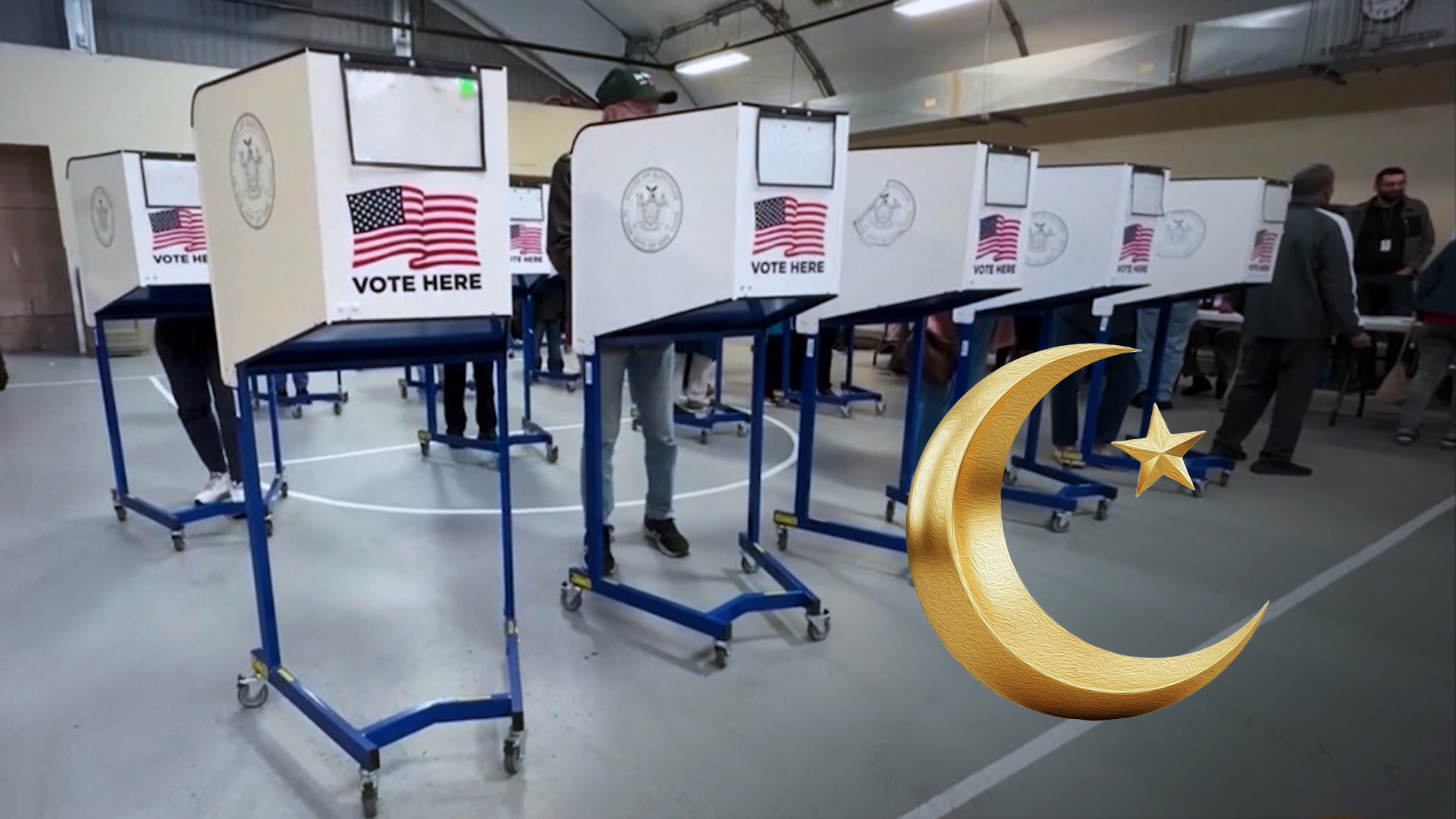
A political earthquake threatens to reshape America. Muslim candidates are winning U.S. primary elections and political offices in record numbers. These victories have led to a concern among some Americans that growing Muslim political influence could lead to greater antisemitism and possibly shariah law in Islamic communities.
Last in November, a record 42 Muslim Americans swept into public office—an unprecedented shift. Leading the pack: Zohran Mamdani, becoming New York City’s mayor. His win sent shockwaves through the political establishment.
With mid-term elections just months away, analysts foresee a ‘Mamdani effect’—and its influence is only growing.
Sam Westrop, Middle East Forum director, says these Muslim electoral gains are no accident, calling them the result of a decades-long strategy of lobbying and candidate training first implemented in late 2000.
“What is happening now in New York, New Jersey, and indeed, in Michigan, and across the country, is we’re seeing the fruits of those efforts, decades of development by Islamist radicals into building the infrastructure that is now allowing dangerous radicals to run for office,” Westrop said.
Eight years ago, Muslim American voters made history by propelling Rashida Tlaib of Michigan and Olhan Omar of Minnesota into Congress as the first Muslim women to serve on Capitol Hill.
Today, a new wave is poised for even bigger breakthroughs, especially in deep-blue states, where energized Muslim communities can carry outsized influence in low-turnout primaries.
Behind the headlines, however, a more complicated story is unfolding. While some candidates, like New Jersey’s Adam Hamawy, have impressive public service records, critics say there’s more beneath the surface.
Westrop said, “Hamawy has a history of involvement with Islamist causes. Recent allegations have surfaced regarding his role as a witness in a terrorism trial, many years ago.”
In 1995, Hamawy testified in defense of Omar Abdel-Rahman, known as the “blind sheik” accused of masterminding the 1993 World Trade Center bombing. Though Hamawy has since distanced himself, critics argue his testimony minimized the sheik’s extremism, raising new questions about his judgment.
In 2024 and again in 2025, Hamawy volunteered as a doctor in Gaza. His work at a hospital in Khan Younis was praised by some and questioned by others. His trips were sponsored by the Palestinian American Medical Association, a group dogged by accusations of Hamas ties—allegations firmly denied by the group.
“So there are concerns about Hamawy. And the best thing that he could do is to explain his relationship with some of these radical organizations in the United States… The silence on his part is concerning, to me. And he’s not the only candidate, that happily looks the other way,” Westrop said.
Publicly, Hamawy condemns antisemitism and the October 7th Hamas attacks on Israeli civilians. At the same time, he criticizes Israel, calling it an apartheid state, labeling its Gaza campaign as genocide, and demanding Washington cut military aid.
Other prominent Muslim candidates sharing those views include:
New York primary winners Dominican Darialize Avila Chevalier and Palestinian Aber Kawas, as well as Egyptian-born Michigan senatorial candidate Abdul El-Sayed.
Westrop said, “There’s no doubt about his Islamist affiliations. He is heavily and openly backed by some pretty dangerous groups and has a long-standing history of involvement with Islamist organizations in Michigan. So, we should be concerned, deeply concerned about him.”
Westrop and others believe all Americans should be concerned because, if Islamists gain enough seats in state legislatures and Congress, radical agendas could become law.
Primary winners Chevalier and Kawas are closely affiliated with the Democratic Socialists of America, the DSA. Some of their critics fear the strengthening of a red-green alliance—Muslims working with leftists to impose a radical agenda of expansive government control.
Jewish Americans say anti-Israel rhetoric from the left and Islamist office-holders could also fuel a surge in antisemitic hate crimes. Others warn that sharia law could spread in segregated Muslim enclaves—such as East Plano, Texas.
That concern has led to the Sharia-Free America Caucus.
“I remember British Islamists 10, 20 years ago doing exactly this in northern England. And it led to deeply segregated societies. And it was these, these Islamist communities in northern England, from where radicals emerged, who were radicalized to join foreign terror groups or commit acts of terror at home. Those radicalization recruits came from these deeply segregated, isolated communities,” Westrop recalled.
On his YouTube channel, former Muslim Danny Burmawi, founder and head of the Ideological Defense Institute, predicts efforts to ban sharia law in the U.S. will fail.
“When the Founding Fathers wrote the Constitution, they were not thinking about Islam… you cannot ban sharia. It will always be protected under the First Amendment as part of religious freedom,” Burmawi warned.
Westrop believes that enough Islamist victories in state assemblies and Congress pose a threat to American foreign policy and U.S. taxpayers.
“I think we should be particularly worried about the direction of public money to radicals. Both the left and right have given huge amounts of money in public money, federal and state money to Islamists over the past few decades. I worry that these Islamist candidates will increase that flow,” Westrop said.
To prevent this, Burmawi insists the solution starts with recognizing Islam as a political system—not just a religion.
“Recognize that a large part of its function as a political ideology similar to communism or fascism. Islam is not just a religion. Islam has a religion. Islam is a political ideology that seeks to acquire power and impose its system on society,” Burmawi said. “That is not a religion…and do not separate that political component by calling it Islamism, as if it has nothing to do with Islam. It is Islam.”
