
WALAGU, Papua New Guinea – In the remote mountains of Papua New Guinea, some villages are so isolated that the only practical way to reach them is by air.
For Johnny Reeves, a missionary pilot with JAARS, that means flying into airstrips carved into mountainsides, where gravel, grass, mud, and clay replace the paved runways found at conventional airports. For one flight, however, the cargo aboard his Kodiak airplane was more significant than anything he had carried before.
It was the first complete New Testament ever translated into the language of the Onobasulu people, a project more than 30 years in the making.
As Reeves prepared for takeoff, the routine of a dangerous mountain flight unfolded around him.
“The gauges are on the green. The flaps are 20. Trims are by 3 for takeoff.”
“We’ll be airborne by the third cone, past the parking bay.”
“Prop is required. Conditions are cut-off. Fuel valves are off. Selectors off.”
“Flaps are set. Harnus locked on, on, locked. Left is locked. Right is locked.”
Then came the final call:
“We are a go for takeoff.”
For the past eight years, Reeves has made these mountains his office. As a pilot with JAARS, a Christian aviation organization, he helps Bible translators reach some of the world’s most remote communities, flying what the organization describes as the “last mile.”
“It’s going that last mile. And that’s sometimes the hardest. But if we don’t go the last mile, we won’t get there. There are over 800 languages here. We need to reach them with the gospel.”
That last mile can be especially challenging in Papua New Guinea, a country where rugged terrain makes conventional transportation difficult. “There’s not a lot of flat places to put airstrips in Papua New Guinea and so as a result you often times have these portions that are carved out on the side of a mountain, really, or a ridgeline.”
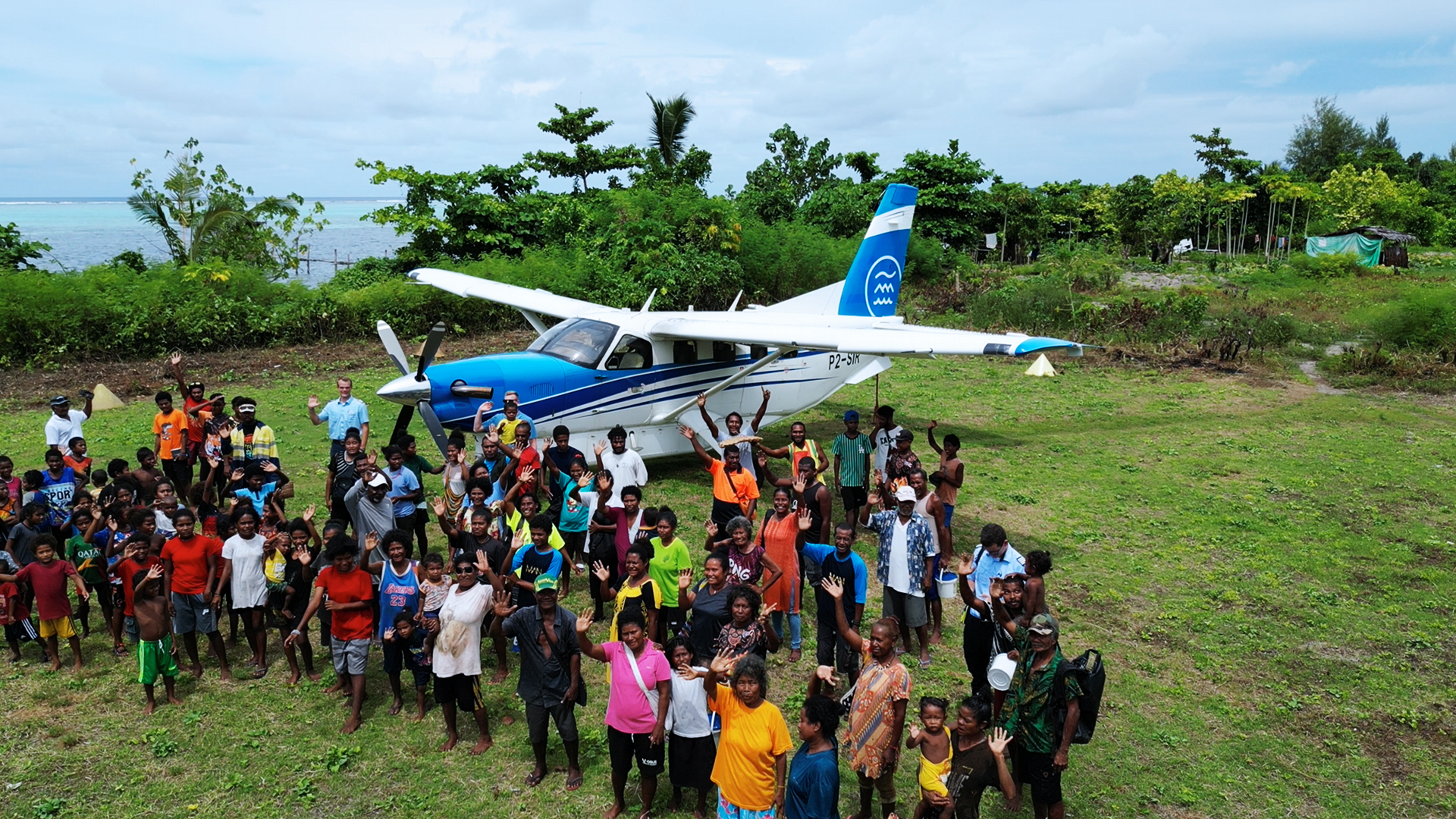
JAARS operates Kodiak aircraft specifically suited to the environment. Here in Papua New Guinea, the Kodiak airplane is known as the workhorse of the jungles. JAARS has four of these Kodiaks. And why are they known as the workhorse of the country?
“Well, the Kodiak has to be a really rugged airplane for the type of terrain we’re flying it into Papua New Guinea,” said Reeves. “We’ve got lots of mountains, and sometimes the airstrips are very steep and very rugged. And we land on gravel, we land on grass, we land on mud, we land on clay and the Kodiak needs to be able to do that repeatedly, time after time and take a beating.”
For years, Reeves has transported translators, supplies and missionary families to places few others can reach.
On this day, however, the flight carried what he called “precious cargo.”
“We’ve got precious cargo. We’ve got Bibles on board today for a 30 plus year project, that are being delivered to the people of Onobasulu and so this is precious people. They’re precious cargo.”
The Bibles arriving in Walagu represented the culmination of decades of work. But before there could be a New Testament, there first had to be a written language.
When Dutch linguist Dr. Anne Stoppels arrived in Walagu in 1997, the Onobasulu language had never been written down. There was no alphabet.
Stoppels initially thought the assignment might take 15 years. Instead, it became her life’s work.
Her interest in Bible translation had begun much earlier. “When I was fifteen, I read a book by Don Richardson and that really got me interested,” Stoppels told CBN News. “And then I thought, when I grow up, I want to be a Bible translator.”
She eventually traveled halfway around the world to learn the Onobasulu language from the people themselves and help develop the tools needed to put it into written form.
“Give me a book to translate and I’ll start at chapter one, verse one, and I end at the last verse. And I enjoy translating with the translators and talking with the people.”
The work required far more than simply finding words in one language that corresponded to words in another. Before translation could begin, linguists had to document the language itself: its sounds, grammar, and vocabulary.
Jed Carter, the Summer Institute of Linguistics country director in Papua New Guinea, described the process this way:
“These languages are not written to begin with in pretty much any case,” said Carter. “So, it’s language development, writing down orthographies together with the local community after analyzing the grammar and the sounds.”
Only then could the translation begin, one verse and one chapter at a time.
And the deeper the translators went, the more they discovered how much meaning can be carried inside a single expression.
“It’s not easy work. Sometimes they have expressions that are way deeper than I have in my own language in Dutch,” said Stoppels. “Like the word for love is actually, like you carry somebody in your breath. So when you breathe that person that you love, it’s in your breath.”
Beverly Mosley, an American linguist with Wycliffe Bible Translators, was among those who eventually joined the effort.
For Mosley, the years of painstaking work produced an emotional reaction when she finally saw the project reaching its destination.
“So many emotions. It’s like a volcano erupting in my heart because you worked so long to give God’s Word in the language in a way that the people can understand,” said Mosley.
There were times, she admitted, when the work felt almost impossible. “There were so many days, ‘it’s so hard, I’m not going to make it, I’m going to go home and sell shoes at the mall,'” Mosley recalled.
The sacrifices were real. The work meant years away from family, missed birthdays and holidays, and long stretches of loneliness.
But Mosley kept going.
“What kept me from quitting is the love for the Onobasulu people, my love for God and His Word. I want the light to shine in the darkness and the Onobasulu people to have it in a way they can understand,” said Mosley.
Other translators became part of the story along the way.
Swiss translator Johann Alberts joined the project later and spent a decade working on it.
For Alberts, the dedication ceremony marked the end of one journey and the beginning of another.
“It’s the end of a long journey for me,” recalled Alberts. “It’s ten years in the project. Thirty years overall. The big prayer is that the day will come and go, but the Bible comes, and it will stay and it will bear much fruit. That’s our prayer.”
Liz Buesnel, an American Bible literacy expert, was also part of the team.
“God wants us to know that we can know Him, and we can be close to Him, and people hear that best when it’s in their own language and in ways that are familiar to them,” said Buesnel.
Australian translator Shelley Weeks returned to Papua New Guinea for the first time in nearly 30 years.
“Just really happy and calm and I’m looking forward to meeting some of the people we worked with. It’s very good to be back,” said Weeks.
The Onobasulu people were equally eager to see the translators who had spent years working alongside them.
At one point, Buesnel was greeted by an Onobasulu woman who called her “daughter.”
Then came the moment everyone had been waiting for.
Thirty years after Stoppels first arrived, boxes containing the newly printed Onobasulu New Testaments emerged from the jungle.
Hundreds of people gathered at the edge of the village, waving palm branches, singing songs of praise and wearing brilliantly colored traditional Papua New Guinean clothing.
The celebration drew more than 2,000 people from surrounding regions. Some walked six to eight hours to attend. Others traveled for four days through the jungle.
They came simply to witness history.
For the first time, the Onobasulu people could hold the New Testament in the language of their own hearts.
The dedication was not simply the closing chapter of a 30-year translation project.
For Stoppels, it was the beginning of something she hoped would continue for generations.
“I’m praying that this Word of God will do its work,” said Stoppels. “The Word of God will not come back empty. Now, they have the whole book, and it is a beautiful book. I’m praying that it will bear fruit for the next generation.”
The team also recognized a practical reality: a printed Bible is of limited use to someone who cannot easily read it or who lives without electricity.
Many homes in the region have no electricity, and many adults are still learning to read. So, the team brought another tool: solar-powered audio Bibles.
“They have a tiny solar panel on the back to recharge so it’s just such a great blessing to hear God’s Word as you’re walking through the village in the evening,” said Mosley.
The project also highlighted the role aviation played throughout the three decades of work.
Every flight into these isolated communities could carry something essential: food, medical supplies, teachers, translators, books, paper, or construction materials.
Stoppels said the translation project could not have happened without the pilots and aircraft that repeatedly connected the remote community with the outside world.
“This whole Bible translation project would not have been possible without aviation, without JAARS,” insisted Stoppels. “JAARS brought us out here for the first time. JAARS has picked us up many times. They brought our books, they brought the chalk for literacy, they brought the paper.”
Reeves has seen that impact firsthand.
“Anything that comes along setting up structure here, we’ve been a part of,” said Reeves. “So roofing iron for building schools and outposts, and flying teachers in and out, so it’s a huge benefit to the community.”
The question of whether decades of work are worth it becomes particularly striking when considering the size of the Onobasulu population.
Stoppels put it simply:
“You could basically say I gave my life for two thousand people. Every Christian has a task, has a calling to serve the people around them, and for me, it happened to be the Onobasulu people. So I think, yes, it’s worth it.”
Reeves sees the question differently.
For him, the value of the work cannot be measured simply by the number of people who will receive a Bible.
“My perspective is if you’d ask me, ‘Is it worth it for one? I think so.’ God knows how many lives are going to be changed for the Onobasulu people, so absolutely it’s worth it. I’d do it all over again,” insisted Reeves.
During the dedication, Reeves also had an opportunity to share his own story with the people he had spent years serving.
“I told them just a brief testimony about how God’s Word changed my life as a kid and that ultimately that’s what led me to becoming a missionary pilot and being willing to give my life for kingdom work,” said Reeves.
He says watching the Onobasulu receive the New Testament made the years of flights and difficult landings feel worthwhile.
“I can’t help but be excited with them,” Reeves said. “We had a little part in making this happen, but it’s really the joy that they get to experience for having God’s Word in their language for the very first time.”
The Onobasulu translation may be complete, but in Papua New Guinea, the larger task continues.
More than 800 languages are spoken in the country, while only 17 have a complete Old and New Testament.
That leaves enormous work ahead, and growing challenges for the organizations doing it.
Stoppels says fewer people are willing to commit the years required to learn a language and work in remote communities. At the same time, the aviation ministry faces its own shortage of pilots and mechanics.
“The problem really is nowadays people don’t want to spend a long time,” said Stoppels. “People come for two years, but then two years you can’t learn a language, and we also need aviation people. We need pilots and we need mechanics. It’s much harder to go out now because we have a shortage than it was back when I started in 1997 when there were many pilots and many mechanics.”
For Mosley, however, the vision extends far beyond one village or even one country.
“When I picture the future in heaven, we’re all speaking our vernacular, heart language. It will be like a symphony of praise,” said Mosley. “One language is not enough. Ten languages are not enough. A thousand languages are not enough. Seven thousand languages around the world, really aren’t enough to give God the glory, honor, and praise that He deserves.”
As the dedication ceremony ended, people continued lining up to receive their copies of the New Testament.
The Kodiak would eventually lift off from the Walagu airstrip and disappear into the clouds.
For Reeves, it was another flight home.
For Stoppels, it marked the close of a 30-year journey.
For the Onobasulu people, it was the beginning of something new: a book written in their own language, to be read, heard and shared for generations.
