


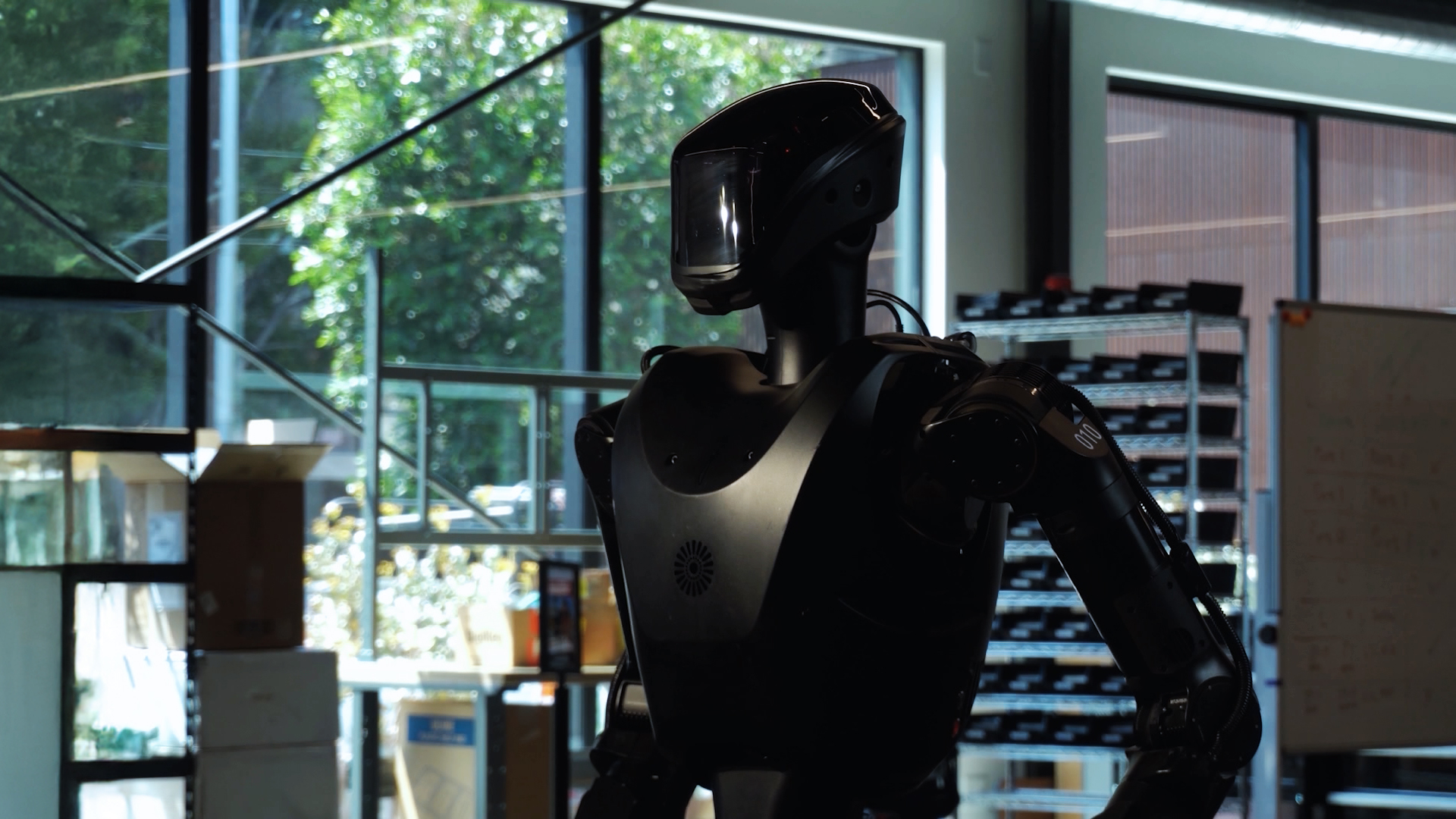
There are moments in war when the danger is at its highest: clearing buildings, searching unfamiliar terrain, going where no one knows what’s waiting. With that in mind, military leaders are exploring an option that was once only a scenario in science fiction movies: sending a robot in first.
In general, these machines are already in America’s arsenal, part of a Pentagon push to gain the advantage both today and for the future.
“Simply put, the United States must win the strategic competition for 21st-century technological supremacy. Artificial intelligence, autonomous systems, quantum, hypersonics and long-range drones…” Secretary of War Pete Hegseth said during a speech at SpaceX earlier this year.
As technologies advance, a major goal is removing risk to human life wherever possible.
“This has been a key point for Secretary Hegseth. From the very beginning, he said how he wants to send electrons, machines, fires, in the place of manpower in so many ways,” said Sarah Pearson, Chief of Strategic Initiatives at the Defense Innovation Unit.
Humanoid robots are being trained to do just that, machines designed to move, work, and even look like those they will one day replace.
“Everything that our military is built for, down to the tactics, to the weapons, the tools, the vehicles, they are all built for a human shape. And so these robots, I like to joke, are built in my image,” said former Marine, Mike LeBlanc, now co-founder of Foundation Future Industries.
LeBlanc and his team are developing humanoids to operate in a world designed for people.
“The idea is they are going to be able to get into Humvees. They’re going to be able to pick up an M4. They’re going to be able to stand behind a heavy machine gun, and it is the only robotic form factor that’s going to be able to bring all of that arsenal to life.”
For LeBlanc, this mission isn’t about replacing the warfighter. It’s about reducing casualties.
“Everybody thinks that it’s scary to have a Terminator out there until they think of the alternative as someone’s son or daughter, and so I think that our military has really looked at that, and so they’re embracing new ways to acquire this technology.”
Still, concerns remain, especially over what happens when artificial intelligence and autonomy are combined with weapons.
“If I told you that we were going to build a machine that anything that it touched, good guy or bad guy, it was going to kill, you would say that’s a very scary thing to put out there. That is a landmine,” he said.
“We’ve seen these technologies out before. So I think when you see it in the human form factor, it can seem like something new, but there’s not really anything new from digging a pit and putting spikes in it. There have always been passive weapons in war. When we start to put AI in that, we’re only going to make better decisions than that pit with spikes in it,” LeBlanc explained.
Questions regarding humanoid robots go beyond whether machines should be used in combat to what decision-making should ever be left to the machine itself.
“You need mature technology to be able to do that thing, one. Number two, you need to have the right guardrails in place. Responsible AI is a thing, and we have to be able to observe and assess and refine these systems in a continuous manner,” Pearson said.
Ukraine has become a battlefield laboratory for unmanned warfare, with drones and other machines increasingly involved on the ground, in the air, and at sea. For humanoids, initial uses could be far less dramatic.
“The most excitement that we’ve had so far has actually been with maintenance of aircrafts, so especially with drones. As you start thinking about putting drones strategically around, say, the Pacific, right…The promise is that if you had two humanoids that moved with that drone, they could do all this maintenance right in the beginning, load back onto the drone, and fly to Thailand and do the same thing,” LeBlanc told CBN News.
He says America’s adversaries are pursuing the same technology, without necessarily drawing the same lines around how it could be used. “If your adversaries are still going to invest in this technology, it doesn’t make a lot of sense to hold off.”
China displayed its rapid progress this summer in Beijing, where more than 2,000 robots from various teams competed in the World Humanoid Robot Games.
While it wasn’t military-based, robots raced, fought, played sports, and took on real-world tasks in a public show of just how quickly the technology is advancing.
“In modern warfare, the fastest innovator and iterator will be the winner, and no one can out-innovate an American entrepreneur who has been liberated from the constraints of stifling bureaucracy,” Hegseth said.
With humanoids, winning will require more than simply building a robot that can walk, run, or fight in a controlled setting; they will have to reliably perform complex tasks in unpredictable environments.
And LeBlanc says one of the biggest challenges is something humans tend to take for granted – our hands.
“Hands are going to have to be one of the biggest hardware innovations that we see throughout all of humanoid robotics,” he said.
Developers here at Foundation Future Industries are training robots using massive amounts of data, including videos showing people performing the same tasks the machines will eventually be asked to do. The goal is a robot not just following a pre-programmed set of movements, but understanding and adapting to the situation.
For LeBlanc, the push is partly personal.
His nine-year-old son wants to follow in his footsteps and become a Marine.
“To me, I have nine more years that I have to develop these robots so that there’s no job left for him,” he said.
For now, the robots are still learning. But one day soon they could take on some of war’s most dangerous missions, so that our soldiers never have to.
