


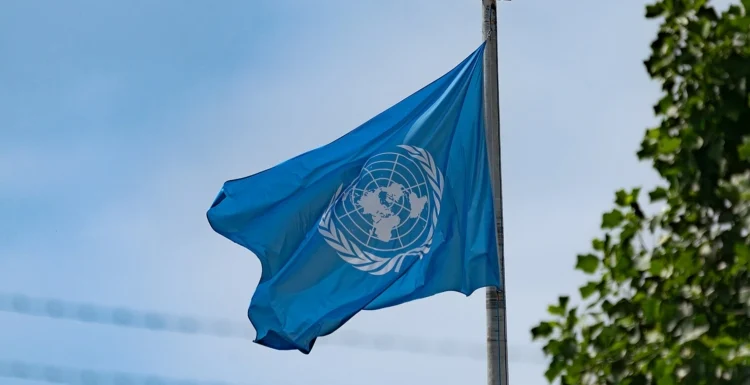
This fall, the United Nations will select a new person to serve as the UN’s tenth Secretary General in the 81 years of the UN’s existence. The new Secretary-General will take office on January 1, 2027.
Who is praying on the wall?
While we pray for a godly Secretary-General, left-leaning influential globalist leaders like George Soros are working diligently to make sure that the next Secretary General is a woman, and not just any woman, but a woman from the Global South who embraces Radical Feminist Foreign Policy (RFFP). According to a major conservative watchdog at the UN, C-Fam, Mr. Soros has spent billions of dollars on a campaign focused on the selection of a radical feminist. However, George Soros denies any connection to the massive amounts of money given to the campaign.
Feminist Foreign Policy (FFP) made its debut in 2014, as the brainchild of Sweden’s Foreign Minister, Margot Wallstrom. The Swedish policy is recognized by progressives as a rights-based foreign policy framework built around Rights, Representation, and Resources, grounded in gender language. However, within that framework, the reality is that the policy represents all rights given to individuals as gender rights. Included are abortion on demand as a reproductive right and LGBTQ+ rights as “civil rights” of women everywhere.
At the time, Ms. Wallstrom wrote the handbook for Feminist Foreign Policy (FFP), she had no idea that the ideas she proposed based on gender would soon sweep across the world, swaying votes in national elections and eventually becoming one of the policies that could determine who would become the next Secretary General of the United Nations. Her FFP transformed a domestic initiative into a global movement, something no other country had ever done.
By embedding feminism into diplomacy, development, trade, and security — and publishing a practical handbook that other governments could copy — Sweden turned an abstract ideal into a usable policy model that rapidly spread across the world. Within a few years, nations across Latin America, Europe, and Africa began creating their own version of Feminist Foreign Policy, turning FFP into a global movement. It’s already reached Chile, Columbia, Mexico, France, Germany, Scotland, Slovenia, Spain, and Liberia. In March 2024, France became the first country in the world to explicitly enshrine abortion rights in its constitution.
Under the leadership of a Secretary-General who embraces FFP, growth would continue to expand exponentially.
Below are examples of how abortions become core components of all Feminist Foreign Policy.
- Funds for a country’s NGOs are given to expand abortion access
- Pressures governments to liberalize abortion laws
- Frames abortion as a “human right” within its legal messaging
- Uses foreign aid to support sexual and reproductive health programs that include abortion services.
- Abortions are normalized as routine healthcare
- Every woman has a right to an abortion
So far, four women and three men make up the pool of potential UN candidates for the next Secretary-General. All the women embrace the Radical Feminist Foreign Policy. They are Michelle Bachelet (Chile), Maria Fernanda Garces (Ecuador), Rebecca Grynspa (Costa Rica), and Carolyn Rodrigues‑Birkett (Guyana).
The three men, Macky Sall (Senegal), Rafael Grossi (Argentina), and Olara Otunnu (Uganda), have not embraced any of the Radical Feminist Foreign Policy, nor have they taken a stance on abortion, which doesn’t mean they are against abortion on demand, as they are most likely to accept the liberal policy that already exists at the UN.
The newly elected Secretary-General will inherit a plethora of issues, with gender rights not being among the most urgent, as the United Nations remains on the brink of dissolution due to reduced funding from the U.S. and other prominent nations.
UN Under Secretary-General Guy Ryder made clear his priorities for the UN’s next Secretary-General. In a public statement, Mr. Ryder said, “As the Global Progressive Movement reshapes the international conversation, the United Nations faces its own moment of reckoning. The next Secretary‑General will inherit an institution that must modernize to preserve its integrity and remain capable of collective action. UN Under‑Secretary‑General Guy Ryder has been clear on this point, warning that only a ‘renewed multilateralism that delivers for people and planet alike’ can restore trust and equip the UN for the challenges ahead. His words underscore the urgency: without structural renewal, even the world’s most established institutions risk falling behind the transformations now unfolding around them.”
Share your prayers for the United Nations below.
Nancy Huff is an educator with a mission to equip believers to pray strategically for the Cultural Mountain of Education. She has authored Taking the Mountain of Education: A Strategic Prayer Guide to Transform America’s Schools. She leads prayer groups to pray at key educational locations across the US. For additional information, go to: https://takingthemountainofeducation.com/author/nancyahuff/. Photo Credit: Tony Webster – United Nations Flag at the International Court of Justice at The Hague, CC BY 2.0, https://commons.wikimedia.org/w/index.php?curid=156599545.
