


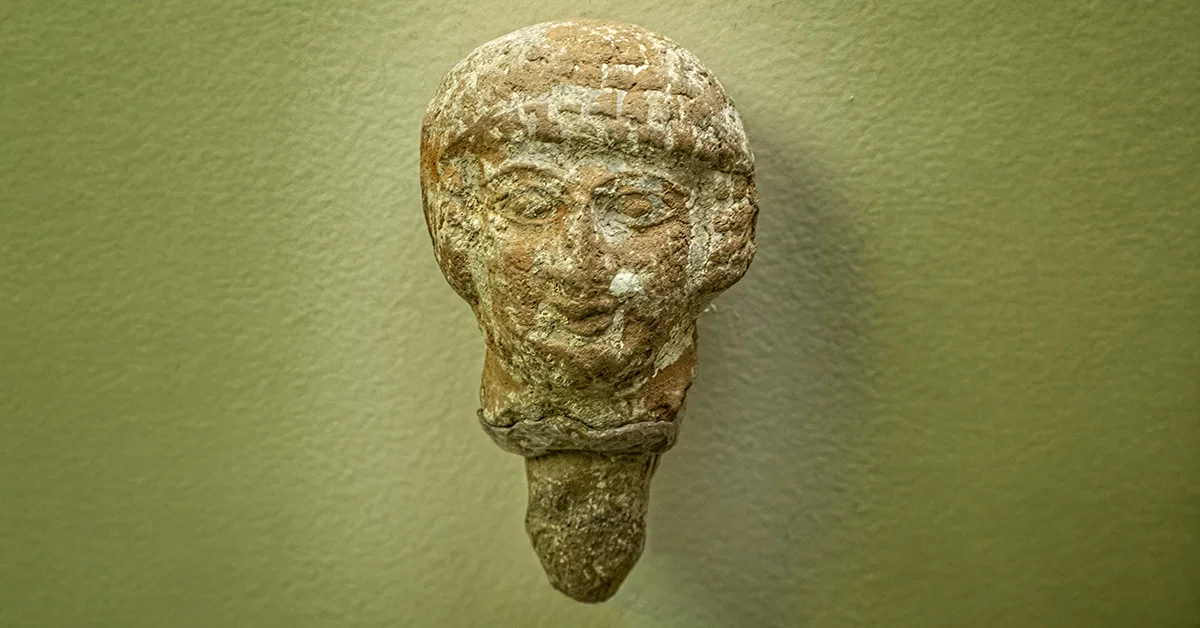
In a recent article, Biblical Archaeology Review (BAR) wrote on a unique find in Jerusalem: the discovery of a Judean pillar figurine mold. Molds are much scarcer than the figurines, and the article suggests a quite reasonable explanation; namely, that figurines were used in many households, whereas molds would be expected to be found only in pottery-related workshops. While the article is undecided on why these figurines were created and the importance they had in Jewish life around the eighth through sixth centuries BC, they offer the following postulations:
Nonetheless, there is one framework for understanding Judean Pillar Figurines that has persisted. It distinguishes between two forms of Israelite religion: an “official” religion centered on the Jerusalem Temple and Yahweh alone, and a parallel sphere of popular or folk religion expressed through household rituals and objects like Judean Pillar Figurines.
The widespread use of Judean Pillar Figurines certainly reflects forms of household religious practice, but it does not necessarily follow that these practices constituted a sphere separate from official Yahwism. Biblical texts portray Judah’s eighth- to sixth-century kings, priests, and populace as repeatedly incorporating objects and deities into their religious practice that were later condemned by biblical authors, even within the Jerusalem Temple itself (e.g., 2 Kings 21:3–7). Rather than revealing idolatrous “popular” religion, the evidence seems to point to a contested religious landscape in which the boundaries of Yahwistic practice were being negotiated.1
What Does Scripture Have to Say About Idolatry in Israel?
The article tries to paint the issue as “the boundaries of Yahwistic practice” being negotiated, but that is completely contrary to what the Bible states. At Sinai, God was very clear on His position of the Israelites making idols and explained the consequences in the strongest possible terms (Exodus 20:2–6; Leviticus 26:1, 26:29–31; Deuteronomy 7:3–6, 12:2–4, 32:20–22). Furthermore, God continuously sent prophets to warn the people against idolatry (2 Kings 17:9–13; 2 Chronicles 24:17–19; Isaiah 10:10–11; Jeremiah 16:17–18, 44:2–6; Ezekiel 14:6–8; Micah 5:13–14), and when the godly kings of Judah are recorded as having destroyed altars, idols, and other cultic practices, they are celebrated (Hezekiah in 2 Kings 18:1–4; Josiah in 2 Kings 23:4–15; Asa in 2 Chronicles 14:2–4, 15:9–15). In fact, God severely chastised Jeroboam for his idolatry (which every subsequent king of Israel followed) in 1 Kings 14:8–10 and repeatedly warned that destruction was coming upon Israel and Judah because of their idolatry and abominations.
In that regard, this is not a contested landscape but a compromised religious landscape.
So to claim that a “contested religious landscape” is what these figurines represent is correct in one sense—it does show that Israel and Judah were syncretistic and infected with idols. But it ignores the fact that since Sinai, God had repeatedly told the Israelites not to make idols, not to bow down to them, and not to sacrifice to them. In that regard, this is not a contested landscape but a compromised religious landscape. There was no “negotiation” here at all, as God unilaterally stated (over and over again) that He would punish those who worshipped other gods with war, captivity, famine, and wild animal attacks.
What Does Scripture Have to Say About Syncretism in Religion?
Syncretism is the blending of beliefs and practices with other religions, secular philosophies, or local cultural customs. In the case of Israel, it was adding rites and customs to their worship of God, quite obviously without His approval. There are many statements in Scripture that condemn the Israelites for incorporating idolatry into what should have been the worship of God alone. Even godly kings of Judah are mentioned as worshipping Yahweh at the high places—starting with Solomon (1 Kings 3:3), who then set a bad example that later kings (most described as not following the Lord) repeated, including Rehoboam (1 Kings 14:21–24) who did follow Yahweh initially (2 Chronicles 11:17) and later kings like Ahaz who completely abandoned the worship of God (2 Kings 16:2–4). Several times the king of Judah is mentioned as not abolishing the high places (even if they did not worship there); for example, Asa (1 Kings 15:14), Jehoshaphat (1 Kings 22:43), Jehoash (2 Kings 12:3), Amaziah (2 Kings 14:4), Azariah (2 Kings 15:4), and Jotham (2 Kings 15:35).
But there were a few godly kings of Judah, Hezekiah (2 Chronicles 31:1) and Josiah (2 Chronicles 34:1–4), who removed the high places, and the implication in those passages is that God was pleased with this “desecration” of idols and shrines to false gods. In other words, most kings, even the godly ones, are portrayed as not being wholly right with their devotion to and worship of the Lord, but either allowed or practiced syncretism, contrary to what God had said.
The psalmist Asaph, when recounting the history of Israel, said that God was provoked to anger with their high places; they moved Him to jealousy with their idols (Psalm 78:57–58). Jeremiah prophesied that idolatry and syncretistic worship of God was one of the main reasons that God would send Judah into captivity (Jeremiah 17:1–3, 19:3–6).
Lest there be any doubt about how God felt about idolatry and worship at the high places, we can see that even before Israel entered the promised land, they were instructed to destroy idols and desecrate shrines on the high hills:
Speak to the sons of Israel and say to them, “When you cross over the Jordan into the land of Canaan, then you shall dispossess all the inhabitants of the land from before you and destroy all their carved stones and destroy all their molten images and demolish all their high places; and you shall take possession of the land and inhabit it, for I have given the land to you to possess it.” (Numbers 33:51–53)
Then again in Deuteronomy 12:1–4:
These are the statutes and the judgments which you shall be careful to do in the land which Yahweh, the God of your fathers, has given you to possess all the days you live on the earth. You shall utterly destroy all the places where the nations whom you shall dispossess serve their gods, on the high mountains and on the hills and under every green tree. And you shall tear down their altars and shatter their sacred pillars and burn their Asherim with fire, and you shall cut the graven images of their gods in pieces and destroy their name from that place. You shall not do thus toward Yahweh your God.
God did (and does) not want syncretistic worship, He wanted Israel to worship Him alone and declared that “my glory I give to no other, nor my praise to carved idols.”
Notice that last phrase; God did (and does) not want syncretistic worship, He wanted Israel to worship Him alone and declared that “my glory I give to no other, nor my praise to carved idols” (Isaiah 42:8, see also Isaiah 48:11). There was no negotiation from God’s perspective; there was either obedience and proper God-ordained worship or a flat-out rejection of Yahweh, even though some of the Israelites thought they were worshipping God alone. God calls such syncretism “harlotry” and decreed it to be an affront to His name, requiring judicial punishment.
For thus says the Lord God: “Surely I will deliver you into the hand of those you hate, into the hand of those from whom you alienated yourself. They will deal hatefully with you, take away all you have worked for, and leave you naked and bare. The nakedness of your harlotry shall be uncovered, both your lewdness and your harlotry. I will do these things to you because you have gone as a harlot after the Gentiles, because you have become defiled by their idols. You have walked in the way of your sister [Israel]; therefore I will put her cup in your hand.” (Ezekiel 23:28–31 NKJV)
Is There Any Confusion About Idolatry and Syncretic Practices in Scripture?
The short answer to the above question is “No!” And BAR’s article falls seriously short here. There are not “competing religions” here but true religion and false religion. Yes, the people of Israel and Judah did syncretistically worship God, along with idols, some perhaps thinking that God was being represented by the idols, while others knew they were worshipping false gods like Chemosh, Baal, Sin, Molech, etc.
If I were to rewrite those two paragraphs from the BAR article (near the beginning of this article), it would probably look like this:
Nonetheless, there is one framework for understanding Judean Pillar Figurines that has persisted. It distinguishes between two forms of Israelite religion: a “God-ordained” religion centered on the Jerusalem temple and Yahweh alone, and a parallel sphere of rebellious folk religion expressed through household rituals and condemned objects like Judean Pillar Figurines.
The widespread use of Judean Pillar Figurines certainly reflects forms of household religious practice, but it does necessarily follow that these practices constituted a sphere separate from official Yahwism. Biblical texts portray Judah’s eighth- to sixth-century kings, priests, and populace as repeatedly incorporating objects and deities into their religious practice that were later rightly condemned by biblical authors, even within the Jerusalem temple itself (e.g., 2 Kings 21:3–7). Revealing idolatrous “popular” religion, the biblical text points to a contested religious landscape where people truly followed God or rejected what He had instructed for almost 900 years: namely, loving the Lord, which meant no idols, no worship in high places, and obedience to the law. If Israel would not do this or if they worshipped God improperly, they would die in battle or in sieges or be sent into exile (Ezekiel 6:3–10).
Proverbs 15:8–9 says, “The sacrifice of the wicked is an abomination to Yahweh, but the prayer of the upright is His delight. The way of the wicked is an abomination to Yahweh, but He loves one who pursues righteousness.”
