


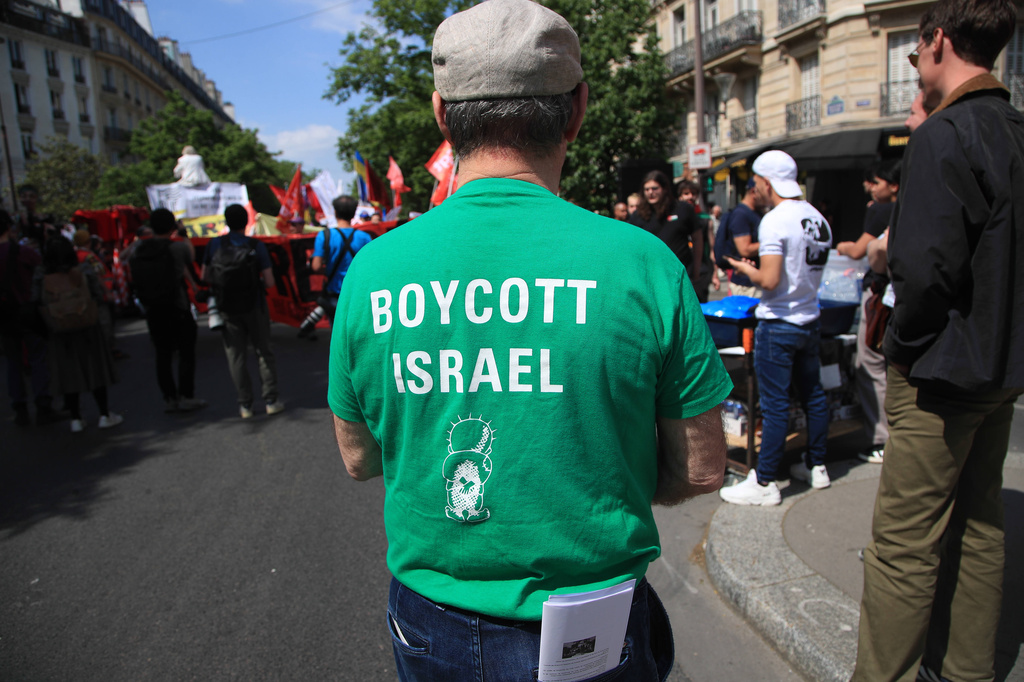
JERUSALEM, Israel – The Boycott, Divestment and Sanctions movement (BDS) has gone on for decades. It’s an effort to put the squeeze on Israel and cause real economic pain. It’s gone from a rallying cry on college campuses to governments around the world. And, while political pressure is growing, the Jewish state’s economy tells a different story.
At a grocery store in the U.K. recently, protesters moved down the aisles, removing Israeli products. One protester explained, “Today, we went into this ASDA supermarket, and we took the Israeli goods and the Coca-Cola products from the shelves.”
From Europe to the United States, the campaign against Israel is increasingly becoming an economic one. Several countries have moved to restrict trade specifically with Israeli communities in Judea and Samaria.
In New York City, Mayor Zohran Mamdani has said he won’t continue the New York-Israel Economic Council created under former Mayor Eric Adams. Mamdani publicly supports the Boycott, Divestment, and Sanctions movement.
Mamdani said at one rally, “We want to let them know that there are three letters that we have as an answer to what is happening in Palestine: And it’s B-D-S!”
The political debate isn’t limited to New York. The Democrats’ nominee for the U.S. Senate in Michigan, Abdul El-Sayed, is targeting American financial support for Israel.
He commented, “The question about whether Israel has a right to exist is actually quite secondary to whether or not they have a right to our tax dollars.”
***Please sign up for CBN Newsletters and download the CBN News app to ensure you keep receiving the latest news from a distinctly Christian perspective.***
Dr. Charles Asher Small is executive director of the Institute for the Study of Global Antisemitism and Policy. He sees the campaign against Israel as part of a much larger information battle.
He told CBN News, “The demonization of Jews, the demonization now of Israel, has a deep pedigree.”
Small notes that as this persecution spreads across media, culture, and Western universities, he’s most concerned about what’s happening on college campuses.
“Qatar is a small country in the Middle East of only 300,000 people, and they give more money to American universities than any other country in the world,” he explained. “And revolutionaries know, if you want to change the society, you start at the universities. You start with young people who go to school to learn to be citizens.”
The anti-Israel movement took hold on college campuses and made its way into politics. Now the question is: will it reach the boardroom and threaten the international investment that has boosted the Israeli start-up economy?
Venture capitalist Michael Fertik contends that it’s already happening.
He told us, “For reasons of political bent, propaganda, antisemitism, or otherwise, or just a mistake, there are people who want to put the brakes on anything to do with Israel. And that could be academic research or collaboration; that could be investment.”
And there’s another side to that equation. Gabe Groisman works with Israeli companies entering the American market. He points out those companies don’t just sell to America; they also start U.S. operations and hire American workers.
“You can’t help but understand the economic diplomacy aspect of Israeli companies opening entities in the U.S. to serve the U.S. market: what that does, how many people, how many Americans that employs, how many dollars it actually brings to the pockets of Americans, how the products and services that they’re creating help improve American lives?
Groisman believes it’s a relationship that runs both ways. He made a recent visit to Tel Aviv, where each company he met with was developing technology for the U.S. market.
Fertik says that when business leaders look past the politics, the economic case for Israel is hard to ignore.
“I think that among people who care about business first, the information war is being won by the people sympathetic to Israel, because the business case for Israel is inarguable,” he remarked.
He’s also putting his own money behind that conclusion.
“We at Verdict have been deploying Verdict Fund One, and we expect to deploy approximately 15 percent – 15 percent of the fund – into Israeli startups,” he revealed.
This represents a ten-fold increase in his financial commitment to the Israeli economy, which continues to persevere.
“Well, I’m very excited to see that, in spite of all the naysayers, wherever they may come from, Israel seems to go from strength to strength,” Fertik declared.
Even after years of war and disruption, the Bank of Israel forecasts 4 percent growth this year and 5.5 percent in 2027.
U.S. Ambassador to Israel Mike Huckabee sees that resilience when he walks the streets of Jerusalem.
“The GDP has grown in Israel in the midst of wars. The stock market, since October the 7th, is up 100 percent,” Huckabee observed.
He added, “It’s a very vibrant economy, and if one just goes to a high point of lookout in Jerusalem and looks out, you will see 300 cranes building things around Jerusalem. Now, if your country is dying and falling apart, the cranes aren’t gonna be there building anything. You’ll see big wrecking balls tearing stuff down.”
Israel has faced economic boycotts before. Still, despite efforts to isolate Israel, the economy continues to grow. A nation under pressure, yet still innovating. And for those of us who see through a biblical lens, demonstrating remarkable resilience.
