
Reading Time: 4 minutes
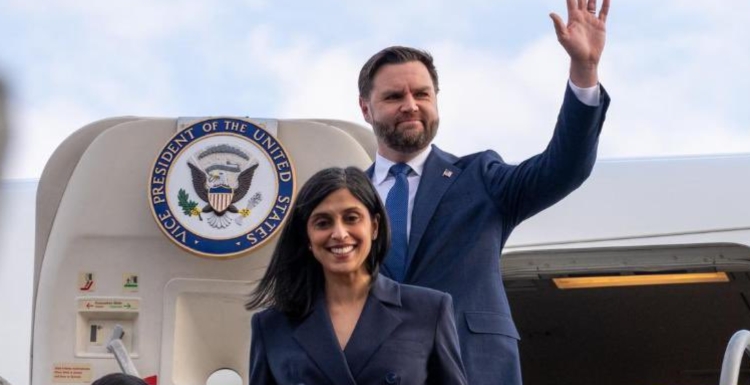
Vice President JD Vance announced that his second child has been baptized into the Catholic Church.
While speaking at an event at the University of Georgia Tuesday hosted by the conservative activist organization Turning Point USA, Vance reflected on the life and legacy of TPUSA founder Charlie Kirk, who was assassinated last year. Vance noted that the late conservative activist’s widow, Erika, is “really sad about the fact that her two little kids may never have memories of their father.”
This content is supported by your donations.
Give today.
“One of the things that you think about as a father is I want my kids to remember this moment,” the father of three young children told the audience, which primarily consisted of college students.
“I want my 6-year-old to remember when I took him to the zoo,” Vance announced, “My 6-year-old son [Vivek] was just baptized on Easter Sunday. … I want him to remember that moment with me.”
After Vance announced his son’s baptism, the crowd erupted into applause.
The vice president previously revealed at the 2025 National Catholic Prayer Breakfast that his eldest son, 8-year-old Ewan, was baptized into the Catholic Church the week after the election, which he called “the thing that I was most excited about in November of 2024.”
As a compromise with his wife, Usha, who was raised in a Hindu family and identifies with that heritage, the couple will raise their children Catholic but “let them choose the moment that they want to ultimately become baptized.”
At Tuesday’s event, Vance also weighed in on President Donald Trump’s criticism of Pope Leo XIV in the wake of the pontiff’s criticism of the war in Iran. The vice president rejected the idea that church leaders, both Protestant and Catholic, should “preach the Gospel” and “ignore public policy.”
“I actually don’t agree with that,” he said. “Part of preaching the Gospel is talking about how the Gospel applies to the issues of the day.”
At the same time, Vance stressed that “each of us has our own role.” Acknowledging his role as vice president of the United States, Vance stated, “The fundamental way I understand my role is that I’m trying to take the lessons, the moral truths that are … rooted in Christianity, and I’m trying to apply them to a whole host of complicated real-world scenarios.”
Vance contrasted his role with that of the pope, which he described as “to preach the Gospel.” He added that “it doesn’t bother me, even when I disagree with him.”
“I have a lot of respect for the pope. I like him. I admire him. I’ve gotten to know him a little bit,” he said. “It doesn’t bother me when he speaks on issues of the day, frankly, even when I disagree with how he’s applying a particular principle.”
Vance addressed his frustration that “some of the Catholic clergy have attacked mercilessly the Trump administration on immigration,” specifically the “constant idea that somehow everything that … the Trump administration does when it comes to … securing our borders is inhumane.” He responded by asking, “How is it humane to allow drug traffickers and sex traffickers to bring little kids across the southern border?”
Reiterating that he does not mind when the pope weighs in on public policy, “even when there’s disagreement,” Vance addressed the pontiff’s assertion that “God is never on the side of those who wield the sword.” While expressing admiration that the pope “is an advocate for peace,” Vance asked, “How can you say that God is never on the side of those who wield the sword?”
“Was God on the side of the Americans who liberated France from the Nazis? Was God on the side of the Americans who liberated Holocaust camps?” Vance said. “I certainly think the answer is yes.”
Vance also discussed his forthcoming book Communion: Finding My Way Back to Faith and elaborated on his motivation for writing it. He recalled that after leaving the Marine Corps at age 22, “I realized that I was sort of winning this game of life in one sense, and I was losing it in the way that mattered.”
“I was raised in a Christian household,” he said. “I hadn’t been properly formed in my faith. And so I got to the Marine Corps, and by the time I left the Marine Corps, I was starting college, I called myself an atheist. And I kind of went through this period of being an angry atheist.”
Vance said his perspective began to change after he started considering “what actually matters in life.”
“It’s not getting into Yale Law School, which I had done,” he said. “It’s not making a lot of money. It’s not credentials. It’s not good jobs. It’s being a good person.”
“The philosophy of secular liberalism,” which Vance claimed encourages people to “achieve, achieve, achieve” and “get as many credentials, make as much money as possible,” had left him “feeling empty.” He contrasted that worldview with “this faith that I had discarded as a kid,” which he said, “actually provided a real sense of meaning and purpose.”
Vance shared a conversation he had with a priest who told him, “If you think that the Christian faith is right about all these moral questions, maybe it’s right because … there’s a witness element to it.” The priest also suggested, “Maybe the fact that it’s right about morality and about virtue and about sin, maybe that means it’s also right about the fact that Jesus Christ was the Son of God,” and “maybe it’s also right that Jesus Christ died and … rose from the dead on the third day.”
“That kind of got me down a pathway of where eventually I was baptized and became a very devout Christian,” he said. Vance said he began writing the book in 2017 and worked on it intermittently in the years that followed before Kirk’s death motivated him to finish and publish it.
Share your prayers for our leaders and their families below.
This article was originally published at The Christian Post. Photo Credit: the White House – https://x.com/VP/status/2020984290654163354.
