


UKARUMPA, Papua New Guinea — This is one of the most isolated places on Earth. Towering mountain ranges, dense jungles, and deep river valleys have kept entire communities separated from the outside world for thousands of years. In many parts of the country, there are no roads. No highways. No easy way in or out.
“There were people that lived here for thousands of years and had never any contact with the outside world because of how rugged this place is,” said Greg Raychard, a missionary pilot with JAARS.
Papua New Guinea is also unlike anywhere else on Earth for another reason. It is home to more than 840 languages, the highest concentration of languages anywhere in the world.
For the men and women dedicating their lives to translating the Bible into those languages, simply reaching the people they serve can be the greatest challenge of all.
That’s where JAARS comes in.
With its airplanes and helicopters, the Christian aviation ministry has spent nearly eight decades helping Bible translators reach some of the world’s most isolated communities, using specially equipped aircraft to cover what they call “the last mile.”
“JAARS is really committed to really the most remote areas because we want to go to them. We have to get the gospel to these people,” said Dr. John Marselus, who leads JAARS’ aviation ministry in Papua New Guinea. “It’s going that last mile. And that’s sometimes the hardest. But if we don’t go the last mile, we won’t get there. There are over 800 languages here. We need to reach them with the gospel.”
For many villages, reaching them by foot means days of hiking through dense jungle, climbing steep mountain ridges, crossing rivers, and navigating dangerous trails.
Christopher Clark has spent more than two decades flying for JAARS.
“This is not your little four-mile hike at Yosemite,” Clark said. “This is just hiking through the bush. They’re treacherous trails. There’s often people falling down and getting injured.”
For fellow missionary pilot Greg Raychard, aviation here is not a convenience—it’s often the only practical option.
“Aviation was used as a luxury, you know, to speed things up, make things more efficient,” he explained. “In some cases here in Papua New Guinea, it’s really the only practical way to reach some of these people groups.”
Every mission begins with weather checks, fuel calculations, cargo loading, and flight planning before another journey into some of the most unforgiving terrain on Earth.
“It’s interesting, like you share with people like ‘unreached people groups’ or, you know, ‘difficult to reach places’ in the world, and everyone assumes, like, well, ‘surely there’s a back road, you know, surely there’s a jeep service that will take you,'” Raychard said. “People who try to hike out of here to go to the nearest city die on the way sometimes.”
Raychard understands difficult missions better than most.
Before joining JAARS, he flew Black Hawk helicopters into combat zones as an Army medical evacuation pilot.
“The physical danger was real in combat,” he recalled. “I did experience times when I was taking enemy fire and just had to keep doing my job.”
After retiring from the military, he assumed his flying career had come to an end.
“I thought I was saying goodbye to aviation. I wasn’t going to fly helicopters anymore. I did not think that I would be doing this for missionaries in this part of the world. This is something that God had in mind that He prepared me for.”
Today, nearly every hour he spends in the cockpit is dedicated to supporting Bible translation.
“Almost every blade hour that I put on this helicopter is related to actually helping a missionary, moving translators from place to place, moving materials and logistics. So that’s very rewarding.”
The importance of JAARS becomes even clearer when talking with the translators themselves.
Finnish linguist Katri Linnasalo has spent nearly four decades serving in Papua New Guinea.
“Before I was able to come here by helicopter, I had to travel by road and it’s six days and it’s very stressful and dangerous at times.”
Without aviation, she says, her ministry would likely have ended years ago.
“If I wasn’t able to come by helicopter, I doubt I would have been able to stay here as long as I have stayed here.”
She says the pilots don’t simply drop her off and leave.
“The pilots are very good at stopping here and making sure everything is okay in my house before they leave me here.”
Whether repairing equipment, checking solar panels, or helping solve unexpected problems, they become mechanics, problem-solvers, and trusted friends.
Landing in Papua New Guinea’s highlands is unlike almost anywhere else in the world.
Many of the mountain airstrips weren’t carved out by bulldozers or construction crews. Instead, entire villages spent years building them by hand, hoping that one day an airplane would connect them to the outside world.
“They’ll spend years to make an airfield, and we’re talking about making an airfield with no bulldozers, no nothing. Just their hands,” Marselus said.
For Bible translator Matt Taylor, aviation made it possible to answer God’s call.
In 2004, Matt and his wife Christy moved into a remote part of Papua New Guinea and spent the next six years learning the Nukna language. A language that, at the time, had no written alphabet.
“Our goal has been to translate the New Testament into the Nukna language,” Taylor said.
The work is painstaking.
“It’s not just about a book,” he explained. “It’s about seeing changed lives and transformed hearts.”
Translating a single book of the Bible can take years. “If I had to give a number, I’d say maybe like three years.”
“For one book?” I asked.
“For one book. Well, some of these books are long.”
Completing an entire New Testament can take decades.
“The first seven years we weren’t translating, we were building up our team, I was learning the language, investing in training.”
For Taylor and his team, every word, phrase, and meaning had to be checked repeatedly.
“So we’ve seen as we’ve been translating God’s Word into their own language, like people are understanding sometimes for the first time, what the gospel is really all about. And we’ve seen lives changing.”
Taylor says JAARS isn’t simply making life in the jungle easier. It’s making the ministry itself possible.
During one recent visit, Raychard stayed overnight in Taylor’s village to repair a broken rainwater collection tank—another example of how missionary pilots often serve in ways far beyond flying.
Christopher Clark says that’s exactly what the ministry has become. “We are the lifeline and the technical experts many cases, and just helping hands, here to serve.”
After more than 20 years, he says the work remains deeply fulfilling. “I love the mix of the flying. I like interacting with Papua New Guineans, and I love supporting our translators. Using gifts and skills, you know, in the technical world, in the spiritual world.”
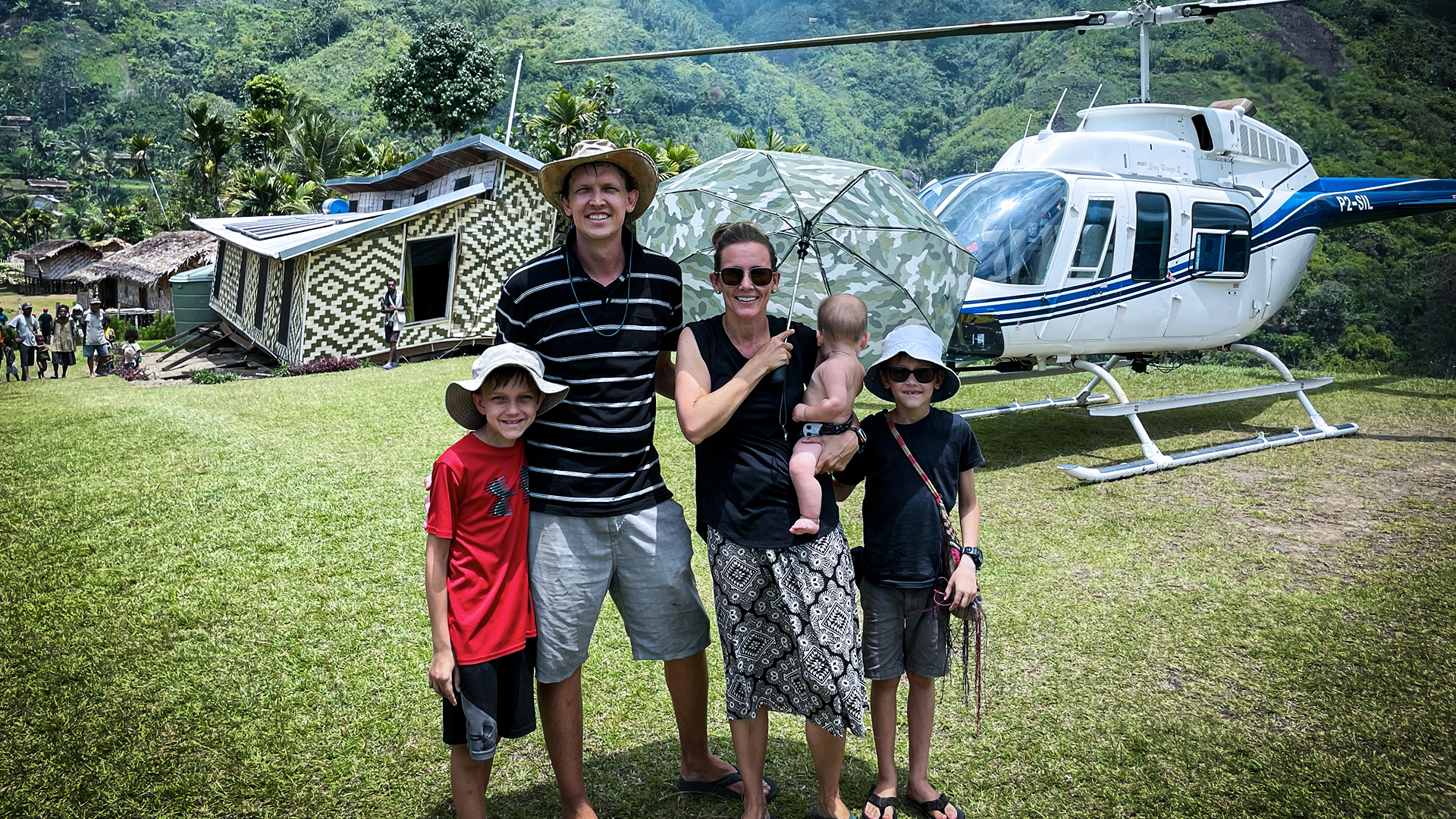
In another isolated mountain village, Bible translator Zac Cann says helicopters made it possible to build both a ministry and a home. “If we didn’t have a helicopter, nothing that you see here would exist because I wouldn’t have been able to carry it in.”
His wife, Cassidy, says aviation has also been critical during emergencies. “We’ve had two medical emergencies for which we have had to medevac out, as well as a natural disaster where our, big earthquake came through here and our houses actually fell down and broke.”
Marselus believes the impact of JAARS cannot be measured simply in flight hours or miles flown. Instead, it’s measured in relationships.
“When the airplane lands, it’s like they come out of everywhere and you’re just like, ‘where did all these people come out of?'”
He says what happens next tells the real story.
“They know our pilots by their first names, and our pilots know them by their names. A relationship, not only with the translators, but even more important, with the people. It opens me up, obviously, to the gospel, which is critical, but it opens them up to the world in ways that just transforms their communities.”
Across Papua New Guinea, hundreds of languages still do not have a complete Bible translation. For many of those communities, the next chapter begins with the sound of an approaching airplane.
For the pilots of JAARS, the mission remains simple: keep flying, keep serving, and keep going wherever that last mile leads.
“JAARS doesn’t look for the easy answers,” Marselus said. “We look for the hardest answers to ease burdens, reduce barriers, and bring God’s Word to these people.”
And for the people waiting in villages scattered across Papua New Guinea’s mountains and jungles, that commitment means one day being able to read God’s Word, not in a foreign language, but in the language of their own heart.
