


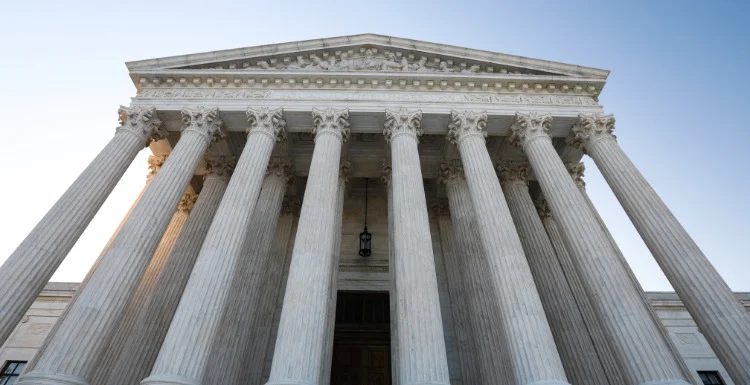
The Supreme Court is being asked to enter a major dispute over the place of the Ten Commandments in America’s public schools. A group of Texas families is challenging a state law requiring the biblical commandments to be displayed in every public-school classroom, potentially giving the justices an opportunity to revisit a decades-old precedent.
Pray for your fellow intercessor.
The appeal follows a closely divided ruling from the U.S. Court of Appeals for the 5th Circuit, which upheld the Texas law earlier this year.
From SCOTUSblog:
Lawyers for a group of Texas families with children in the state’s public schools came to the Supreme Court on Monday, asking the justices to weigh in on the constitutionality of a 2025 law that requires each classroom in that state to display a copy of the Ten Commandments. Asking the justices to review a ruling by the U.S. Court of Appeals for the 5th Circuit that upheld the law, the challengers told the justices that the lower court “flouted this Court’s binding precedents and gutted the religious-freedom rights of public-school children and parents.”
The justices have considered a similar law before. In 1980, in Stone v. Graham, the court ruled that a Kentucky law requiring public schools to display a framed copy of the Ten Commandments in classrooms violated the Constitution. In an unsigned opinion, the court wrote that “[i]f the posted copies of the Ten Commandments are to have any effect at all, it will be to induce the schoolchildren to read, meditate upon, perhaps to venerate and obey, the Commandments. However desirable this might be as a matter of private devotion, it is not a permissible state objective under the Establishment Clause,” which prohibits the government from favoring one religion over another.
In the 46 years since the Stone decision was handed down, both the court’s make-up and its religious-freedom jurisprudence have changed significantly. In particular, the court’s ruling in Stone rested on its conclusion that the Kentucky law failed the “Lemon test” – a three-part test, outlined in the 1971 case Lemon v. Kurtzman, to determine whether a law violates the Constitution’s establishment clause.
The Texas law, S.B. 10, was passed in 2025 and requires public elementary and secondary schools to display a specified version of the Ten Commandments in a conspicuous location in every classroom. The required text is based on the King James Bible.
At the heart of the case is how dramatically the Supreme Court’s approach to the Establishment Clause has changed since Stone. The 1980 decision relied heavily on the framework established in Lemon v. Kurtzman. But in its 2022 decision in Kennedy v. Bremerton School District, the Supreme Court said that the Lemon approach had been abandoned in favor of an analysis grounded in historical practices and understandings.
That change proved decisive for the 5th Circuit. In April, the full appeals court upheld S.B. 10 by a narrow 9-8 vote. The majority concluded that once Lemon was removed from the equation, little remained of the reasoning underlying Stone. Instead, the judges examined whether displaying the Ten Commandments resembled the kinds of government-established religion prohibited at America’s founding.
The majority concluded that it did not. The law does not require students to profess belief in the commandments, punish those who reject them, dictate how religious institutions worship, or require teachers to provide religious instruction.
The families challenging the law disagree. Their Supreme Court petition argues that Stone remains binding precedent because the Supreme Court has never expressly overruled it. They also contend that permanent displays of biblical text in classrooms interfere with parents’ ability to direct the religious upbringing of their children.
That argument invokes another recent religious-liberty decision, Mahmoud v. Taylor. In that 2025 case, the Supreme Court sided with parents who challenged a Maryland school district’s refusal to allow their children to opt out of instruction containing LGBTQ+ themes. The 5th Circuit, however, determined that the situations were different because the Texas law does not authorize religious instruction or permit teachers to challenge students’ religious beliefs.
The Supreme Court has not yet agreed to hear the Texas case. If the justices grant review, however, the dispute could force the Court to address a significant unresolved question: What remains of Stone v. Graham now that the constitutional framework upon which it relied has been discarded?
The case also reaches beyond Texas. A Supreme Court ruling could clarify how far states may go in recognizing the Bible and the Ten Commandments in public institutions without violating the Establishment Clause. At a time when courts are increasingly reconsidering interpretations that pushed religious expression out of the public square, this case could have significant implications for religious liberty and America’s recognition of its biblical heritage.
Let’s pray for the Supreme Court justices as they consider whether to hear this important case. Pray that they would rule according to the Constitution, protect genuine religious liberty, and recognize the important role that biblical principles have played in America’s history and legal tradition.
Share your prayers and scriptures for the Supreme Court and religious liberty in the comments.
(Excerpt from SCOTUSblog. Photo Credit: P_Wei/Getty Images Signature via Canva Teams)
