


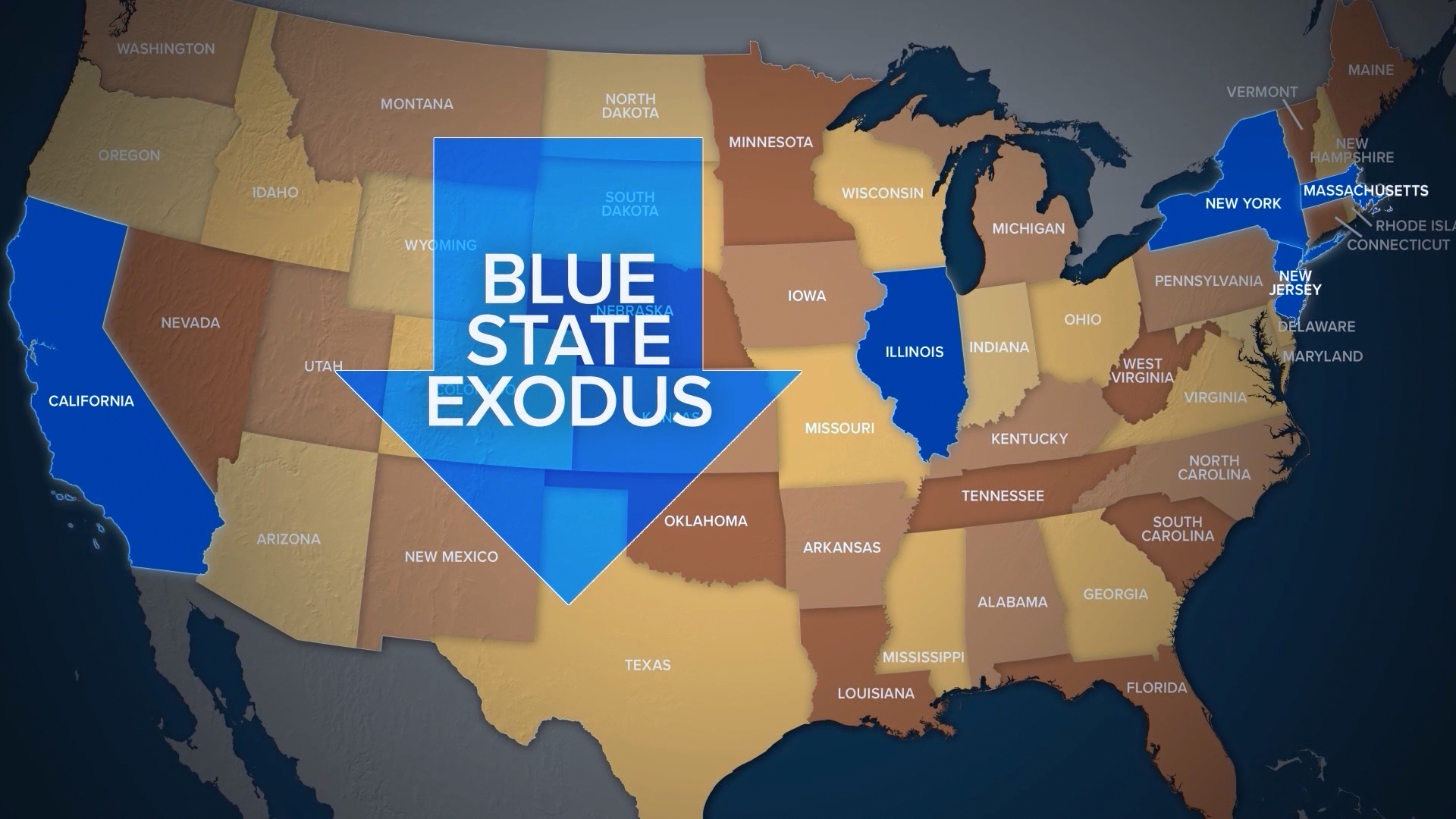
America has covered a lot of ground over its short history—and it’s on the move again. This time, the shift is both political and geographical, with people leaving blue states and heading straight for red ones.
Economist Stephen Moore doesn’t mince words. “This is the greatest wealth transfer in the history of the United States. We’ve never seen anything like this,” Moore tells CBN News.
Indeed, billions of dollars are shifting as millions of Americans pack up and move. The latest census data shows a clear trend: California, New York, Illinois, New Jersey, Massachusetts and others like them are losing people. It’s been labeled the “Blue State Exodus.”
Meanwhile, red states are benefiting—and booming. States like Texas, Florida, the Carolinas, Alabama, Arkansas, Georgia, Tennessee, and Utah are seeing population growth.
The main drivers behind this migration? Sky-high housing costs, heavy regulations, and high tax rates.
Moore points directly to tax policy. “If they continue to charge 10, 11, 12, 13, 14% income taxes when you can pay zero income tax in Tennessee and Texas and Florida, that’s not working out very well. So, progressivism is destroying blue states.”
Add to that government mandates for green energy. Many business leaders say those policies often double power expenses for residents. And it doesn’t stop there. Many blue states prioritize unionization over right-to-work laws, often making it harder for businesses to operate or relocate.
States on the other side of the political spectrum offer a different package: Lower taxes; lighter regulation; school choice expansion and more conservative social policies. That combination is proving hard to ignore.
Joel Kotkin, Presidential Fellow in Urban Studies at Chapman University, says culture plays a role too. “People move in part because they don’t feel comfortable anymore where they are,” Kotkin tells CBN News. “This is very much expressed in the public schools, where not only are they not teaching particularly well, but they’re also imposing ideologies on people and I think that drives some people, to red states.”
For many Americans, it comes down to a basic question: What am I paying, and what am I getting? “In a state like California, you pay high taxes, but you don’t get much for your money,” Kotkin explains. “Schools, though, are pretty bad in much of the state. The roads are in terrible shape. The infrastructure isn’t keeping up so people have to make a rational choice.”
And it’s not just families making that choice. The money is moving too. A growing number of billionaires, CEOs, and major corporations are also relocating—following the numbers. “The people who are moving out are the millionaires and billionaires, and they’re taking their incomes, their jobs, their businesses with them,” Stephen Moore says.
For more than 200 years, the Northeast was America’s economic engine—New York, Philadelphia, Boston, Baltimore. Not anymore. “For the first time… the Northeast is no longer the dominant economic section… now… the South… is the dominant region.”
This population shift could bring major political changes. At the current pace, the congressional map is expected to see a significant reshuffle after the 2030 census. The Brennan Center predicts that red states could pick up 12 House seats lost by blue states; the Northeast representation could drop from 92 to 81 seats; Southern states could gain 19 seats, reaching 164 total and there could be a potential net gain of 10 electoral votes in states won by President Trump in 2024.
The bottom line: the old narrative has flipped. The days of people moving to Beverly Hills are fading. “Now it’s people are moving from Beverly Hills, California, to Arkansas, another movie locale, but they’re moving to even the states that once were considered backwater states,” Moore tells CBN News. “That’s how embarrassingly, counterproductive these policies are in these big blue states.”
There’s also a deeper political transformation happening inside blue states themselves.
“In many of the very deep blue cities, it’s really now a race between moderately left-wing progressives and extremely left wing progressives,” Joel Kotkin says. “That’s not a very good atmosphere for business. It’s not a very good atmosphere, for families.”
The result is an America continuing to change before our very eyes.
